


RAM prices have long followed a familiar cycle: they rise, they crash, and eventually they become affordable again. For years, PC builders and gamers learned to wait out spikes, confident that cheaper memory was just around the corner.
But this time, the situation looks different. A combination of industry shifts, manufacturing changes, and rising global demand suggests that RAM prices may not follow their usual pattern anymore.
This guide breaks down, in simple terms, why RAM could stay expensive for the foreseeable future. Instead of focusing on short-term market fluctuations, we’ll explore the bigger forces reshaping memory production and prices, and what they mean for gamers, PC builders, and anyone planning an upgrade.
Why RAM Prices Feel Out of Control?
The Usual Explanation (Supply vs Demand)
At the heart of the RAM price surge is a straightforward supply-and-demand problem caused by the rapid expansion of AI and cloud data centers, such as those run by AWS. These facilities consume enormous amounts of DRAM, far more than the consumer PC market, and they are buying it in bulk.
As a result, a large share of memory production is being pulled away from gaming PCs, laptops, and other consumer hardware, creating a shortage that drives prices higher.
The Real Reason – AI Is Taking Over Memory Production
This shortage leaves a small group of DRAM manufacturers in a powerful position. With limited consumer supply and guaranteed profits from AI clients, companies can raise prices or even reconsider whether serving the consumer market is worth it at all.
Micron’s pivot toward AI-focused memory, which has already affected its consumer brand Crucial, is a clear real-world example of this shift. Micron has also warned that the RAM shortages could last until 2028, suggesting that unless AI demand slows down, fewer consumer-focused suppliers and higher prices may become the new normal.
Why Even Older DDR4 RAM Is Getting Expensive?
If you’ve tried buying DDR4 RAM recently, you’ve probably noticed higher prices and limited availability. That’s because major manufacturers like Samsung, Micron, and SK Hynix are gradually reducing DDR4 production to focus on DDR5, LPDDR5X, and high-bandwidth memory for AI and enterprise data centers.
For instance, Micron has announced it will end DDR4 shipments for its consumer Crucial brand by early 2026. While DDR5 offers higher profit margins and supports newer platforms like Intel’s 13th/14th-gen CPUs and AMD’s AM5 motherboards, millions of PCs and servers worldwide still rely on DDR4.
This combination of ongoing demand and shrinking supply naturally pushes DDR4 prices higher and limits what’s available in retail stores. Consumers who still rely on DDR4 should plan upgrades carefully to avoid paying a premium.
Why Manufacturers Aren’t Fixing Prices Quickly?
The pressure on DDR4 is further amplified by AI and data center memory taking priority in production line, leaving even less for consumer products. Small manufacturers have stepped in to fill the gap, but higher production costs and lower yields mean premium pricing.
Retailers and resellers also contribute by raising prices and stockpiling kits, creating a feedback loop that keeps costs high. The best approach is to secure DDR5 sticks now if you still rely on them, while new builds should move to DDR5 as it becomes increasingly mainstream.
How High RAM Prices Affect Laptops, Phones, and PCs
At CES 2026, laptop makers like Lenovo and HP showcased devices such as Rollable and Ultrathin models, but final pricing remained uncertain. Executives explained that memory prices are in flux because manufacturers are prioritizing AI and server chips, creating a shortage of DRAM and NAND for consumer PCs, laptops, and gadgets.
This scarcity is driving up costs and affecting the pricing of nearly every device with a memory slot.
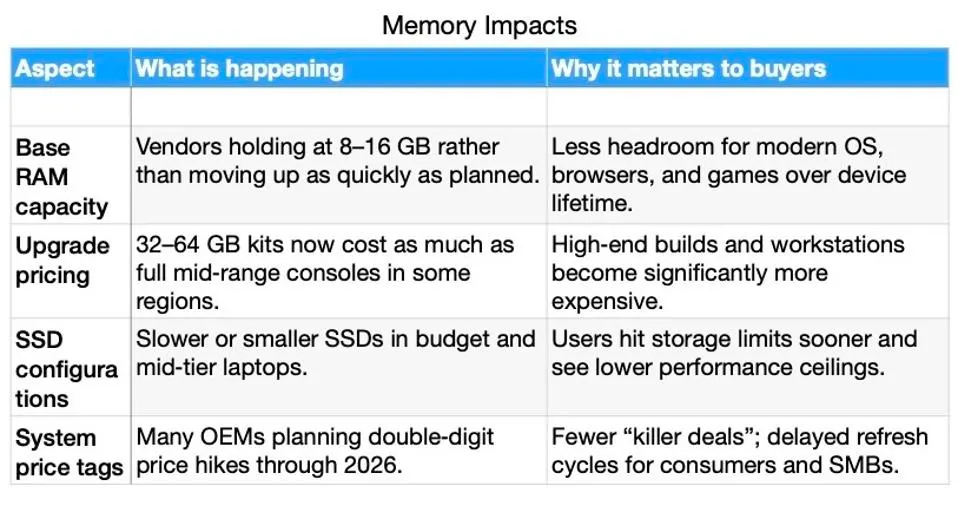
For PCs, memory costs have shifted from a minor expense to a major factor in overall system pricing. OEMs who once negotiated a few cents per gigabyte are now facing double-digit percentage increase in component costs almost overnight.
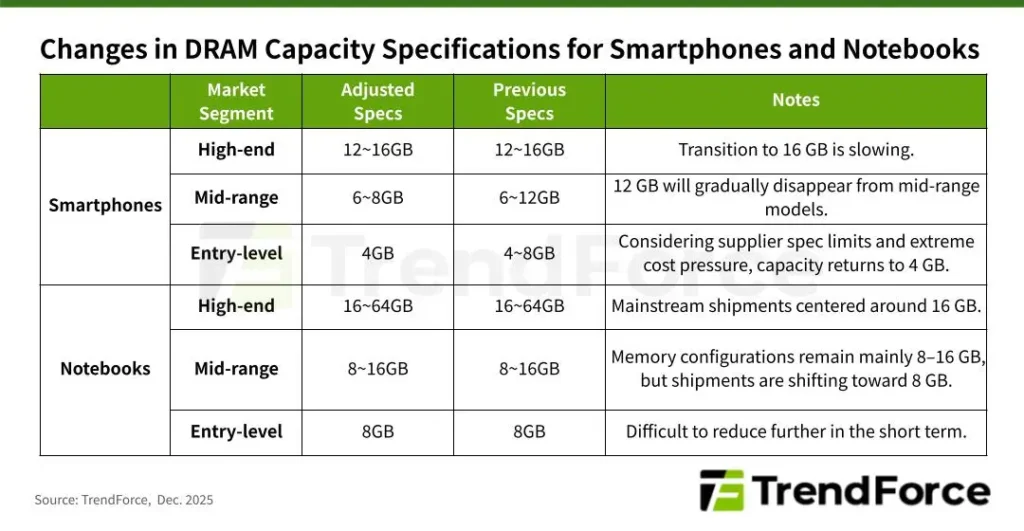
Analysts report that memory’s share of a typical PC’s bill of materials has roughly doubled since 2024, forcing manufacturers to make tough decisions on upgrades. Entry- and mid-range notebooks are already experiencing downgrades, with fewer populated slots, lower default capacities, or slower specifications as companies try to maintain price points without eroding their margins.
Some PC makers are signaling retail price hikes of 15-20% in 2026 due largely to these rising RAM and SSD costs.
The impacts extend beyond desktop and laptops to virtually all consumer electronics. Smartphones and tablets are facing higher contract prices for DRAM and NAND, which is leading manufacturers to limit default storage or hold back on RAM increases in lower-end models.
Even devices like smart TVs, routers, game consoles, cameras, and cars are affected, as memory remains a key cost driver. Analysts warn that these supply pressures could contribute to broader tech-driven inflation, since semiconductors form the backbone of so many finished products.
Will RAM Prices Ever Drop Again?
According to TrendForce report, memory prices are expected to continue rising at least through the first quarter of 2026. This ongoing increase in forcing smartphone and computer manufacturers to adjust their products by raising prices and sometimes reducing specs, meaning consumers may get less performance for the same cost.
Looking further ahead, there is some hope for relief in later 2026. Lynden Singh, eCommerce Director at Laptop Station, predicts that prices may start to ease in the second half of the year as new production lines ramp up and DRAM processes mature, citing expansions from SK Hynix, Samsung, and Micron.
However, Michael Pedrotti, co-founder of GhostCap, warns that the impact of new manufacturing capacity will take several years to fully reach the market, meaning RAM prices are likely to stay high throughout 2026 before gradually stabilizing.
What Consumers Should Do Now
With RAM prices and overall memory cost expected to remain high through at least early 2026, many experts are advising consumers to act sooner rather than later on planned upgrades. TrendForce forecasts continued strong price increases as memory supply stays tight and demand for AI and data center markets pushes prices upward.
If you do need to upgrade or build a system, consider securing the RAM you need now rather than waiting for prices to drop. Kingston representatives have explicitly warned that memory and SSD costs are likely to continue climbing in 2026, meaning the same RAM kit could cost more later.
For those on a tighter budget or unwilling to buy at peak prices, optimizing your existing setup—for example by tweaking software settings or reducing unnecessary background memory use—can help you cope until prices stabilize.
Monitoring market reports and keeping an eye on new production capacity timelines will help you make informed buying decisions rather than reacting to sudden price spikes.
More Guides:
AI Agents in Games: Your Future Gaming Companions
Agentic AI: Your Guide to Self-Driving Intelligence
Setting Up a Digital Workspace for Remote Work: A Step-by-Step Guide
