


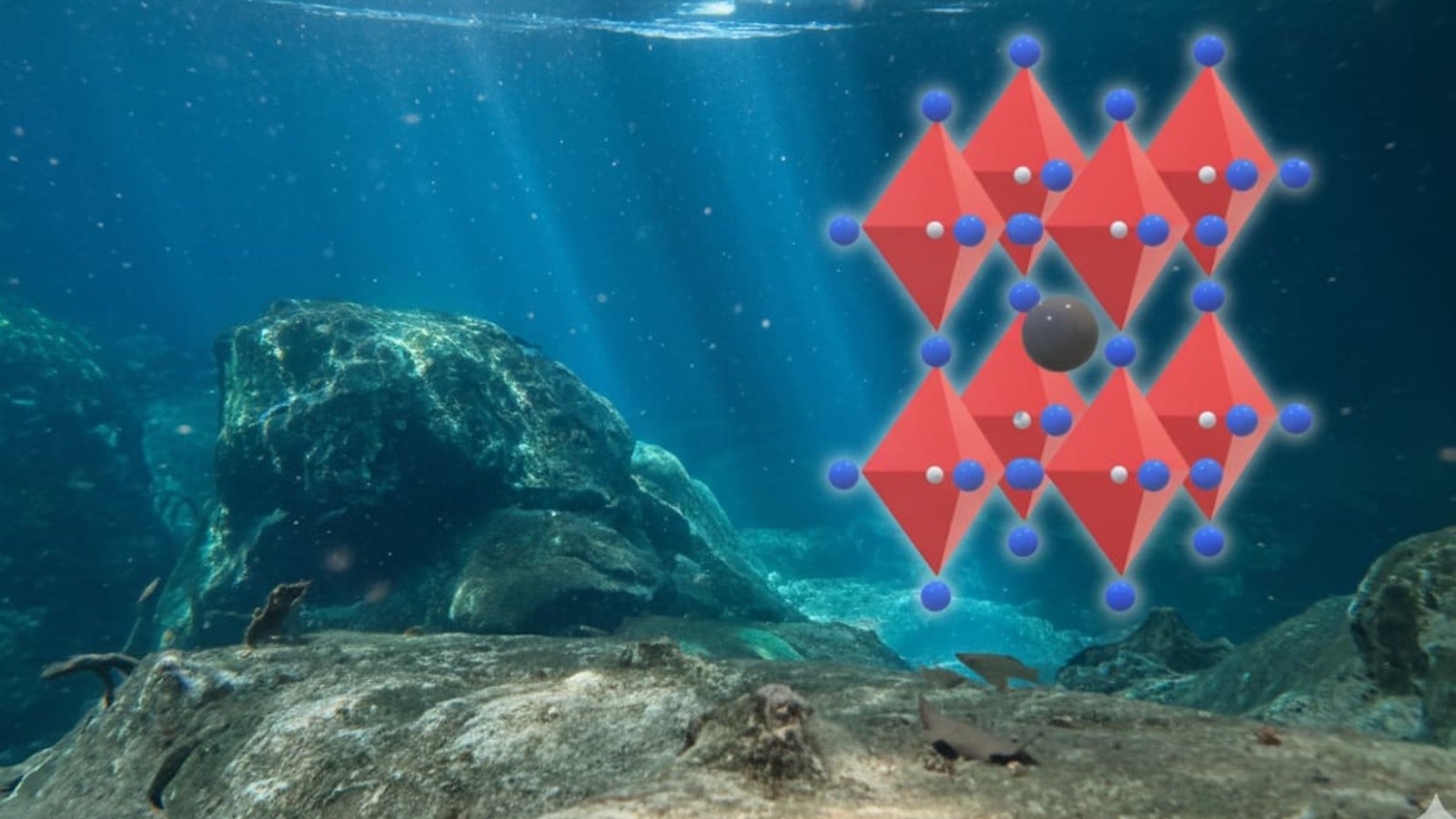
Researchers have demonstrated perovskite solar cells that can generate useful electricity 10 meters underwater, including a large-area module tested in real seawater in the South China Sea. The work was published September 11 in the journal Joule by researchers led by Wen-Hua Zhang of Yunnan University and the Southwest United Graduate School. The team says the technology could eventually provide local power for underwater sensors, cameras, communications equipment and autonomous marine systems.
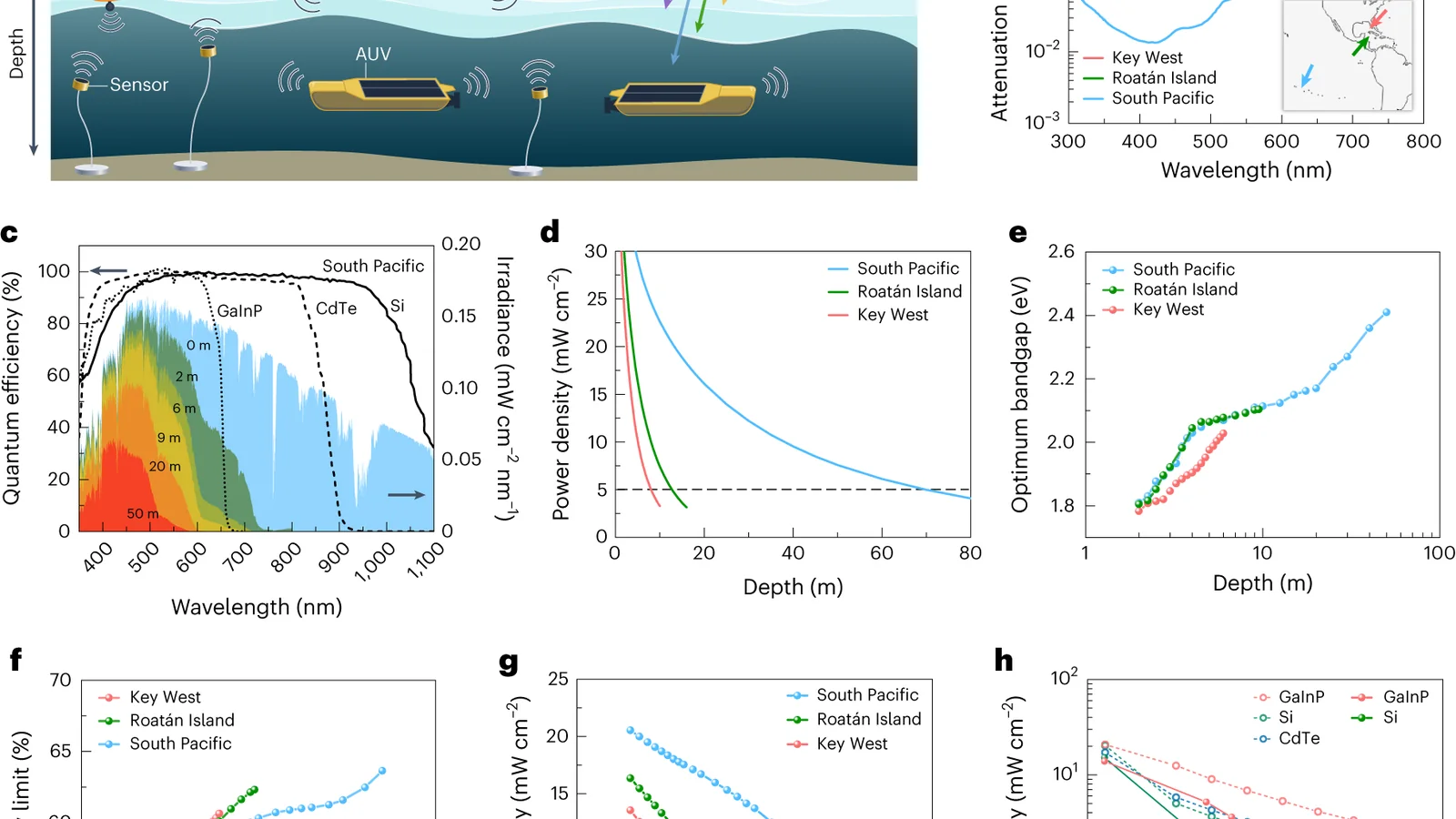
Sunlight changes substantially as it travels through water, with longer wavelengths absorbed much more quickly than the blue-green portion of the spectrum. That makes conventional photovoltaic cells poorly matched to the light available several meters below the surface. The researchers instead developed a wide-band-gap lead-halide perovskite with a band gap of roughly 1.96 eV, designed to absorb the wavelengths that remain most useful at depths between about five and 10 meters.
The resulting cells reached a power-conversion efficiency of 34.71% when tested under laboratory illumination designed to reproduce the spectrum found at a depth of 10 meters. That figure should not be directly compared with ordinary terrestrial solar-panel efficiency, because the incoming spectrum and light intensity are fundamentally different underwater. Under conventional AM 1.5G simulated sunlight, the same devices reached 17.08% efficiency, with a certified result of 16.79%.
To improve both efficiency and stability, the team added polyhexamethylene guanidine hydrochloride, or PHMG, during fabrication. According to the study, the additive improves crystallization, reduces defects, suppresses halide-ion migration and helps optimize electron extraction. Those changes are particularly important for wide-band-gap perovskites, which can suffer from instability and non-radiative energy losses.
The researchers also tested durability under simulated underwater conditions. The cells retained essentially stable output through 1,160 hours of continuous maximum-power-point tracking under light representing a 10-meter depth. Accelerated aging measurements produced an estimated T80 lifetime of 48,094 hours, or around 5.49 years at 25 degrees Celsius, meaning the researchers predict output would remain above 80% of its initial level for that period under comparable conditions.
That lifetime is a projection rather than a five-year real-world deployment result, but the team also conducted practical field testing. Large perovskite modules with an active area of 115 square centimeters were attached to underwater equipment near the Weizhou Islands in the South China Sea and operated at depths of two, six and 10 meters. During two hours of underwater illumination, the modules generated 1,416 mWh at two meters, 752 mWh at six meters and 324 mWh at 10 meters.
The 10-meter result was sufficient to charge lithium-ion batteries, while the system was also demonstrated powering LEDs. The researchers argue that similar modules could eventually support distributed underwater electronics without requiring frequent battery replacement or wired connections back to the surface. That could be useful for monitoring systems, submerged Internet of Things equipment and autonomous underwater vehicles operating in areas where regular maintenance is difficult.
Perovskite solar cells are particularly interesting for this application because their optical properties can be tuned more easily than those of conventional silicon cells. Underwater environments also remove some of the conditions that often make perovskites difficult to use on land, including intense full-spectrum sunlight and high operating temperatures. At the same time, moisture remains an obvious challenge, making encapsulation and long-term sealing critical to any real deployment.
The researchers say earlier studies of underwater photovoltaics generally focused on depths of two meters or less. Their work extends testing to 10 meters while also demonstrating a larger module outside the laboratory rather than relying exclusively on small test cells. The team now plans to investigate greater depths and establish more standardized methods for evaluating underwater photovoltaic systems.
The study does not mean large underwater solar farms are about to replace conventional panels. Available sunlight continues falling rapidly with depth, and long-term durability, encapsulation, manufacturing cost and environmental reliability still need further testing. The result instead points toward a more specialized use case: small autonomous systems that can harvest enough local energy to keep underwater electronics operating for extended periods without constant servicing.
