


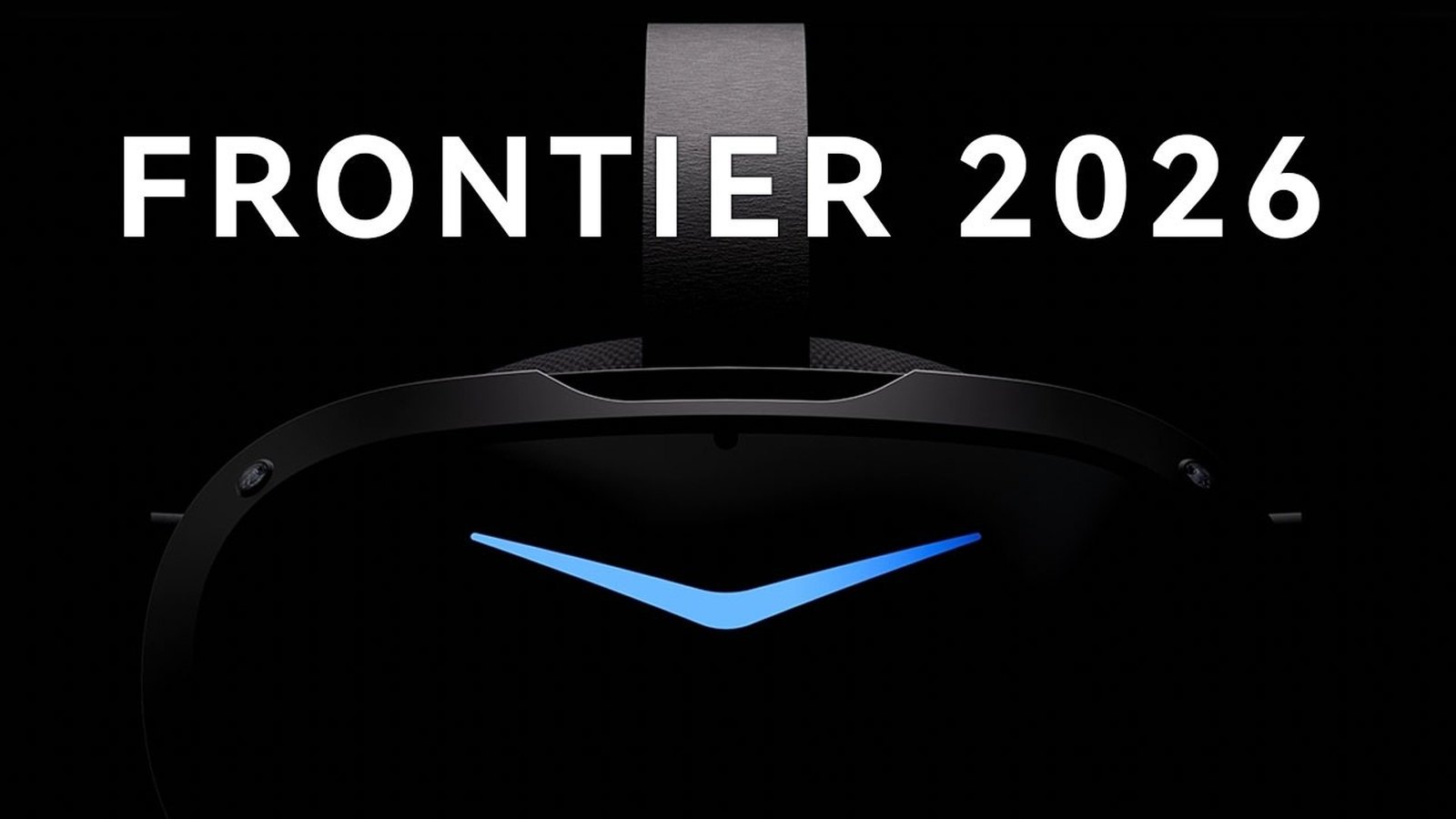
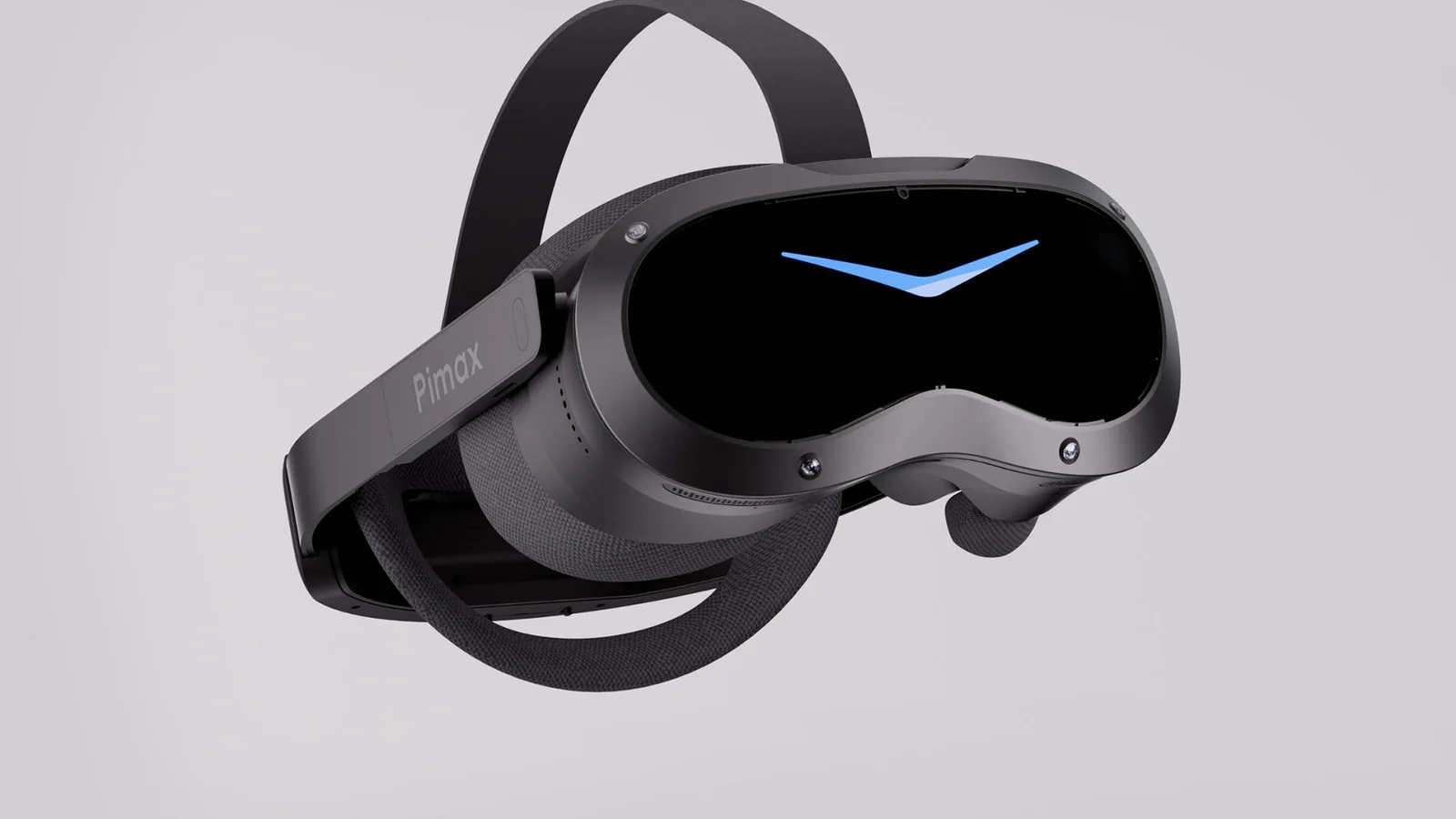
Pimax has unveiled the Crystal Pro, a new wireless PC VR headset built around eye-tracked 60GHz streaming, alongside its new Ringless VR Controllers and a compact high-end gaming PC called Spation. Announced during the company’s Frontier 2026 presentation, the Crystal Pro will cost $1,399 on its own or $1,899 bundled with Pimax’s third-generation 60G AirLink kit. Hands-on demonstrations are scheduled to begin in the fourth quarter of 2026, with headset shipments planned for spring 2027.
The Crystal Pro uses 2880 x 2880 QLED panels per eye with Mini-LED local dimming, a 110-degree horizontal field of view and refresh rates of 72Hz, 90Hz and 120Hz. Pimax says the headset reaches roughly 35 pixels per degree and includes integrated eye tracking that samples at 120Hz. It also supports inside-out SLAM tracking by default, while optional faceplates can add Lighthouse base-station tracking or mixed-reality functionality with full-color passthrough and LiDAR depth sensing.
Wireless play is included through built-in Wi-Fi streaming and a dedicated Wi-Fi 6E adapter supplied in the box. The more unusual option is the third-generation 60G AirLink, which Pimax says uses two room antennas and two headset antennas in a 2×2 MIMO configuration to deliver up to 6 Gbps of bandwidth. The company claims the system can send the GPU’s native image to the user’s focus area without the video encoding normally associated with Wi-Fi streaming, adding less than 2 milliseconds of latency.
Pimax calls the system Native Foveated Streaming. Eye tracking follows where the user is looking, while the focused portion of the image is transmitted uncompressed and the surrounding view is handled more efficiently. The company says this allows wireless PC VR to preserve image quality in the area where visual detail matters most, although the performance claims will still need independent testing once production hardware becomes available.
The headset can also operate over a wired DisplayPort connection, where its panels can run at the full 120Hz refresh rate. Power comes from an included 16,000mAh external battery rather than an internal battery, while the headset itself features a rigid backstrap, magnetic face interface, adjustable eye relief and active cooling. Buyers will receive two traditional ringed controllers at launch, with Pimax’s newly announced ringless controllers offered separately.
Those new controllers replace the tracking ring with infrared LEDs, motion sensing, wrist-pose detection and what Pimax describes as AI-assisted prediction. They use TMR joysticks and linear haptic motors, with claimed battery life of up to 40 hours. The two controller halves can also clip together to function as a conventional wireless gamepad for Windows and Steam without requiring the headset.
Pimax also introduced the Spation, a compact desktop designed specifically for demanding PC VR workloads. Despite its small chassis, the company says the standard configuration will use desktop-class components including a Ryzen 7 9800X3D or equivalent processor and either an AMD Radeon RX 9070 XT or Nvidia GeForce RTX 5070 Ti. The system also includes 32GB of DDR5-6000 memory, a 1TB M.2 NVMe SSD and a 1000W SFX power supply.
Connectivity includes Wi-Fi 7, Bluetooth 5.4, 2.5Gb Ethernet, dual DisplayPort 2.1 outputs, HDMI 2.1, USB-C DisplayPort 1.4a, USB4 and six USB 3.2 Gen 2 ports. Pimax says the Spation has been designed around workloads such as Microsoft Flight Simulator 2024 in VR and will support both Windows and SteamOS. Storage, memory and graphics will be upgradeable, while a DIY configuration will also let buyers supply some of their own hardware.
Pricing and release timing for Spation and the ringless controllers have not yet been announced. Pimax has confirmed that Pimax Play is also coming to Linux, further supporting the company’s SteamOS plans for Spation. The Crystal Pro is currently available for a $1 reservation, with the headset itself set to become Pimax’s main new wireless PC VR product when shipments begin in 2027.
