


MSI’s EdgeMesa N AI+ mini-PC has undergone independent testing with Nvidia’s RTX Spark N1X processor, revealing substantially higher power consumption than its laptop counterpart but more limited improvements in gaming performance. In Gears of War: E-Day, the compact desktop reached approximately 105W of SoC power consumption at 1440p Ultra settings with DLSS Quality, compared with 63W for an Asus ProArt P16 laptop using the same processor.
The results come from benchmarks published by German hardware publication ComputerBase on November 18, 2026. The outlet tested MSI’s EdgeMesa N AI+ with 128GB of LPDDR5X unified memory and a 4TB SSD, comparing its performance against an Asus ProArt P16 equipped with the same 20-core RTX Spark N1X processor and 64GB of memory.
Nvidia allows RTX Spark N1X to operate at a maximum 140W TDP in mini-PC configurations, compared with 80W in laptops. The additional 60W of available power provides more headroom for the processor’s integrated Blackwell RTX graphics, although ComputerBase’s measurements show that actual consumption varies considerably depending on the workload.
In Gears of War: E-Day at 1440p Ultra with DLSS Quality, the MSI system consumed 105.1W at the SoC level, including 68.8W for the GPU and 36.3W for the CPU. The Asus laptop consumed 63.3W under the same settings, with 37.1W allocated to graphics and 26.2W to the CPU.
That represents approximately 66% higher total SoC power consumption for the mini-PC. GPU clock speeds also increased from 1,930MHz on the laptop to 2,305MHz on the desktop, an improvement of roughly 19%.
However, the additional power did not translate into a comparable improvement in frame rates. ComputerBase found that Gears of War: E-Day delivered little practical performance improvement at 1440p despite the higher GPU clocks and power draw. The mini-PC achieved a small advantage at 4K, while the laptop was slightly faster at 1080p.
The results are particularly relevant because Gears of War: E-Day places significant demands on both the CPU and GPU. Separate Gears of War: E-Day storage benchmarks have also demonstrated how hardware configuration can affect memory usage and gameplay smoothness.
Synthetic graphics testing showed a more consistent advantage for the desktop configuration. In 3DMark Steel Nomad, the EdgeMesa N AI+ recorded approximately 92.6W of SoC consumption, compared with 70.1W for the laptop. The mini-PC also achieved around 8% higher GPU clock speeds in this workload.
The power increase was not universal. In Blender’s GPU benchmark, the MSI system consumed approximately 51.5W, slightly below the laptop’s 53.6W. GPU clock speeds improved by only about 2%, indicating that the higher desktop power limit does not benefit every graphics-intensive application equally.
CPU-only workloads showed similarly limited scaling. ComputerBase measured maximum performance-core frequencies of approximately 3.9GHz on the EdgeMesa N AI+, compared with 4.0GHz on the Asus laptop in Cinebench 2026. The results suggest that the processor’s existing clock limits constrain how much additional performance the desktop configuration can deliver.
The EdgeMesa N AI+ uses Nvidia’s RTX Spark N1X architecture, combining 10 Arm Cortex-X925 performance cores, 10 Cortex-A725 efficiency cores and an integrated Blackwell RTX GPU with 6,144 CUDA cores. MSI offers configurations with 64GB or 128GB of unified LPDDR5X memory.
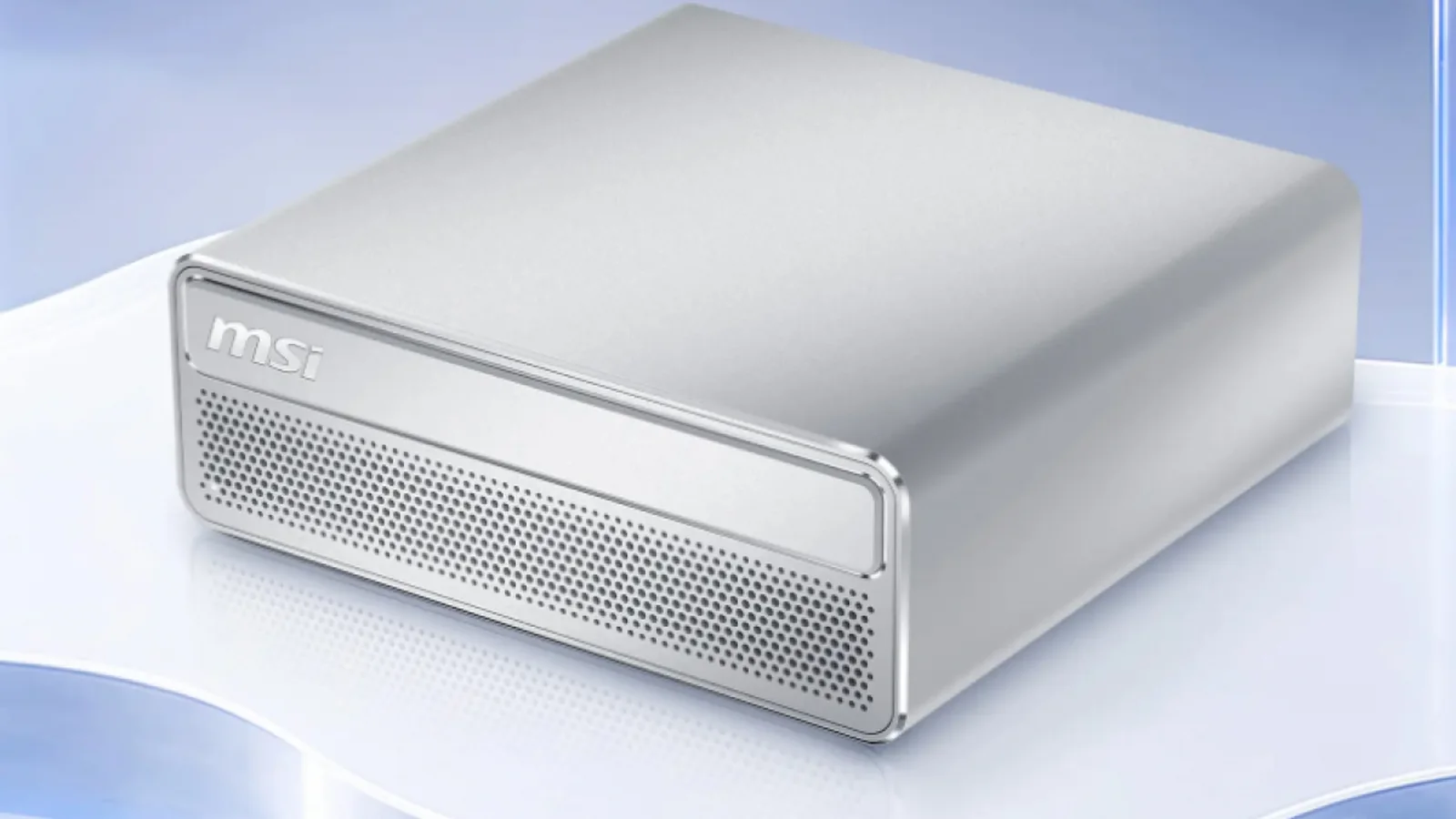
Despite its desktop classification, the system occupies approximately 1.3 liters and measures 152 × 147 × 55mm. Cooling is handled by a dual-fan system with a vapor chamber and heatpipes, while an external 240W USB-C power supply provides power.
MSI lists the 64GB model with a 1TB SSD at €4,599, while the tested 128GB configuration with 4TB of storage costs €7,999 in Germany. Both configurations include Windows 11 Pro, alongside 10Gb Ethernet, Wi-Fi 7, HDMI 2.1b and DisplayPort 2.1 connectivity through USB-C.
ComputerBase’s testing establishes that RTX Spark N1X can operate with substantially more power in a compact desktop than in a laptop. For gaming workloads, however, the benefits depend heavily on resolution and application behavior, with higher GPU clocks and power consumption not necessarily producing significantly higher frame rates.
