


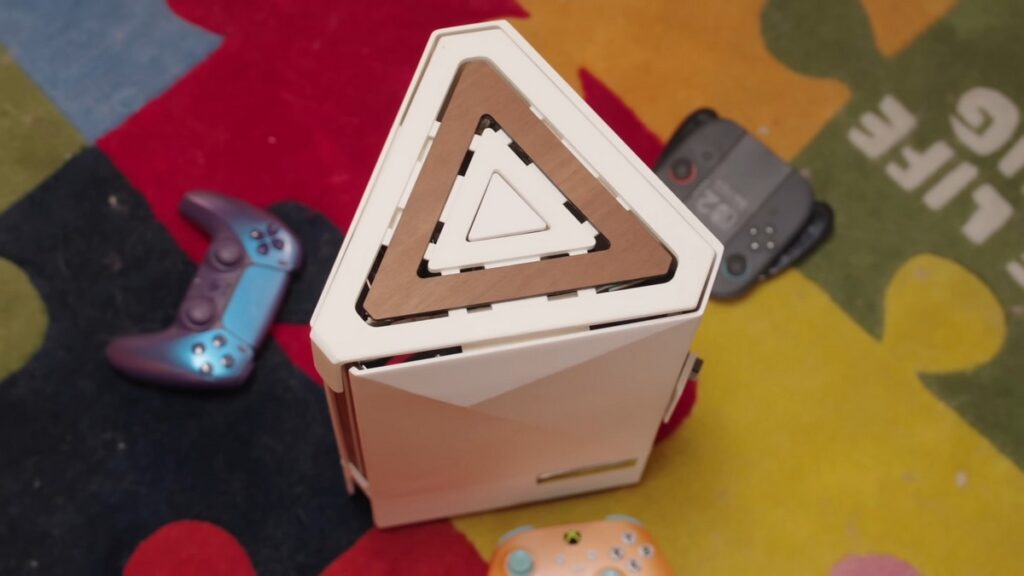
A Chinese hardware modder known online as 小宁子 (XNZ) has pulled off one of the most ambitious console mods ever seen, merging the PlayStation 5, Xbox Series X, and Nintendo Switch 2 into a single, fully functional gaming system. Dubbed the “Ningtendo PXBOX 5,” the project was born out of a simple frustration: juggling multiple consoles just to access exclusive games across different platforms.
Rather than accepting the usual setup of stacked hardware and tangled cables, XNZ set out to consolidate all three systems into one unified device. The concept quickly evolved into a full teardown-and-rebuild operation. Each console was carefully disassembled, stripped down to its essential components, with only the motherboards retained.
Everything else — including the original cooling solutions, power supplies, and casings — was discarded to make room for a completely custom design.
The physical structure of the console took inspiration from Apple’s Mac Pro, particularly its triangular internal layout. This shape proved ideal for mounting the three motherboards on separate sides while sharing central components like cooling and power delivery. The design allowed for efficient airflow and compact assembly without compromising functionality.
Cooling was one of the biggest challenges. With the PS5 and Xbox Series X both producing significant heat, XNZ needed a solution that could handle both systems simultaneously without their stock hardware.
Initial attempts at 3D printing a custom heatsink were abandoned due to material and cost limitations, while CNC machining was ruled out entirely because of its expense. Instead, XNZ turned to an ancient manufacturing technique rarely seen in modern consumer hardware projects: lost-wax casting.
Using PLA plastic, she created a detailed model of a triangular heatsink, encased it in a heat-resistant mold, and melted the plastic away to form a cavity. Molten metal was then poured in to create the final heatsink structure. After polishing the finished piece, copper plates were added to improve thermal conductivity, ensuring efficient heat transfer from the PS5 and Xbox system-on-chip units.
During testing, the PS5’s liquid metal thermal interface material was replaced with conventional thermal paste, yet temperatures still peaked at a safe 60 degrees Celsius under load.
The third side of the heatsink was reserved for the Nintendo Switch 2, which generates far less heat than the other two consoles.
To integrate it cleanly, XNZ modified the Switch 2 dock itself, shrinking it down and housing it inside a custom 3D-printed enclosure. The redesigned dock includes a spring-loaded mechanism and a USB-C connection, allowing the console to be inserted and removed easily without dismantling the system.
Power management presented another hurdle. By measuring real-world power consumption, XNZ discovered that both the PS5 and Xbox Series X draw less than five watts when idle, with peak usage reaching roughly 225 watts during gameplay.
Based on these figures, she opted for a single 250-watt power supply, enough to run any one of the three consoles at full load. The caveat is that only one system can be active at a time, a limitation enforced through custom electronics rather than software.
To make switching between consoles seamless, XNZ built a custom Arduino-based control board. A large button mounted on top of the unit allows users to cycle between the PS5, Xbox, and Switch 2, with the transition taking roughly three seconds. An LED lighting system changes color depending on which console is active, removing any guesswork for the user. HDMI and display switching are handled automatically, so there’s no need to manually change inputs.
The finished Ningtendo PXBOX 5 is fully operational but not without compromises. Due to space constraints, the PS5 and Xbox components are limited to digital-only gaming, as disc drives could not be integrated into the combined chassis. Still, for a single-box solution capable of running exclusives from all three major gaming ecosystems, the trade-off is relatively minor.
The console is not a commercial product and never will be. It exists purely as a personal project and a demonstration of what’s possible with enough technical knowledge, patience, and creativity. XNZ has shared the entire build process in a detailed YouTube video, effectively turning the Ningtendo PXBOX 5 into both a functional console and an educational showcase.
In a gaming industry increasingly defined by locked ecosystems and platform exclusivity, the Ningtendo PXBOX 5 stands as a bold, if impractical, statement. It’s a fusion of ancient metalworking techniques and modern hardware engineering, proving that with enough ingenuity, even the most rigid boundaries in gaming hardware can be bent — or in this case, melted down and recast into something entirely new.
More News:
Borderlands 4 Nintendo Switch 2 Release Date Potentially Revealed Due To Retailer Slip Up
AMD GPU Patents Signal Hardware-Accelerated Ray Tracing Shift
