


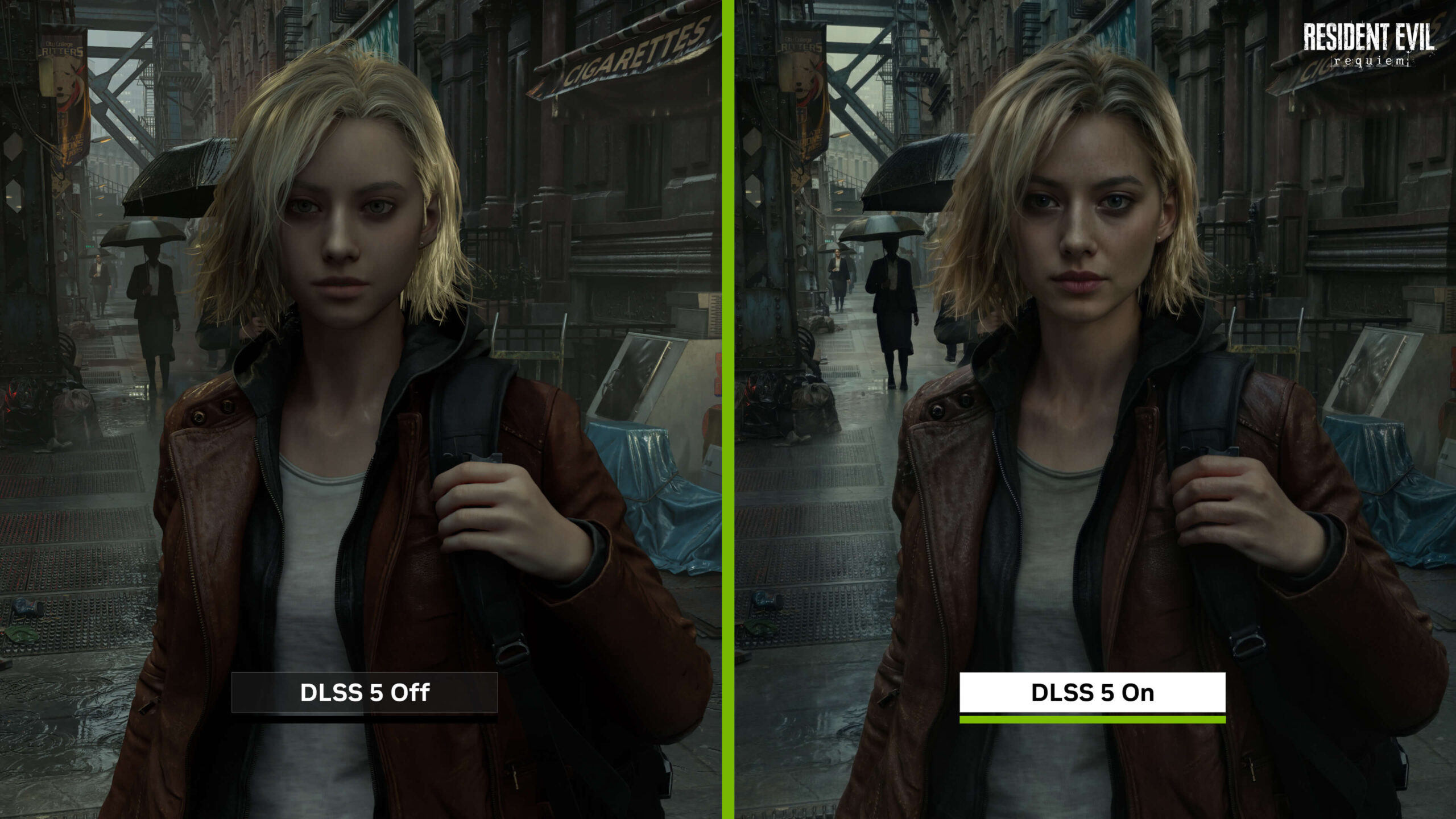
Nvidia’s next generation graphics technology, DLSS 5, is scheduled to arrive this fall, promising a dramatic leap in AI-driven rendering—but the announcement has already sparked debate across the games industry.
Early demonstrations show the technology significantly altering characters, lighting, and environments in major titles such as Resident Evil Requiem, Starfield, and Assassin’s Creed Shadows, raising questions about how much influence artificial intelligence should have over a game’s original visual design.
DLSS, short for Deep Learning Super Sampling, is Nvidia’s AI-based rendering system that uses neural networks to improve performance and image quality in PC games. The technology was originally introduced to upscale lower-resolution frames and generate additional frames, allowing games to run at higher frame rates without requiring equivalent increases in hardware power.
Over several iterations—from DLSS 2’s improved upscaling to DLSS 3’s frame generation—Nvidia has gradually expanded the system’s capabilities using the Tensor Cores inside GeForce RTX graphics cards.
DLSS 5 represents a far more ambitious step. According to Nvidia, the system uses generative AI to interpret the semantic structure of scenes—identifying elements such as characters, lighting conditions, and materials—and then dynamically enhance them in real time.
These enhancements can include more realistic skin shading, altered lighting behavior, and improved material reflections. Nvidia CEO Jensen Huang described the technology as a “GPT moment for graphics,” suggesting it could fundamentally reshape how images are rendered in games.
The company says developers will retain control over how the AI modifies visuals. Tools within DLSS 5 allow studios to adjust “intensity, color, and masking,” enabling them to decide exactly where enhancements appear in a scene.
The goal, Nvidia argues, is to preserve each game’s artistic style rather than replace it. By allowing developers to fine-tune the AI’s influence, Nvidia claims studios can maintain the unique aesthetic of their projects while benefiting from more advanced rendering techniques.
However, early reaction from some game developers and artists has been skeptical. Critics argue that the technology’s ability to significantly alter characters and environments risks undermining deliberate artistic choices made during development.
In demonstrations shared by Nvidia, AI-enhanced scenes sometimes appeared noticeably different from the original game output, with characters looking more stylized and lighting dramatically reinterpreted. For some industry professionals, this raises concerns that AI could override carefully crafted art direction in favor of automated visual “improvements.”
The debate reflects broader tensions in modern game development. Technologies like DLSS were initially embraced because they helped increase performance without altering the creative vision of a game. Earlier versions primarily focused on reconstruction and frame generation, enabling higher frame rates or improved ray tracing without changing the core image design.
But generative AI systems capable of modifying textures, materials, and character details introduce a different dynamic—one that moves beyond optimization into reinterpretation of the artwork itself.
Supporters of DLSS 5 argue that the technology could significantly enhance realism in games while reducing development constraints. Studios often spend years optimizing lighting, shaders, and environmental effects to achieve a desired look while maintaining performance.
If AI can handle some of those calculations dynamically, developers could theoretically push visual fidelity further without overwhelming hardware requirements. Some developers involved in the early demonstrations have praised the technology for the added realism it can bring to scenes.
Whether DLSS 5 ultimately becomes a standard feature in PC gaming may depend on how effectively developers can balance AI enhancements with creative control. Nvidia’s upcoming fall release will likely provide the first real-world test of the technology across multiple high-profile games.
For now, DLSS 5 represents both an ambitious technological milestone and a flashpoint in the evolving relationship between artificial intelligence and artistic design in video games. If widely adopted, it could reshape not just how games perform—but how they ultimately look.
More News:
Crash Franchise Almost Ended After 2003’s Nitro Kart
Pokémon Legends Galar Leak Reveals Pikmin-Style Gameplay
Starfield PS5 Release Date Reportedly Leaked as April 7, 2026
