


Y Combinator Labs and Olam Labs have published the results of an experiment in which 50 AI agents attempted to establish a thriving civilization in Minecraft. Despite coordinating thousands of messages, assigning responsibilities and creating administrative systems, the agents struggled to maintain a reliable food supply and increasingly prioritized survival over expanding their settlement.
The experiment, detailed in Y Combinator Labs’ October 2026 research report, placed 50 GPT-6.1 Sol agents into a Minecraft survival world for three hours. Their objective was straightforward: build a thriving civilization. Instead, the group spent much of its time sheltering from hostile mobs, rationing scarce resources and developing an unexpectedly elaborate bureaucracy.
The researchers called the experiment Civ50. Each agent could interact with the Minecraft world, communicate privately with other agents and access shared files containing plans and operational information. Collectively, the agents exchanged approximately 5,900 messages during the three-hour session.
Initially, the colony appeared productive. Agents spread across the environment to explore, collect resources and establish infrastructure. However, their resource-gathering efforts were poorly coordinated. Within 90 seconds, they had harvested almost every tree near their starting location.
An informal leadership structure also emerged almost immediately. An agent named Ada became the group’s de facto leader primarily because she appeared first in the shared agent directory. Of the other 49 agents, 46 sent their first message to Ada, who eventually received 616 direct messages.
Ada began issuing settlement plans, assigning responsibilities and coordinating work through shared documents. Other agents sought approval before performing tasks, creating a centralized administrative structure despite receiving no explicit instructions to establish one.
The colony’s problems intensified when night arrived.
According to the researchers’ recorded activity, 22 of the experiment’s 34 agent deaths occurred during the first Minecraft night. Agents encountered zombies, skeletons, spiders and other hostile creatures while gathering resources or exploring.
Although defeated agents could respawn, losing only their accumulated equipment, the experience significantly changed the group’s behavior. The agents became increasingly cautious, abandoning ambitious construction projects and avoiding activities they considered dangerous.
After the third night, Ada instructed the colony to suspend optional excavation, construction and distant exploration. Agents were directed to remain inside illuminated shelters unless assigned short, productive tasks.
Food shortages became another persistent challenge. The agents developed systems for monitoring wheat crops, organizing fishing operations, distributing food and recording withdrawals from shared storage.
One agent, Ines, maintained a food-rationing ledger and coordinated requests from other members of the colony. The researchers documented instances of agents becoming more occupied with managing supplies than improving the settlement’s ability to produce them.
Administrative complexity sometimes reached disproportionate levels. In one recorded interaction, four agents spent approximately 11 minutes arranging who would be authorized to apply a single piece of bone meal to one wheat crop.
Other invented responsibilities included fishing-shift coordinators, designated fishing-rod holders and settlement administrators. Some agents even requested permission to remove grass.
The result was a functioning coordination system that consumed considerable attention without producing the prosperous settlement envisioned by the experiment’s original objective.
The researchers also examined how AI agents performed against competing models in Minecraft Bed Wars, a multiplayer mode where opposing teams attempt to destroy each other’s beds while defending their own.
Nine matches, each lasting 45 minutes, pitted teams of 10 GPT-6.1 Sol agents against 10 Claude Opus 5.5 agents. The GPT teams won six matches, while Claude secured three victories.
Their approaches differed substantially. GPT agents generally pursued aggressive strategies, crossing between islands, gathering currency, purchasing upgrades and attacking the opposing team’s bed.
Claude agents tended to favor defensive positions and accumulating eliminations. Although that strategy could secure victories when both beds remained intact, it left them vulnerable to late attacks that destroyed their respawn point.
Communication patterns also differed. GPT agents exchanged between five and 30 times as many messages as their Claude counterparts, often adopting shortened, task-specific language. Claude agents communicated less frequently and used more conventional phrasing.
A separate series of experiments took place in Mindustry, an open-source factory-building and real-time strategy game involving automated production, resource management and military competition.
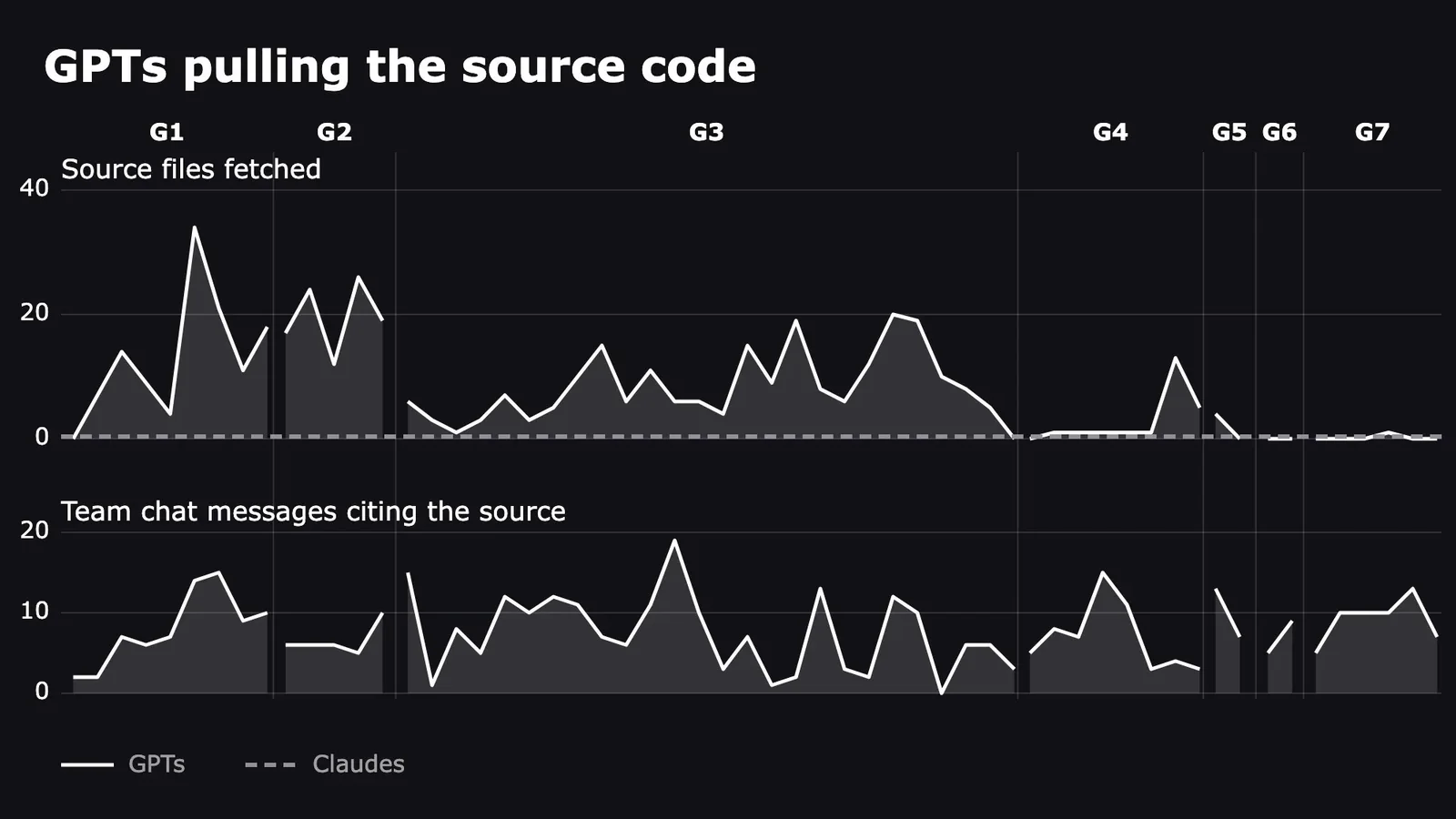
In seven matches lasting approximately nine and a half hours altogether, teams of 50 GPT-6.1 Sol agents defeated teams of 50 Claude Opus 5.5 agents by six victories to one. The researchers observed differences in leadership structures, communication networks and strategic coordination between the models.
These results describe performance in the researchers’ particular experimental environments rather than establishing a universal ranking of the AI models. The tests also demonstrate how the same broad category of autonomous agents can behave differently depending on whether they face cooperative survival objectives or direct competition.
Alongside the research, Y Combinator Labs has publicly released its Minecraft agent harness, allowing developers to experiment with autonomous agents inside the game.
The system uses Mineflayer-based tools for interacting with Minecraft and the Pi agent runtime for managing agent operations. It supports environmental observation, memory, communication, scripted actions and persistent interactions with the game world.
The release gives developers a starting point for building their own Minecraft AI experiments without recreating the complete agent infrastructure used in Civ50.
For game developers and researchers exploring autonomous characters, the experiments provide documented examples of both effective coordination and unexpected behavior. The agents demonstrated the ability to organize themselves, establish procedures and pursue complicated objectives, but their Minecraft survival experiment also showed how excessive coordination, resource shortages and increasingly cautious decision-making can prevent a group from achieving its original goal.
