


Former Counter-Strike commentator Bastian Recha has demonstrated Mausstudio, a software tool that generates customizable gaming mouse shells for 3D printing using existing mouse electronics. The project automatically identifies important hardware components from imported 3D models, allowing users to create different mouse shapes without manually designing an entire enclosure in CAD software.
Recha, known online as Unskilledcast, introduced the work-in-progress project through a demonstration posted on X on October 27, 2026. The software operates locally and generates its designs through mathematical calculations and algorithms rather than generative artificial intelligence.
Mausstudio begins with an STL file containing a 3D model of a gaming mouse’s printed circuit board (PCB). Once imported, the software detects the positions of mechanical switches, the optical sensor, scroll wheel and mounting screw holes.
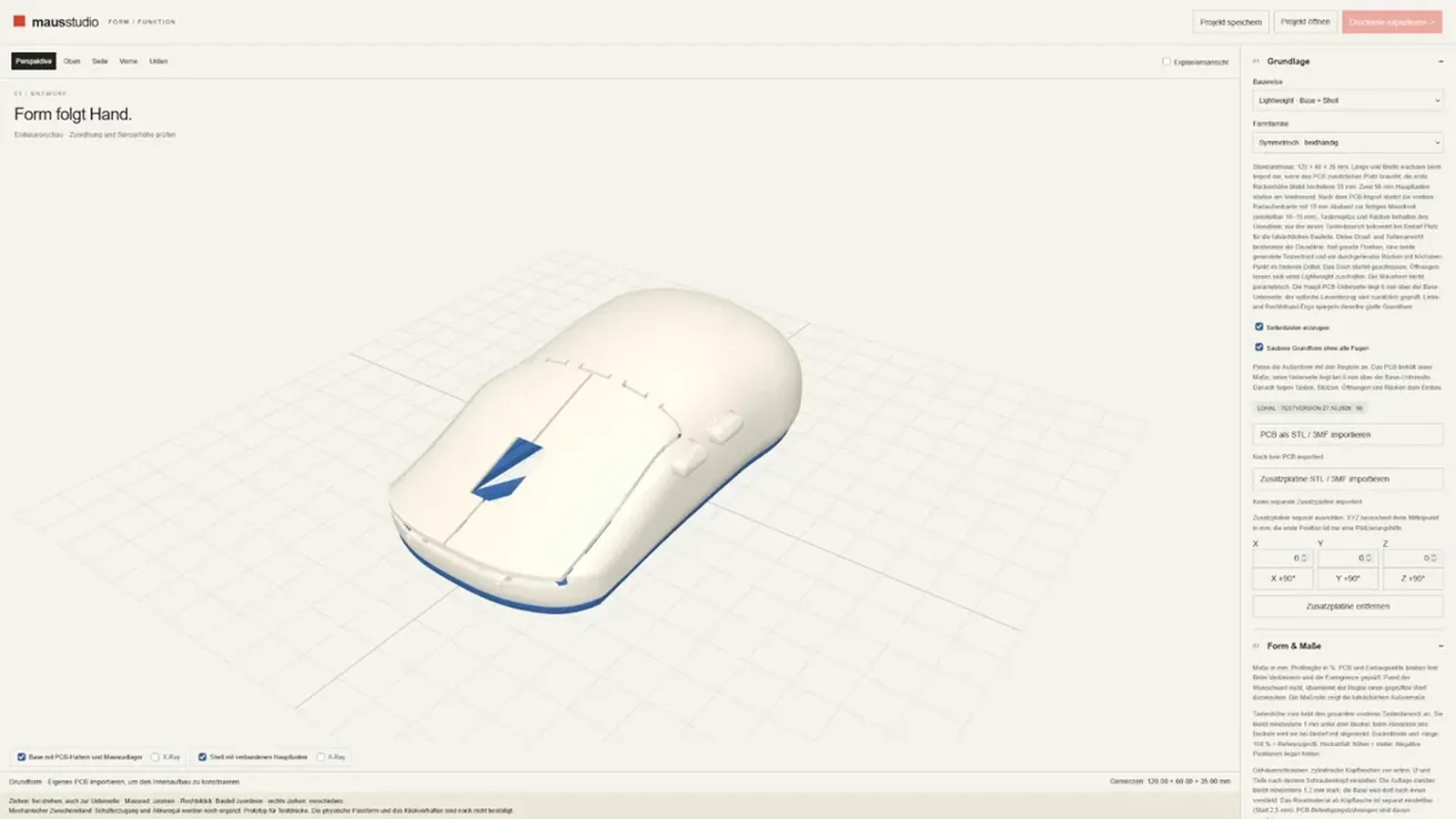
Using these locations, the program generates a surrounding shell with the necessary structural features. These include stems that actuate mouse switches, openings for the scroll wheel, cutouts for the sensor and provisions for side buttons.
The demonstration included PCB models based on the Razer Viper V2 Pro and Zaunkoenig M2K, illustrating how the software can work with electronics from existing gaming mice.
Beyond automatically generating a usable enclosure, Mausstudio provides controls for changing the mouse’s physical shape. Users can adjust its overall width, length and height, along with the position of the raised hump that influences how the mouse fits in the hand.
The program also supports different approaches to reducing weight. Users can introduce cutouts into the upper and lower shell sections or select a more conventional enclosed design.
Another demonstrated feature is adjustable battery placement. Users can enter a battery’s dimensions and modify the size and position of its mounting shelf, accounting for the battery during the shell-design process instead of attaching it afterward with adhesive.
This approach could appeal to enthusiasts who want to retain the electronics of a gaming mouse while experimenting with different shapes, grip characteristics and shell configurations.
Gaming peripheral manufacturers have increasingly explored customization through interchangeable components. Razer’s Wolverine V4 Pro controller with modular controls is one example, although Mausstudio takes a different approach by allowing users to generate an entirely new physical enclosure around existing hardware.
Recha has continued refining Mausstudio since the initial demonstration. Subsequent development updates have shown editable component assignments, additional side-button controls, the ability to save shell designs for use with different PCBs and improvements to the generated geometry.
However, compatibility across different mouse electronics remains uncertain. In particular, support for models that use multiple separate circuit boards, such as the Logitech G Pro X Superlight, has not been established.
Mausstudio is still in development and is not publicly available. Recha has not announced a release date, pricing or whether the software will be distributed for free.
The demonstrations establish its proposed design workflow, but the finished software’s compatibility, reliability and the physical performance of shells produced through it have yet to be independently evaluated.
For gaming mouse enthusiasts interested in custom ergonomics and 3D printing, the project offers a potential way to experiment with personalized mouse designs while reusing existing sensors, switches and other electronic components.
