


Avatar Legends: The Fighting Game has received its Avatar State Patch, a major 4.0 update that redesigns Avatar State Aang and Nightmare Korra, rebalances the entire playable roster and introduces Ranked Mode 2.0. The update also adds two versus stages, expands single-player content and improves training features across the fighting game.
The patch was released on October 28, 2026, according to the game’s official Steam announcement and Paramount Games’ patch notes. Gameplay Group subsequently detailed the changes in an October 30 Xbox Wire feature, explaining the development team’s approach to the redesigned characters and their combat abilities. The update is available on Xbox Series X|S and PC.
The two most substantial character revisions involve Avatar State Aang and Nightmare Korra, both of whom receive revised visual designs, additional attacks and new super techniques. Beyond these individual reworks, Patch 4.0 adjusts character abilities, damage values, movement properties and combat interactions throughout the roster.
Avatar State Aang’s revised moveset introduces new options while changing how he manages resources and connects attacks. His previous Unbound mechanic has been removed, with several follow-up attacks now allowing Flow Cancels when they make contact with an opponent. These follow-ups can no longer be Flow Canceled after missing, changing how players approach offensive pressure.
His projectile attacks also receive adjustments. Certain projectiles now consume Flow individually, while his enhanced 236EX technique requires two Energy Points. Additional modifications affect aerial movement, attack recovery, hit properties and combo opportunities.
Aang also receives a new Super Technique called Roku’s Inferno, which allows him to temporarily transform into Avatar Roku and unleash a large fire attack across the battlefield.
In the Xbox Wire feature, Combat Director Young explained that Avatar Aang’s design draws heavily from his confrontation with Fire Lord Ozai in Avatar: The Last Airbender. The team wanted his movements to communicate controlled elemental power rather than the playful fighting style associated with regular Aang.
Nightmare Korra has undergone an equally extensive revision, introducing new movement options, command attacks, throws and special techniques. Her Vaatu Support configuration can now Flow Cancel every waterbending move, while Dark Spirit changes her dash behavior and shortens her Flow Movement.
The update adds new EX Special Techniques, a command normal, revised throw animations and a Final Technique called Eternal Nightmare. Four new Critical Hit conditions also provide additional combat opportunities, including attacks that reward precise positioning and interactions with an opponent’s Unbalanced state.
Young explained that Nightmare Korra’s redesigned combat style draws from her appearance in The Legend of Korra episode Korra Alone and her confrontation with Zaheer. Her animation contrasts slow, unsettling movement with sudden attacks, chain swings and teleportation.
Patch 4.0 also changes competitive matchmaking through Ranked Mode 2.0. Ranked matches now use mandatory first-to-three sets, requiring a player to win three games before the set concludes.
Ranking points are awarded only after a complete set, and the winning player cannot lose points from that result. Players who leave before finishing a set receive a penalty. These rules make completing an entire set necessary for ranked progression rather than allowing individual game results to determine immediate point changes.
The wider balance update affects every playable fighter. Korra’s Avatar State activation receives a damage reduction and a shorter duration, while Katara loses 50 health and receives several offensive adjustments. Zuko gains additional Redemption-building opportunities through his Ran and Shaw Support attacks.
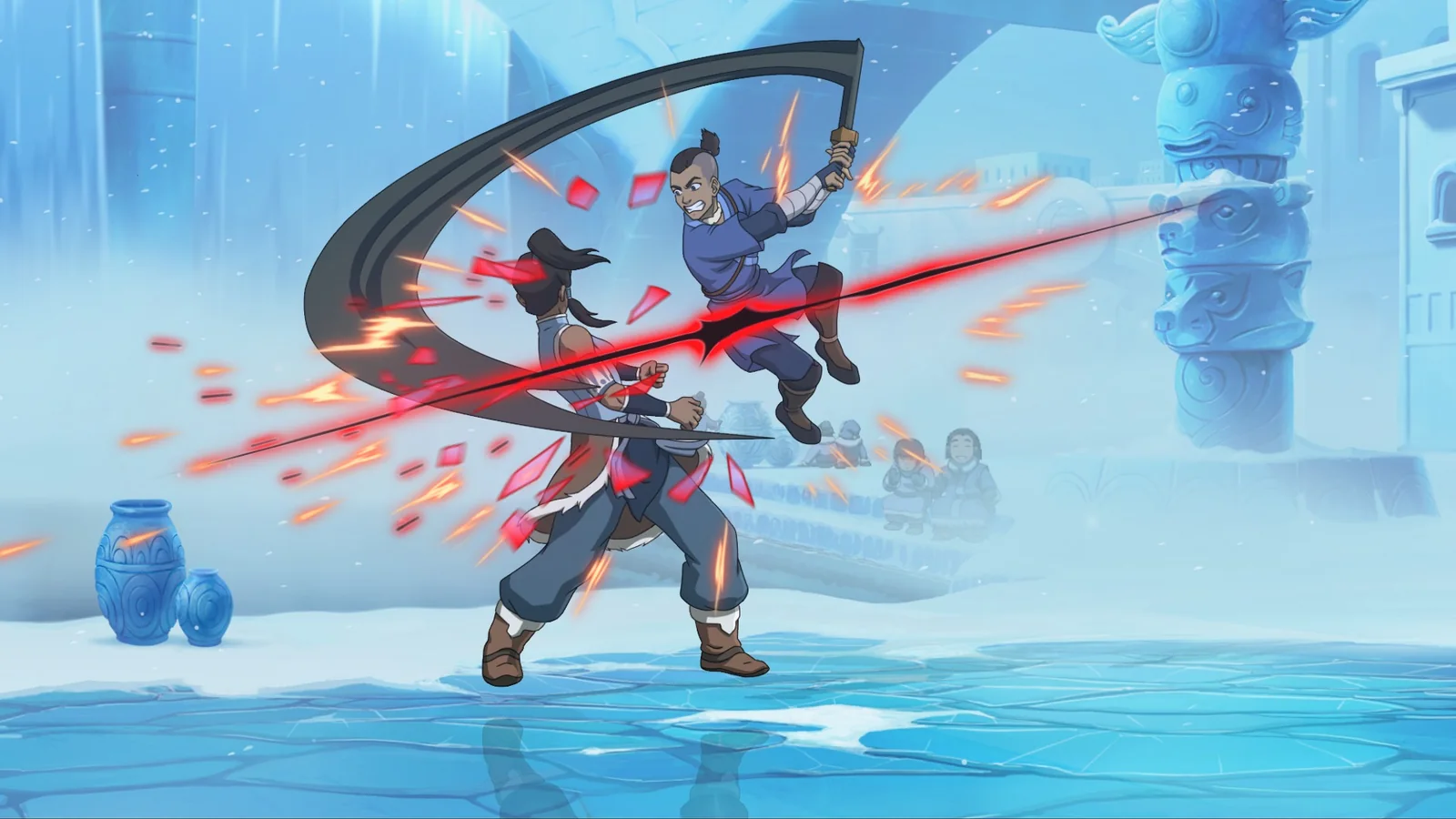
Azula’s Ambition’s Spark attack receives improved tracking, a larger explosion hitbox and additional Flow Cancel functionality. Sokka can also unlock the ability to cancel certain sword techniques directly into a boomerang toss after accumulating enough successful sword hits with Master Piandao Support.
These changes accompany broader adjustments to jump priority, throws, movement and individual character interactions, giving competitive players new matchups and combo routes to evaluate.
Two additional stages, Avatar Road and Air Temple Island, are now available in versus play. Both were previously associated with Story Mode, and their availability expands the selection of environments for local and online matches. The Spirit Wilds stage also receives visual improvements.
The update refreshes the game’s menus, character selection screens, rematch interface and in-game HUD. Online players gain preset chat messages for rematches and customizable lobby titles, including options designed to identify beginner-friendly rooms.
Single-player modes have also received attention. Story Mode+ expands the available content, while Story Mode receives improvements to artificial intelligence difficulty, instructional hints and in-game bonuses. Most story encounters now use first-to-two fights, and players can earn additional coins from revised battle rewards.
Arcade Mode gains a redesigned progression screen, high-score saving and three CPU difficulty options: Novice, Intermediate and Expert. New character dialogue sequences, voiced post-fight lines and additional presentation artwork appear across matches.
Training Mode introduces random playback slots, additional blocking settings and revised reset-position controls. Frame advantage information is now anchored to the HUD, and fixes address incorrect combat data, projectile interactions and delayed reversal playback. New tutorials and Combo Trials further expand the tools available for players learning character mechanics.
Paramount Games also acknowledges several remaining issues involving Combo Trials, including instances where trials can register as completed without the final attack connecting properly.
The update introduces voting for the fifth character in the Year One Character Pass. Iroh, Ty Lee, Lin Beifong and Bolin are already confirmed, while eligible pre-order customers and Deluxe Edition purchasers can participate in selecting the remaining fighter. Voting eligibility and the number of available votes depend on purchase conditions.
Patch 4.0 represents a substantial gameplay revision rather than a cosmetic update, affecting character mechanics, competitive rules and practice tools simultaneously. Its changes are particularly relevant to returning players, who will need to account for revised matchups, resource management and the new ranked-set requirements.
