


Philips has announced updated launch details for the Evnia 27M2D5901A, a 27-inch dual-mode gaming monitor capable of running at 5K resolution with refresh rates up to 180Hz or QHD resolution at up to 350Hz. The Fast IPS display is scheduled to become available in the UK in December 2026, carrying a recommended retail price of £699.
The company confirmed the specifications and availability in its November 10 announcement, following an earlier unveiling in April 2026. The monitor is designed for PC gamers who want to switch between high-resolution visuals and faster refresh rates without using separate displays.
The Evnia 27M2D5901A features a native resolution of 5120 x 2880 pixels, delivering approximately 218 pixels per inch on its 27-inch panel. At this resolution, the display operates at 165Hz by default, with an overclocking option that increases the refresh rate to 180Hz.
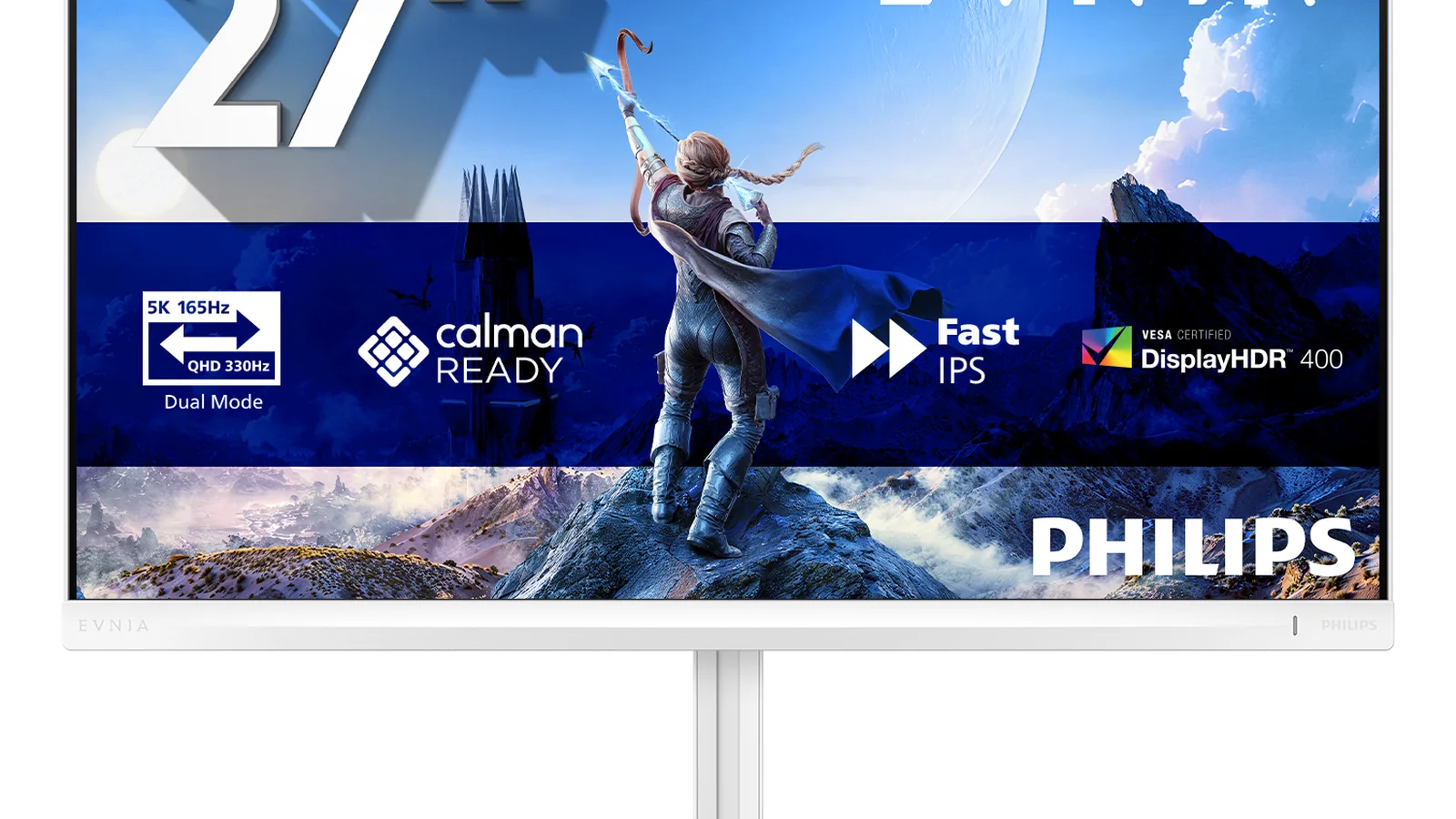
Switching to the monitor’s QHD mode reduces the resolution to 2560 x 1440 while increasing the standard refresh rate to 330Hz. Users can overclock this mode to 350Hz, providing a higher refresh rate for competitive games where motion clarity and responsiveness take priority over pixel density.
The distinction between standard and overclocked refresh rates is important. Although Philips advertises maximum figures of 180Hz and 350Hz, both require the corresponding overclocking mode to be enabled.
The dual-mode configuration also makes the monitor suitable for different PC workloads. Its 5K setting provides additional resolution for detailed games, image editing and desktop applications, while the QHD setting offers a faster refresh rate for esports and other competitive titles.
Philips specifies a 1ms grey-to-grey response time, a typical contrast ratio of 1000:1 and support for adaptive synchronization. The panel also features 500-nit typical SDR brightness and approximately 98% coverage of the DCI-P3 color space.
For HDR content, the Evnia 27M2D5901A carries VESA DisplayHDR 400 certification and supports HDR10. It can display approximately 1.07 billion colors through an 8-bit panel with frame rate control.
Beyond display performance, Philips has equipped the monitor with its AI-enhanced Ambiglow RGB lighting system. LEDs positioned behind the screen produce lighting effects that respond to displayed content, creating a surrounding glow during gameplay and video playback.
The monitor also introduces AmbiScape support, allowing users to synchronize compatible Matter-enabled smart lights with the display’s lighting effects. Configuration is handled through the Philips Evnia Precision Center software, extending the lighting system beyond the monitor itself.
Connectivity includes two HDMI 2.1 ports, a DisplayPort 2.1 connection and USB-C with DisplayPort Alternate Mode support. The USB-C connection can transmit video and data while supplying up to 96W of power to a compatible laptop.
Additional connections include USB-A ports, while an integrated KVM switch allows a single keyboard and mouse to control two connected computers. The monitor also includes two 5W speakers.
Philips supplies the display with an adjustable SmartErgoBase stand supporting 130mm of height adjustment, tilt, swivel and 90-degree pivot rotation. These adjustments allow the monitor to be positioned for gaming, productivity or portrait-oriented desktop use.
The Evnia 27M2D5901A expands Philips’ gaming monitor lineup alongside other recent models, including the 36-inch Evnia ultrawide with a 260Hz refresh rate. While that model focuses on a wider 3440 x 1440 display, the 27M2D5901A combines higher pixel density with a faster optional QHD mode.
The monitor was initially presented earlier in 2026 with an expected European release in July and a proposed price of €799. Its updated commercial launch information now confirms December 2026 availability in the UK at £699.
Philips has not specified an exact December release date in its announcement. Pricing and availability for additional markets have also not been confirmed.
The Evnia 27M2D5901A’s main distinction is its ability to provide 5K resolution and high-refresh-rate QHD operation in a single Fast IPS panel. However, its advertised maximum refresh rates and response-time specifications are manufacturer claims, with independent testing needed to establish real-world motion performance, input lag and image quality.
