


TCL CSOT has demonstrated a 27-inch gaming monitor prototype capable of running at 1250Hz while maintaining its native 2560 × 1440 (QHD) resolution. Unveiled at the DTC 2026 display conference in Wuhan, China, the panel uses ultra-high-mobility oxide (UHMO) technology and features a claimed 1ms response time.
The display manufacturer describes the prototype as the world’s first native 1250Hz QHD gaming panel. Unlike gaming monitors that reach their highest refresh rates by reducing resolution, TCL CSOT’s design supports its maximum advertised refresh rate at the full QHD resolution.
The demonstration marks a further development in ultra-high-refresh-rate gaming displays, particularly for competitive PC gaming, where manufacturers have increasingly pushed beyond 500Hz and 750Hz panels.
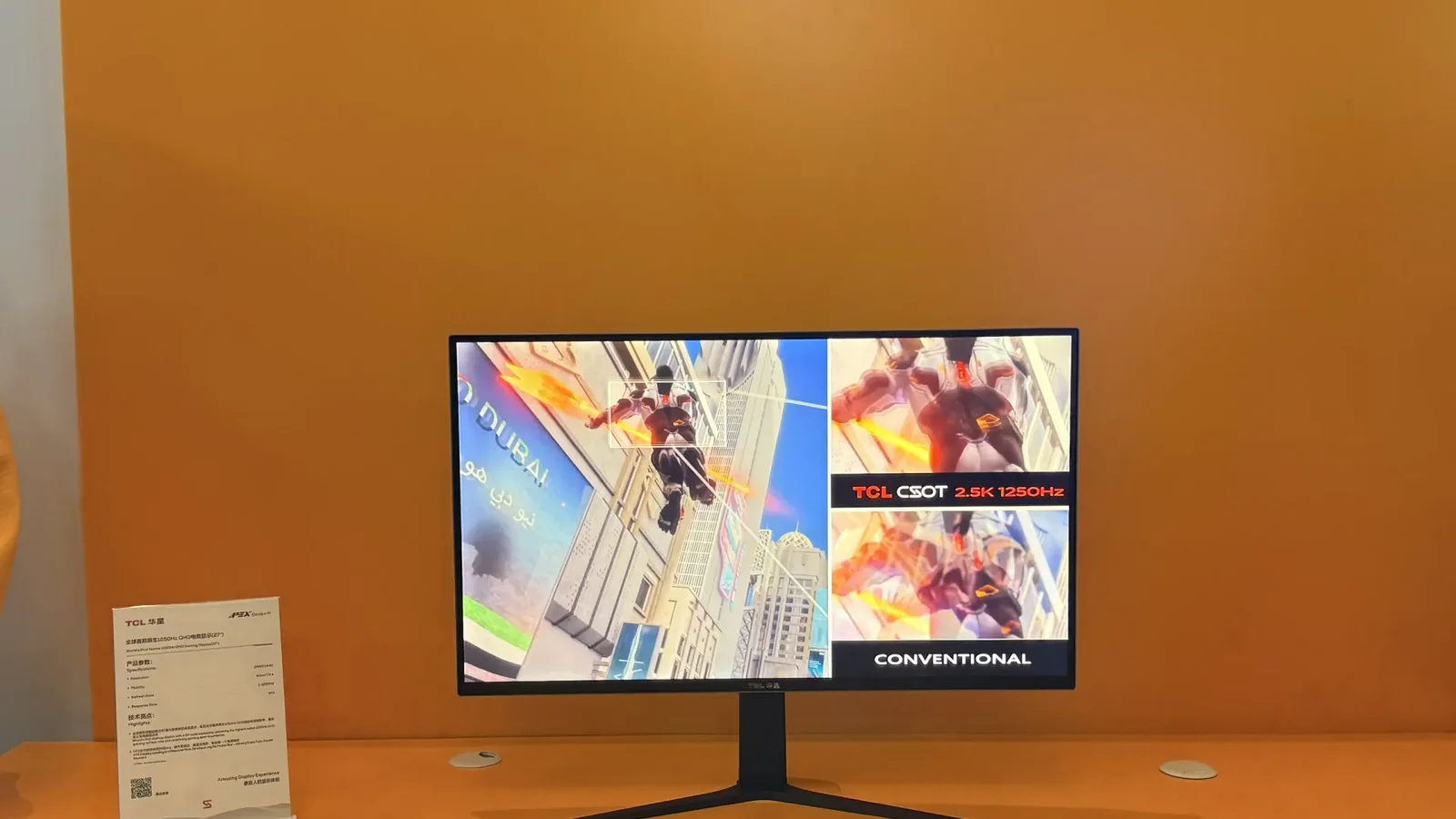
TCL CSOT’s prototype uses an UHMO backplane with a reported carrier mobility of 50 cm²/V·s. The technology supports a native refresh-rate range extending from 1Hz to 1250Hz, allowing the panel to operate at substantially higher frequencies than conventional gaming displays.
At 1250Hz, the screen can refresh every 0.8 milliseconds, compared with 1 millisecond at 1000Hz and approximately 2.78 milliseconds at 360Hz. These figures describe the theoretical interval between refreshes rather than measured input latency or pixel response performance.
The company also claims a 1ms response time, although independent response-time measurements have not been published. TCL CSOT has not confirmed the precise panel technology or disclosed detailed specifications for its variable refresh rate implementation and display connections.
Notebookcheck, which attended DTC 2026 and examined the prototype in person, described the display as highly responsive, with no noticeable motion blur during the demonstration. Its observations also suggested a non-OLED panel with satisfactory color reproduction. These impressions are based on an event demonstration rather than controlled laboratory testing.
The prototype exceeds the 1000Hz refresh rate of LG’s UltraGear 25G590B, which operates at Full HD resolution. Other high-refresh-rate gaming monitors have relied on lower-resolution operating modes to achieve their maximum advertised frequencies.
TCL CSOT’s ability to combine 1250Hz with QHD resolution is therefore a significant technical distinction. However, making full use of such a display would require a PC capable of generating extremely high frame rates in supported games. The practical benefits would depend on the game, system performance and the display’s measured motion clarity.
The company also demonstrated a separate 27-inch QHD 500Hz inkjet-printed OLED gaming display at the conference. That prototype targets a different combination of refresh rate and image quality, with a claimed response time below 1ms and 100% DCI-P3 color coverage.
Both panels remain developmental products rather than commercially available gaming monitors.
TCL CSOT told Notebookcheck that it is working with partners to bring the demonstrated display technologies to market. However, the manufacturer has not announced a retail model using the 1250Hz panel, identified a commercial monitor partner, or confirmed pricing and release availability.
For now, the demonstration establishes that TCL CSOT has developed a QHD gaming panel capable of operating at a native 1250Hz, while its real-world performance and commercial specifications remain unverified.
