
Close Menu
    Facebook X (Twitter) Instagram
    Facebook X (Twitter) Instagram
    TechtroduceTechtroduce
    Subscribe
    • NEWS
    • GUIDES
    • COMPARISONS
    • REVIEWS
    TechtroduceTechtroduce
    Home » AMD Introduces RT-MLAS to Improve Open-World Ray Tracing
    NEWS Updated:November 26, 2026

    AMD Introduces RT-MLAS to Improve Open-World Ray Tracing

    Abyan KhanBy Abyan KhanNovember 26, 2026Updated:November 26, 2026No Comments2 Mins Read
    Facebook Twitter Pinterest LinkedIn Tumblr Email
    Share
    Facebook Twitter LinkedIn Pinterest Email

    AMD has introduced Ray Tracing Multi-Level Acceleration Structures (RT-MLAS), an experimental Vulkan extension designed to reduce memory consumption and acceleration structure rebuild times in complex ray-traced environments. The company detailed the technology in a GPUOpen technical article published on November 24, 2026, alongside a demonstration application and compatible graphics driver.

    Conventional Vulkan ray tracing uses a two-level hierarchy consisting of Bottom-Level Acceleration Structures (BLAS), which represent geometry, and Top-Level Acceleration Structures (TLAS), which organize geometry instances throughout a scene. Managing these structures becomes increasingly expensive as environments grow more complex.

    AMD’s extension introduces up to two intermediate hierarchy levels through Mid-Level Acceleration Structures (MDLAS). Developers can group recurring geometry into reusable structures rather than register every individual component directly within the top-level hierarchy. Buildings, vegetation and other repeated environmental assets are potential applications.
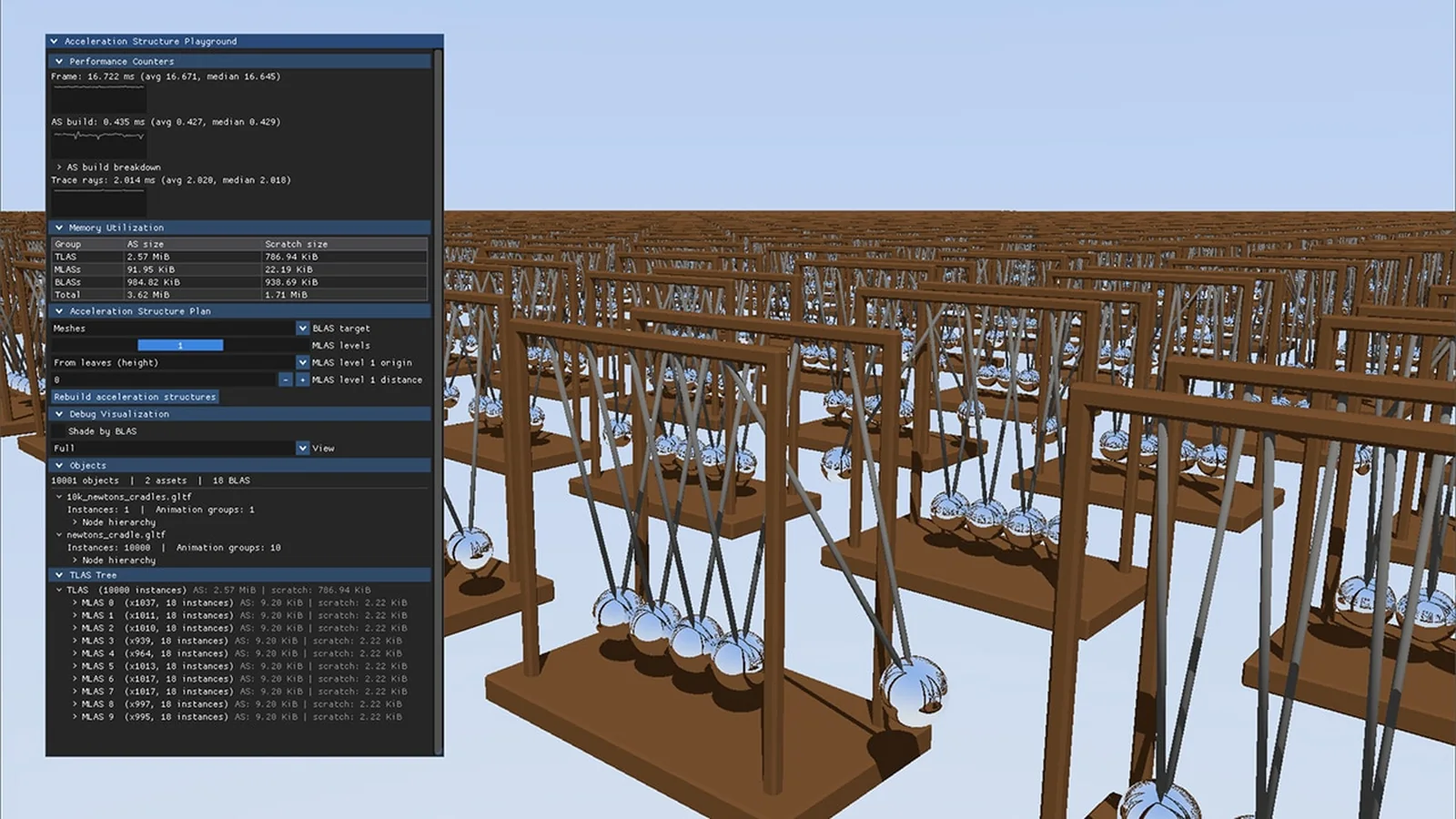
    AMD's Acceleration Structure Playground rendering rows of reflective Newton's cradles

    AMD demonstrated the technology using a scene containing 10,000 animated Newton’s cradles on a Radeon RX 9070. With RT-MLAS enabled, acceleration structures occupied just 3.62 MiB and recorded a median rebuild time of 0.43 milliseconds.

    By comparison, conventional per-component acceleration structures consumed 47.17 MiB with a 0.97-millisecond rebuild time. An alternative implementation using a BLAS for each uniquely animated cradle consumed 11.55 MiB and required 1.60 milliseconds to rebuild.

    These results represent approximately 92% lower acceleration structure memory consumption and 56% shorter rebuild times compared with the per-component implementation.

    AMD acknowledges that traversing additional hierarchy levels introduces its own ray tracing overhead. Consequently, the technology is better suited to sufficiently complex environments where memory and rebuild savings outweigh that additional processing cost.

    Developers can experiment with RT-MLAS using AMD’s Acceleration Structure Playground application, which supports configurable scene hierarchies. The provisional Vulkan extension, VK_AMDX_multi_level_acceleration_structure, requires the Radeon RX 9000 series or Radeon AI PRO R9700 and R9600 series graphics hardware, alongside the specialized Adrenalin Edition 26.20.25.01 Expanded Vulkan Extension Support driver.

    AMD also plans to introduce DirectX 12 support. However, the company has not announced a release date for that implementation or confirmed support in commercial games. The published results measure acceleration structure efficiency rather than overall gaming frame rates.

    Share. Facebook Twitter Pinterest LinkedIn Tumblr Email
    Abyan Khan
    • Instagram
    • LinkedIn

    Abyan Khan is a dedicated writer and tech enthusiast currently pursuing a Bachelor’s degree in Information Technology. With over 3 years of professional writing experience, he specializes in crafting clear, engaging, and informative content across a range of topics, particularly in the tech and gaming industries. Abyan combines his academic knowledge with real-world insights to deliver articles that are both well-researched and reader-friendly.

    Related Posts

    Digimon Alysion Launches on iOS and Android With Free Rewards

    November 26, 2026

    Fortnite Puss in Boots Leak Reveals November 26 Release Date

    November 26, 2026

    Dinghai: The Ocean Pillar Launches December 3 on Steam

    November 26, 2026
    Leave A Reply Cancel Reply

    Google Techtroduce

    See more Techtroduce stories on Google.

    Add us on Google

    • Digimon Alysion Launches on iOS and Android With Free RewardsNovember 26, 2026
      Digimon Alysion launches on iOS and Android in 183 countries and regions, featuring online card battles, an original story and free launch rewards.
    • Fortnite Puss in Boots Leak Reveals November 26 Release DateNovember 26, 2026
      Fortnite leaks point to a November 26 release for the Puss in Boots crossover, featuring a Death outfit, voiced Sidekick and themed cosmetics.
    • AMD Introduces RT-MLAS to Improve Open-World Ray TracingNovember 26, 2026
      AMD introduces RT-MLAS for Radeon RX 9000 GPUs, reducing ray tracing memory usage and acceleration structure rebuild times in complex scenes.
    TRENDING NOW

    Marvelous USA Plans Fewer Physical Xbox Games as Digital Sales Grow

    Ranchonauts Announced as Six-Player Co-Op Game for 2027

    Sony Expands China Hero Project With $1 Million Game Investments

    The Binding of Isaac: Repentance+ Launches With Online Co-op

    Facebook Instagram YouTube
    © 2026 Techtroduce. All Rights Reserved | Cookies Policy | Privacy Policy | Contact Us | About Us | Corrections Policy

    Type above and press Enter to search. Press Esc to cancel.

    Manage Consent
    To provide the best experiences, we use technologies like cookies to store and/or access device information. Consenting to these technologies will allow us to process data such as browsing behavior or unique IDs on this site. Not consenting or withdrawing consent, may adversely affect certain features and functions.
    Functional Always active
    The technical storage or access is strictly necessary for the legitimate purpose of enabling the use of a specific service explicitly requested by the subscriber or user, or for the sole purpose of carrying out the transmission of a communication over an electronic communications network.
    Preferences
    The technical storage or access is necessary for the legitimate purpose of storing preferences that are not requested by the subscriber or user.
    Statistics
    The technical storage or access that is used exclusively for statistical purposes. The technical storage or access that is used exclusively for anonymous statistical purposes. Without a subpoena, voluntary compliance on the part of your Internet Service Provider, or additional records from a third party, information stored or retrieved for this purpose alone cannot usually be used to identify you.
    Marketing
    The technical storage or access is required to create user profiles to send advertising, or to track the user on a website or across several websites for similar marketing purposes.
    • Manage options
    • Manage services
    • Manage {vendor_count} vendors
    • Read more about these purposes
    View preferences
    • {title}
    • {title}
    • {title}