


AMD has introduced Ray Tracing Multi-Level Acceleration Structures (RT-MLAS), an experimental Vulkan extension designed to reduce memory consumption and acceleration structure rebuild times in complex ray-traced environments. The company detailed the technology in a GPUOpen technical article published on November 24, 2026, alongside a demonstration application and compatible graphics driver.
Conventional Vulkan ray tracing uses a two-level hierarchy consisting of Bottom-Level Acceleration Structures (BLAS), which represent geometry, and Top-Level Acceleration Structures (TLAS), which organize geometry instances throughout a scene. Managing these structures becomes increasingly expensive as environments grow more complex.
AMD’s extension introduces up to two intermediate hierarchy levels through Mid-Level Acceleration Structures (MDLAS). Developers can group recurring geometry into reusable structures rather than register every individual component directly within the top-level hierarchy. Buildings, vegetation and other repeated environmental assets are potential applications.
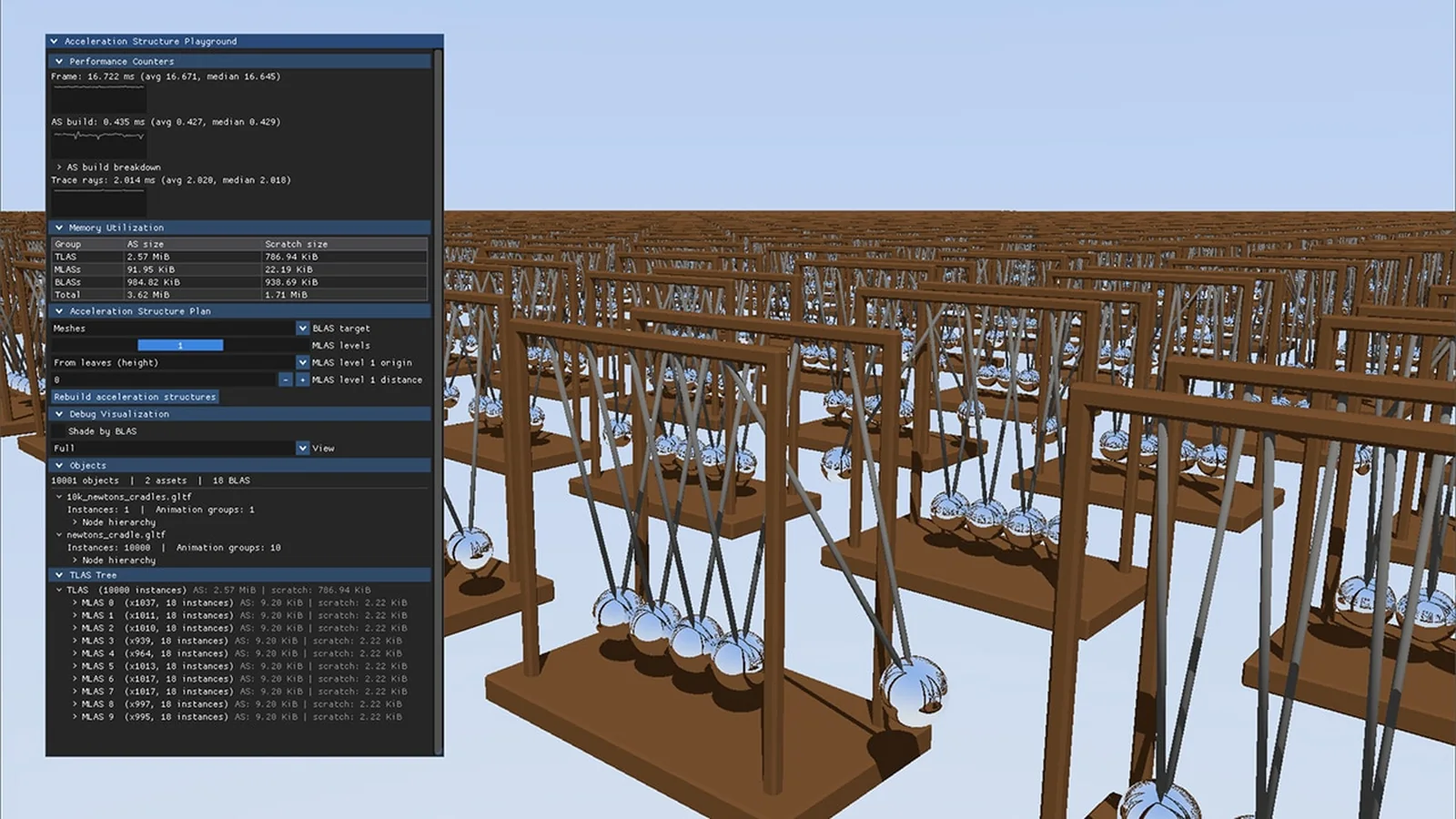
AMD demonstrated the technology using a scene containing 10,000 animated Newton’s cradles on a Radeon RX 9070. With RT-MLAS enabled, acceleration structures occupied just 3.62 MiB and recorded a median rebuild time of 0.43 milliseconds.
By comparison, conventional per-component acceleration structures consumed 47.17 MiB with a 0.97-millisecond rebuild time. An alternative implementation using a BLAS for each uniquely animated cradle consumed 11.55 MiB and required 1.60 milliseconds to rebuild.
These results represent approximately 92% lower acceleration structure memory consumption and 56% shorter rebuild times compared with the per-component implementation.
AMD acknowledges that traversing additional hierarchy levels introduces its own ray tracing overhead. Consequently, the technology is better suited to sufficiently complex environments where memory and rebuild savings outweigh that additional processing cost.
Developers can experiment with RT-MLAS using AMD’s Acceleration Structure Playground application, which supports configurable scene hierarchies. The provisional Vulkan extension, VK_AMDX_multi_level_acceleration_structure, requires the Radeon RX 9000 series or Radeon AI PRO R9700 and R9600 series graphics hardware, alongside the specialized Adrenalin Edition 26.20.25.01 Expanded Vulkan Extension Support driver.
AMD also plans to introduce DirectX 12 support. However, the company has not announced a release date for that implementation or confirmed support in commercial games. The published results measure acceleration structure efficiency rather than overall gaming frame rates.
