
Close Menu
    Facebook X (Twitter) Instagram
    Facebook X (Twitter) Instagram
    TechtroduceTechtroduce
    Subscribe
    • NEWS
    • GUIDES
    • COMPARISONS
    • REVIEWS
    TechtroduceTechtroduce
    Home » Gaming Laptop GPU Drops 35°C With Bounce House Blower
    NEWS Updated:November 22, 2026

    Gaming Laptop GPU Drops 35°C With Bounce House Blower

    Abyan KhanBy Abyan KhanNovember 22, 2026Updated:November 22, 2026No Comments4 Mins Read
    Facebook Twitter Pinterest LinkedIn Tumblr Email
    Share
    Facebook Twitter LinkedIn Pinterest Email

    PC hardware modder Trash Bench has demonstrated an unconventional gaming laptop cooling experiment using a blower designed to inflate bounce houses, reducing GPU temperatures from approximately 84°C to 48.8°C. The test involved a laptop equipped with an Intel Core i7-10750H processor and Nvidia GeForce RTX 2070 Max-Q GPU, with Cyberpunk 2077 performance increasing from 47 FPS to 56 FPS across the cooling comparisons.

    The experiment, documented in Trash Bench’s YouTube video titled “How Far Can You Push Laptop Cooling?”, compared a commercial Llano V12 cooling pad against several custom fan configurations. Rather than modifying the laptop’s internal cooling hardware, the modder focused entirely on forcing additional air through its existing ventilation system.

    The results demonstrated substantial temperature reductions, although increasingly powerful fans produced progressively smaller gaming performance improvements.
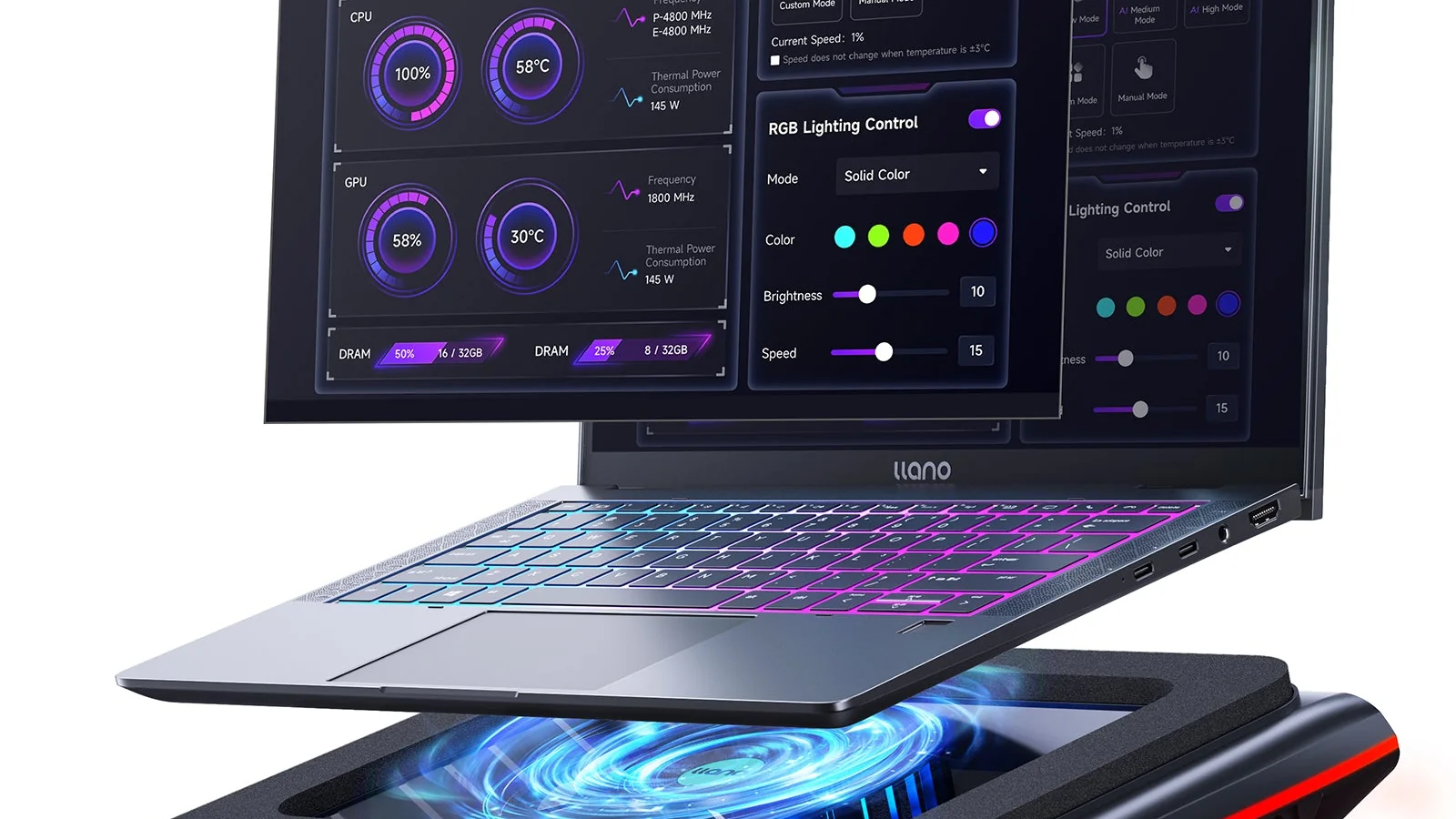
    Gaming laptop positioned above a black Llano cooling pad with RGB lighting, a large illuminated fan and blue airflow

    Trash Bench began with the Llano V12, a commercial cooling stand that uses a fan and foam sealing system to direct airflow into a laptop’s underside vents. At medium fan settings, the cooler reduced average GPU temperatures to 58.3°C, compared with approximately 84°C without external cooling.

    That represented a temperature reduction of roughly 27°C, accompanied by an average gaming performance improvement of 19.4% in the modder’s tests.

    Increasing the Llano V12 to maximum speed reduced GPU temperatures further to 56.7°C. However, the additional airflow generated considerably more noise without delivering a meaningful increase in gaming performance.

    The next configuration used a Noctua NF-A20 200mm fan connected to a custom 3D-printed duct. Foam around the duct helped create a seal against the laptop, limiting airflow escaping before reaching the intake vents.

    Despite the fan’s large diameter, the GPU averaged 66.3°C, making the setup less effective than the commercial Llano cooler.

    Trash Bench then tested six Arctic P12 fans operating at full speed. This arrangement lowered GPU temperatures to 57.4°C, slightly outperforming the Llano V12 at medium speed but falling short of its maximum-speed result.

    A subsequent configuration using two 4,000 RPM server fans delivered another improvement, reducing temperatures by an additional 2.6°C compared with the Llano V12 operating at maximum speed. The server fans were also substantially louder than the previous arrangements.

    For the final test, Trash Bench connected an industrial bounce house blower to the cooling stand using a flexible duct and a custom 3D-printed adapter.

    The blower generated enough air pressure to physically lift the laptop away from its cooling stand. The modder had to tape the laptop down to maintain a seal and prevent air from escaping.

    With the blower operating, average GPU temperatures reached 48.8°C, approximately 35.2°C below the original 84°C reading.

    Despite the substantial thermal improvement, gaming and benchmark performance showed diminishing returns.

    In 3DMark Time Spy, the bounce house blower, six-fan Arctic configuration, dual server fans and maximum-speed Llano V12 produced results within approximately 1% of one another. The Noctua setup trailed the blower configuration by around 3%, although it operated much more quietly.

    The comparison illustrates how cooling can improve gaming performance when a laptop is limited by temperature, but further reductions do not necessarily translate into higher frame rates once other constraints become more significant.

    The experiment also highlights the difference between lowering component temperatures and improving overall gaming performance. The industrial blower delivered the lowest GPU temperature, but its performance advantage over substantially smaller cooling systems was minimal.

    Extreme cooling experiments are not limited to laptops. Another PC enthusiast used an outdoor radiator to cool an RTX 4070 Ti Super, demonstrating a similarly unconventional approach to reducing gaming hardware temperatures.

    Trash Bench’s results are specific to the tested laptop and cooling configurations rather than a universal measure of external laptop cooling performance. They nevertheless show that a conventional cooling pad can capture much of the available performance benefit without requiring the noise, pressure or impractical hardware associated with an industrial blower.

    Share. Facebook Twitter Pinterest LinkedIn Tumblr Email
    Abyan Khan
    • Instagram
    • LinkedIn

    Abyan Khan is a dedicated writer and tech enthusiast currently pursuing a Bachelor’s degree in Information Technology. With over 3 years of professional writing experience, he specializes in crafting clear, engaging, and informative content across a range of topics, particularly in the tech and gaming industries. Abyan combines his academic knowledge with real-world insights to deliver articles that are both well-researched and reader-friendly.

    Related Posts

    Shinobi Nexus: Senran Kagura Launches November 29 on PC and Mobile

    November 22, 2026

    SNES Runs Tiny ChatGPT-Style AI Using Super FX 2 Chip

    November 22, 2026

    GTA 6 Sales Reach 32.5 Million Copies, $3.79 Billion on Day One

    November 22, 2026
    Leave A Reply Cancel Reply

    Google Techtroduce

    See more Techtroduce stories on Google.

    Add us on Google

    • Shinobi Nexus: Senran Kagura Launches November 29 on PC and MobileNovember 22, 2026
      Shinobi Nexus: Senran Kagura launches in Japan on November 29, 2026, for Windows PC, iOS and Android, with pre-downloads starting November 28.
    • Gaming Laptop GPU Drops 35°C With Bounce House BlowerNovember 22, 2026
      A modder cuts gaming laptop GPU temperatures by 35°C using a bounce house blower, but benchmark results show diminishing performance gains.
    • SNES Runs Tiny ChatGPT-Style AI Using Super FX 2 ChipNovember 22, 2026
      A Super Nintendo runs an unofficial 2.2-million-parameter AI chatbot using its Super FX 2 chip, with browser emulation and downloadable ROM support.
    TRENDING NOW

    tinyBuild Connect 2026 Set for September 14

    GTA 6 Delay Could Cost Rockstar $500 Million, Experts Claim

    Once Human Season 5 Adds Four-Player Colossus Raid on November 18

    Sony Announces PS Plus Price Hike Across 15 Countries

    Facebook Instagram YouTube
    © 2026 Techtroduce. All Rights Reserved | Cookies Policy | Privacy Policy | Contact Us | About Us | Corrections Policy

    Type above and press Enter to search. Press Esc to cancel.

    Manage Consent
    To provide the best experiences, we use technologies like cookies to store and/or access device information. Consenting to these technologies will allow us to process data such as browsing behavior or unique IDs on this site. Not consenting or withdrawing consent, may adversely affect certain features and functions.
    Functional Always active
    The technical storage or access is strictly necessary for the legitimate purpose of enabling the use of a specific service explicitly requested by the subscriber or user, or for the sole purpose of carrying out the transmission of a communication over an electronic communications network.
    Preferences
    The technical storage or access is necessary for the legitimate purpose of storing preferences that are not requested by the subscriber or user.
    Statistics
    The technical storage or access that is used exclusively for statistical purposes. The technical storage or access that is used exclusively for anonymous statistical purposes. Without a subpoena, voluntary compliance on the part of your Internet Service Provider, or additional records from a third party, information stored or retrieved for this purpose alone cannot usually be used to identify you.
    Marketing
    The technical storage or access is required to create user profiles to send advertising, or to track the user on a website or across several websites for similar marketing purposes.
    • Manage options
    • Manage services
    • Manage {vendor_count} vendors
    • Read more about these purposes
    View preferences
    • {title}
    • {title}
    • {title}