


Nintendo has revealed major gameplay and audio changes coming to The Legend of Zelda: Ocarina of Time remake, including freely controlled jumping, redesigned Water Temple navigation, fully voiced cutscenes, and more than 150 music tracks. The Nintendo Switch 2 exclusive launches on November 5, 2026, bringing a complete recreation of the 1998 Nintendo 64 adventure with modernized controls and expanded features.
The details come from Parts 3 and 4 of Nintendo’s Ask the Developer Vol. 24 interview series, published on November 3. Series producer Eiji Aonuma and other development team members explained how they rebuilt the original experience while introducing mechanics familiar to players of Breath of the Wild and Tears of the Kingdom.
One of the most significant changes is the removal of the original game’s automatic jumping system. In the Nintendo 64 version, Link automatically jumped when approaching specific ledges. The remake instead allows players to jump freely with a dedicated button.
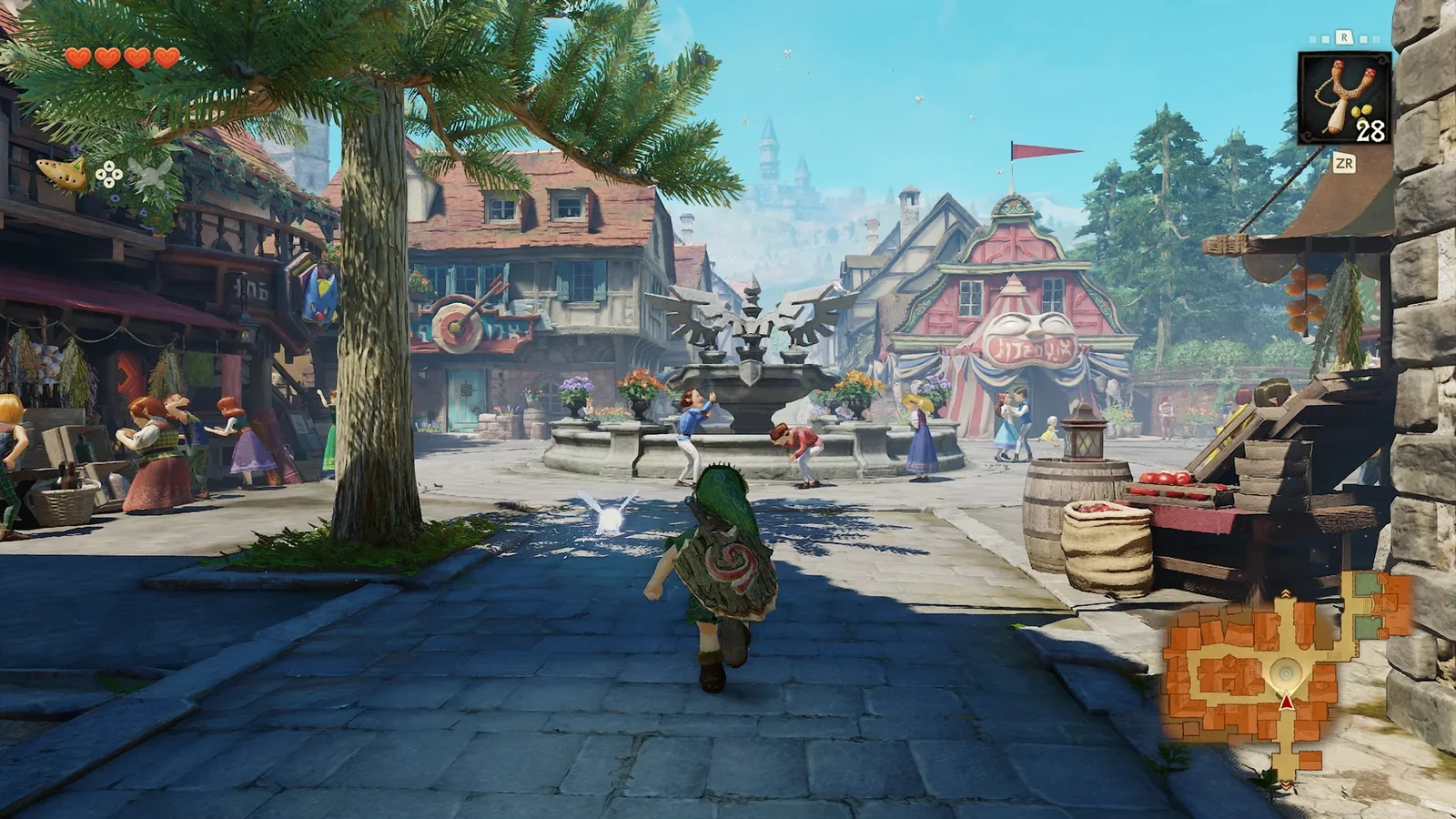
According to the developers, this seemingly straightforward adjustment required substantial changes throughout Hyrule. Areas originally designed around predetermined jumping locations needed to accommodate greater movement freedom, while the team also had to account for the slightly different jumping distances of Young Link and Adult Link.
Combat controls have received similar adjustments. Players can execute jump attacks using the traditional single-button input or the newer two-step method of jumping before attacking. The remake also introduces a dedicated dashing action by holding the roll button, while preserving the original ability to move quickly through repeated rolls.
Camera controls have been modernized for the Nintendo Switch 2’s dual-stick controller. Unlike the original game’s more restrictive camera system, players can freely rotate their viewpoint while exploring environments and dungeons. Nintendo consequently adjusted environmental layouts and navigation cues to help players maintain their sense of direction.
The Water Temple, one of the original game’s most challenging dungeons, has received particular attention. Aonuma, who designed the original dungeon, acknowledged that its complicated structure and frequent equipment changes could make navigation frustrating.
The remake simplifies equipment switching and replaces some solid walls with lattice-style structures, allowing players to see adjoining rooms and better understand how different sections connect. Nintendo emphasized that the underlying dungeon mechanisms have largely been preserved, with changes focused on improving navigation rather than removing the original puzzles.
Boss encounters have also been refined to communicate their mechanics more clearly. Gohma, the game’s first boss, now uses the arms above its head to protect its weak point during periods when it cannot take damage. This provides players with a clearer visual indication of when to attack without fundamentally changing the encounter.
Another addition is Threads of Time, a feature that combines adventure assistance with an illustrated retelling of the game’s story. As players progress, new illustrations and passages of text become available, eventually forming a complete tapestry. The feature is intended to help newcomers follow the narrative while giving returning players another way to revisit familiar events.
These gameplay changes expand on Nintendo’s earlier presentation of the remake’s redesigned characters and environments, which showed how the development team approached updating the original game’s visual identity.
The audio overhaul is equally substantial. Music lead Masato Ohashi confirmed that the remake contains more than 150 pieces of background music, including newly composed tracks accompanying additional cutscenes.
The soundtrack incorporates orchestral recordings while retaining simpler instrumentation where appropriate. Some arrangements also recreate sounds based on the original Nintendo 64 audio sources, combining familiar elements with modern recordings.
Environmental sound has been expanded throughout Hyrule. Players will hear location-dependent effects such as rustling leaves, flowing water, insects, and birds. Nintendo specifically highlighted Kokiri Forest, where the sound of a waterfall changes as Link moves closer to or farther away from it.
The remake supports 5.1-channel surround sound, while its ocarina audio changes depending on the environment in which the instrument is played. Nintendo also recorded a real ocarina to capture more natural instrument sounds.
Another unusual addition uses the Nintendo Switch 2’s built-in microphone. Players can hum melodies or play a real ocarina, allowing the game to recognize the notes and reproduce the corresponding song through Link’s instrument. The developers acknowledged that implementing reliable audio recognition required considerable adjustments.
Fully voiced cutscenes represent another major departure from the Nintendo 64 original. Nintendo conducted blind auditions to select actors whose voices matched the established personalities and sounds of the original characters.
Aonuma revealed that one actor selected during the Japanese auditions had performed the same character in the original Nintendo 64 release. The development team discovered this only after making its selection, as the actors’ identities had been concealed during the process.
Nintendo has also refined the introduction of controls and items for new players. Actions are introduced gradually, with clearer feedback and guidance intended to help players progress without relying as heavily on external walkthroughs.
Support for ZELDA NOTES returns from the Nintendo Switch 2 editions of Breath of the Wild and Tears of the Kingdom, alongside Ocarina of Time-specific features including an ocarina-playing mode. Using ZELDA NOTES requires a Nintendo Account, compatible smart device, and persistent internet connection.
The Legend of Zelda: Ocarina of Time remake is scheduled to launch exclusively on Nintendo Switch 2 on November 5, 2026, priced at $59.99 in the United States. Nintendo’s latest developer interviews establish how extensively the game has been rebuilt, with changes spanning movement, combat, dungeon navigation, storytelling, voice performances, and environmental audio.
