


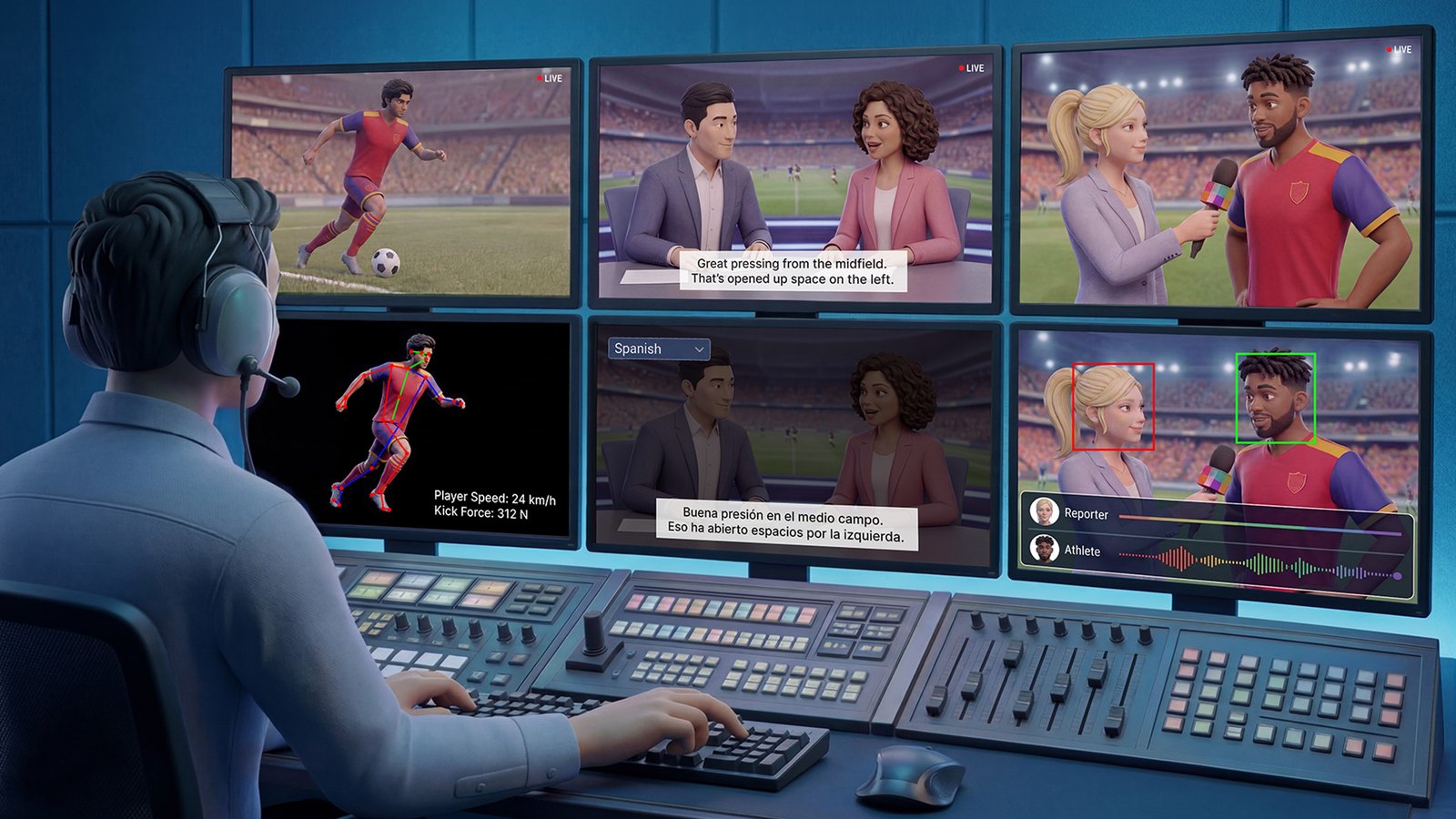
NVIDIA has announced a major expansion of its AI for Media platform ahead of IBC 2026, introducing new tools for live broadcasting, sports production, streaming, content verification and localization. The company is showcasing the technology at the Amsterdam event from September 11-14, with partners including Ross Video, Vizrt, NDI, Wowza and Dalet integrating different parts of NVIDIA’s media stack. The update extends NVIDIA’s broader push to move AI processing closer to real-time professional workflows rather than limiting it to offline content creation.
One of the key areas is video authenticity. NVIDIA’s Synthetic Video Detector NIM microservice analyzes footage to estimate whether it is authentic or AI-generated, with NVIDIA reporting accuracy of 99.3% for text-to-video material and 97.7% for image-to-video content. Dalet is integrating the detector into a cloud-based verification workflow for newsrooms, while TwelveLabs is adding its signals to a compliance product and Wowza plans to make the technology available through its Video Intelligence Framework.
Sports production is another major focus. NVIDIA 3D Body Pose can estimate human joint positions and angles from footage captured by a single camera, creating structured movement data without requiring marker-based motion capture. That information can be used for athlete tracking, biomechanics, officiating, replay enhancements, player-safety applications and virtual-production workflows, while Vizrt is applying the technology to live virtual studios where tracked movement can influence 3D lighting and environmental effects.
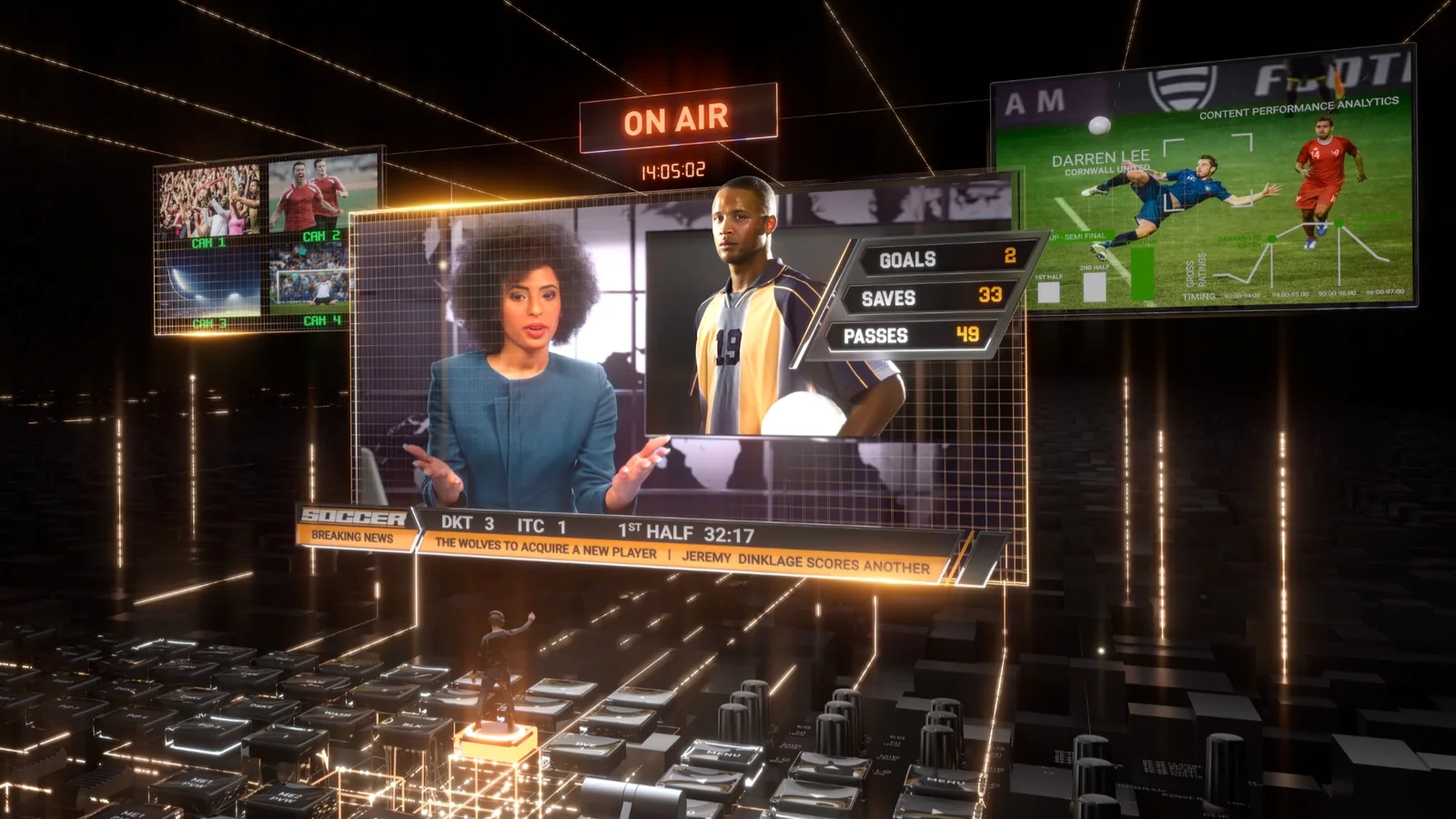
NVIDIA is also bringing generative AI directly into replay production through Video Frame Generation. The technology creates intermediate frames between existing video frames, allowing footage to run at 2x or 4x higher frame rates while maintaining temporal consistency. Ross Video is integrating it into its Rio Replay system for AI-assisted sports slow motion, with current work supporting 6x slow-motion generation and development underway toward 8x interpolation.
Video enhancement tools are being expanded at the same time. NVIDIA Video Super Resolution can upscale footage while reducing noise, blur and compression artifacts, with new modes allowing developers to choose between real-time performance and higher image quality. TrueHDR can convert standard-dynamic-range video into HDR output in real time at brightness levels reaching roughly 2,000 nits, and NVIDIA says VSR, Video Frame Generation and TrueHDR can operate together within one effects pipeline.
Localization is another significant part of the IBC announcements. NVIDIA LipSync modifies mouth movements to match translated audio while attempting to preserve details such as head movement, blinking and facial textures, while an updated Active Speaker Detection microservice identifies who is speaking in multi-person footage. NDI is using those technologies to support real-time translation and lip-synced dubbing within existing broadcast workflows, allowing one media stream to be adapted into multiple regional-language versions.
NVIDIA is extending that work through Holoscan for Media, its software-defined developer toolkit for live production. Content Localization within Holoscan provides a reference workflow combining captions, translated audio, dubbing, synchronized video and localized graphics. Rather than building a separate production chain for each market, broadcasters and streaming providers can select the localization components required for a particular program or territory.
Holoscan for Media is also being integrated with Media Exchange Layer, or MXL, providing an open layer for exchanging live video, audio and data between software-based production applications. The aim is to let AI processing and traditional broadcast functions share accelerated infrastructure rather than operating as isolated systems. NVIDIA says that approach can reduce custom integration work while making it easier for media companies to add new applications as formats and production requirements evolve.
For sports organizations, NVIDIA has additionally introduced Sports Intelligence Playbooks, frameworks for fine-tuning open models using proprietary sports footage, annotations and data. The playbooks cover data preparation, training, inference, evaluation and deployment, with early testing showing substantial gains when models were specialized on particular sports. The technology is intended to support analytics, live-production automation and new fan-facing experiences built around sport-specific AI.
The IBC announcements follow NVIDIA’s wider expansion into local and professional AI computing, including its recent RTX Spark PCs and PAIR software unveiled at IFA 2026. While consumer-facing NVIDIA AI features are often associated with gaming technologies such as experimental DLSS 5 neural rendering, the IBC rollout shows the same accelerated-computing strategy being applied to live television, sports and global streaming infrastructure.
