


D-Matrix has adopted NVIDIA NVLink Fusion for its next-generation Raptor AI inference accelerators, allowing the company’s custom XPUs to connect directly into NVIDIA’s rack-scale AI infrastructure. The partnership will combine Raptor with NVLink scale-up networking, Spectrum-X scale-out networking and NVIDIA’s MGX rack architecture. NVIDIA says the approach is intended to give d-Matrix a faster and lower-risk route from custom silicon to large-scale deployment.
D-Matrix specializes in hardware designed specifically for AI inference rather than model training. Its upcoming Raptor accelerator will succeed the company’s Corsair platform and introduce its 3D In-Memory Compute, or 3DIMC, architecture, which stacks compute and memory more closely together to reduce the latency and energy cost associated with moving data. Raptor is being developed for large-scale generative AI inference workloads where memory bandwidth and response latency can become significant bottlenecks.
NVLink Fusion allows third-party accelerator and CPU designers to integrate their own silicon with NVIDIA’s broader infrastructure rather than building an entire rack-scale platform independently. NVIDIA says the technology provides access to its high-bandwidth NVLink interconnect, MGX rack architecture, networking, power, cooling, software and established supply chain. The platform supports custom XPUs alongside major CPU architectures including Arm, x86 and RISC-V.
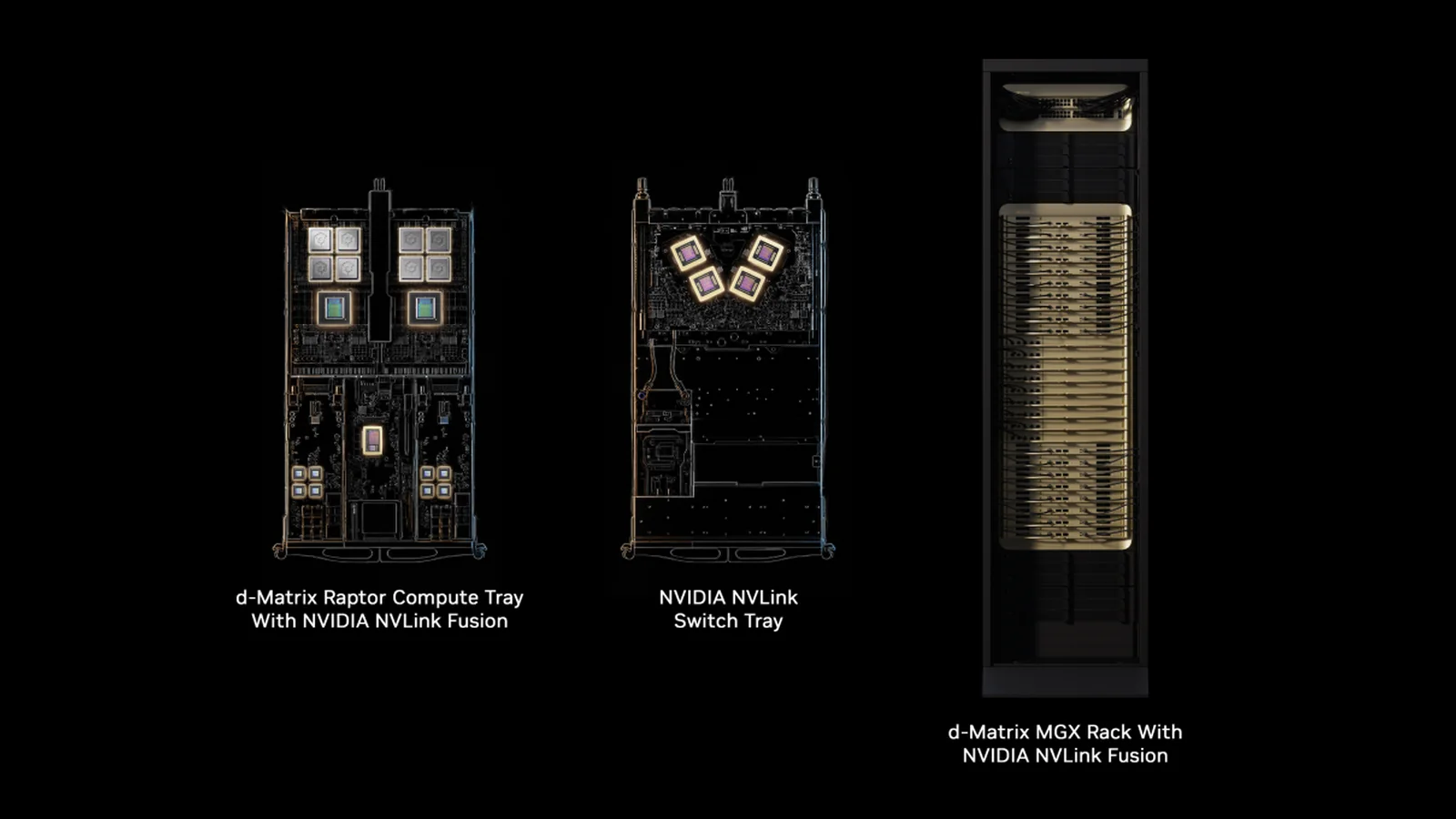
For d-Matrix, the integration means multiple Raptor XPUs can operate within a single high-bandwidth, low-latency NVLink scale-up domain. NVIDIA says sixth-generation NVLink can provide up to 3 TB/s of all-to-all bandwidth per XPU in the configuration described for the partnership, while also delivering lower latency and higher packet rates than conventional Ethernet-based accelerator communication. Those capabilities are aimed at workloads where large numbers of specialized processors need to exchange data quickly.
The companies are also planning integration beyond NVLink itself. d-Matrix intends to use NVIDIA Vera CPUs, ConnectX-9 SuperNICs, BlueField-4 DPUs and Spectrum-X Ethernet networking as part of the wider platform. Raptor-based racks will also be able to operate alongside NVIDIA GPU systems such as Vera Rubin NVL72, enabling heterogeneous inference environments where different processors handle the workloads to which they are best suited.
D-Matrix CEO and co-founder Sid Sheth said the company wants to address rapidly increasing inference demand without allowing capital requirements, deployment time and energy consumption to scale at the same rate. By using NVLink Fusion and MGX, d-Matrix can integrate Raptor into an already established liquid-cooled rack architecture rather than designing and validating every supporting system itself. That could shorten deployment timelines while giving customers a common infrastructure for GPUs, CPUs and specialized XPUs.
The agreement also illustrates NVIDIA’s broader effort to make its infrastructure available to companies building alternatives to its own GPUs. NVLink Fusion is designed specifically around semi-custom AI factories, where third-party accelerators plug into NVIDIA networking and rack technology while retaining their own processor architectures. The company has already identified partners across custom silicon, CPUs and connectivity, including AWS, Arm, Intel, Fujitsu, MediaTek, Samsung, Marvell and several chip-design specialists.
NVIDIA has been expanding its AI platform well beyond traditional GPU products, including recent local AI hardware and software initiatives aimed at moving inference into smaller systems. NVLink Fusion addresses the opposite end of that spectrum, targeting large data centers where customers may want specialized accelerators without abandoning NVIDIA’s surrounding infrastructure. The strategy effectively allows NVIDIA to remain part of an AI deployment even when the primary compute silicon comes from another company.
D-Matrix has not announced a commercial launch date for Raptor as part of the NVLink Fusion announcement. The accelerator remains under development, with the company’s 3DIMC technology expected to make its commercial debut on the platform. The significance of the partnership is therefore primarily architectural for now, establishing how Raptor will scale from individual accelerators into full rack-level AI systems.
If deployed as planned, Raptor will sit within a heterogeneous NVIDIA-based infrastructure rather than operating as a completely separate accelerator ecosystem. That gives d-Matrix access to mature networking, rack design and data-center deployment technology while allowing it to concentrate on its memory-centric inference hardware. For NVIDIA, the deal adds another custom XPU developer to NVLink Fusion as the company works to make its AI infrastructure a common foundation for increasingly diverse accelerator architectures.
