
Close Menu
    Facebook X (Twitter) Instagram
    Facebook X (Twitter) Instagram
    TechtroduceTechtroduce
    Subscribe
    • NEWS
    • GUIDES
    • COMPARISONS
    • REVIEWS
    TechtroduceTechtroduce
    Home » NVIDIA Says DSX MaxLPS Boosts AI Token Throughput by 24%
    NEWS Updated:September 16, 2026

    NVIDIA Says DSX MaxLPS Boosts AI Token Throughput by 24%

    Abyan KhanBy Abyan KhanSeptember 16, 2026Updated:September 16, 2026No Comments4 Mins Read
    Facebook Twitter Pinterest LinkedIn Tumblr Email
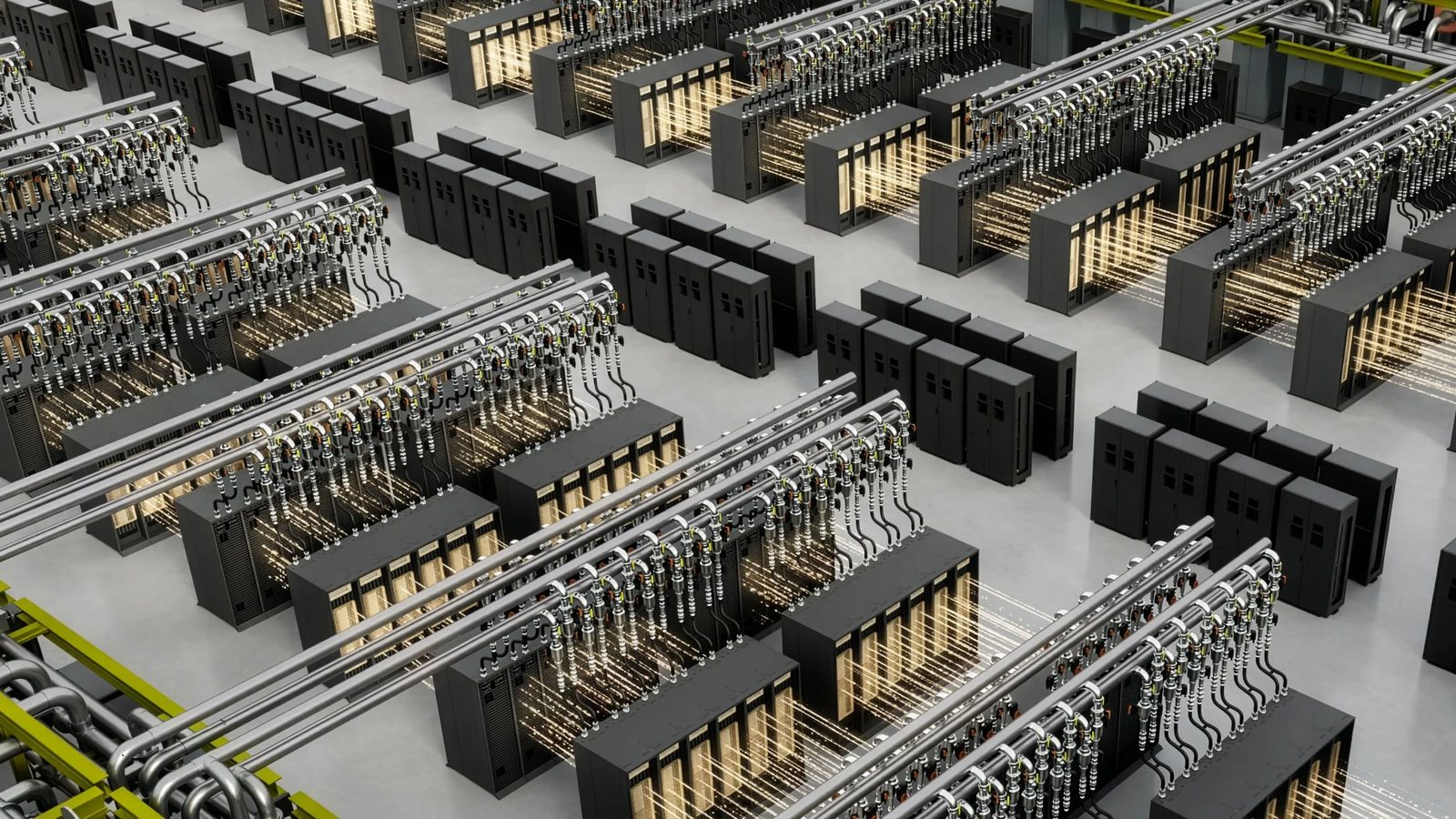
    Official NVIDIA visualization of a large liquid-cooled AI factory filled with rows of GPU racks and supporting
    Share
    Facebook Twitter LinkedIn Pinterest Email

    NVIDIA has published new AI infrastructure efficiency results showing its DSX MaxLPS power-management technology increased cluster-wide token throughput by 24% in its first validation on Blackwell servers. Announced at the AI Infra Summit on September 15, the results also showed a 23% improvement in performance per watt, while NVIDIA detailed further efficiency gains expected from its next-generation Vera Rubin platform. The company is positioning tokens generated per megawatt, rather than raw peak compute, as an increasingly important measure for large-scale AI infrastructure.

    AI cloud provider Lambda carried out the first validation of DSX MaxLPS on NVIDIA Blackwell servers. Using the same power budget normally allocated to 16 full-power nodes, Lambda operated 19 nodes and increased aggregate throughput from roughly 4 million to 5 million tokens per second. DSX MaxLPS does this by continuously monitoring power use across GPUs and racks, moving available power toward workloads that need it while reclaiming capacity that would otherwise remain unused under static provisioning.

    NVIDIA says the approach becomes even more important as AI data centers run mixtures of training and inference workloads with different power characteristics. Rather than reserving enough power for every system to operate at its theoretical peak simultaneously, MaxLPS dynamically redistributes capacity across the facility. In suitable Vera Rubin NVL72 deployments, NVIDIA says the technology can support up to 40% more GPU capacity within the same megawatt power budget and raise token throughput by as much as 35%.
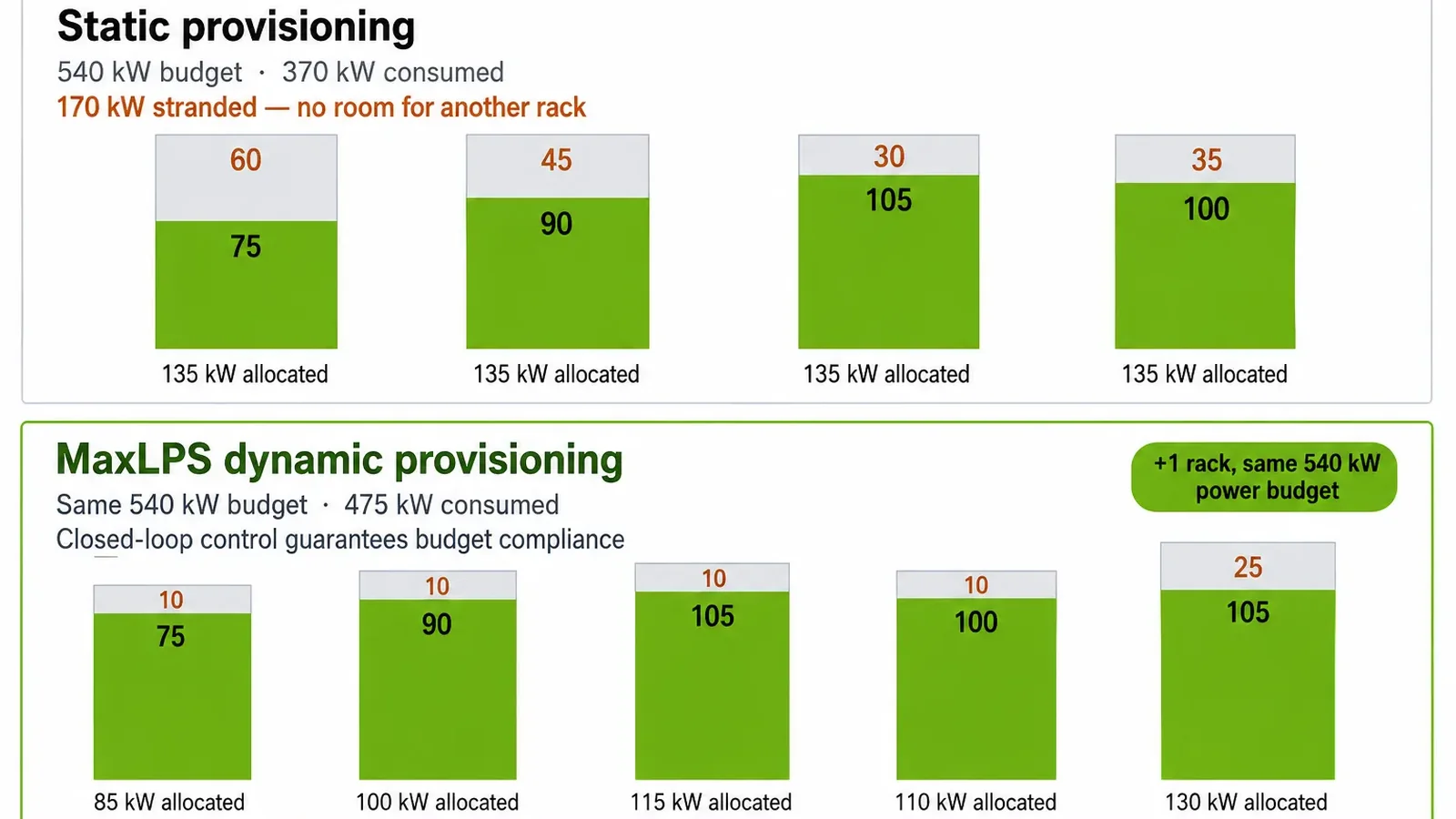
    Official NVIDIA comparison graphic showing static power provisioning versus MaxLPS dynamic provisioning within the same

    The broader Vera Rubin results presented at the summit put those power-management gains alongside substantial improvements at the silicon and rack level. On SemiAnalysis’ AgentX benchmark, NVIDIA says Vera Rubin NVL72 delivered up to 30 times higher throughput per megawatt than GB300 NVL72 while running DeepSeek V4 Pro. AgentX uses recorded agentic coding sessions with growing context, tool calls and sub-agent activity rather than conventional single-request inference tests, making it more representative of the heavier workloads generated by autonomous AI systems.

    NVIDIA says those AgentX results also translate to as much as 45 times lower cost per million tokens. The company attributes the improvement to full-stack changes including the 72-GPU NVL72 scale-up domain, sixth-generation NVLink, NVFP4 precision on fifth-generation Tensor Cores and software such as TensorRT LLM and NVIDIA Dynamo. The results build on NVIDIA’s wider push to improve the economics of AI inference, alongside its recent expansion of local AI hardware and inference software for smaller-scale deployments.

    NVIDIA also highlighted Groq 3 LPX as part of its Vera Rubin inference platform. On a 100,000-context Qwen 3.8 27B workload, the company says the system reached 2,529 output tokens per second per user. Combining Vera Rubin, Groq 3 LPX and DSX power management is intended to address both throughput and latency as AI agents perform longer chains of reasoning and repeatedly invoke tools.

    CPU results were another part of the announcement. Perplexity measured 1.9 times faster sandbox startup performance on NVIDIA Vera CPUs for its SPACE agent environment, while DeepInfra reported 2.2 times faster orchestration-step latency. Redpanda reported 5.5 times lower latency and 73% higher throughput in its testing, while Starburst measured three times faster query throughput; NVIDIA also cited performance results from ClickHouse, Prime Intellect and Kinetica.

    Beyond compute efficiency, NVIDIA demonstrated how AI facilities can respond dynamically to electricity-grid conditions. Emerald AI and NVIDIA worked with Silicon Valley Power on a flexible-load program capable of responding to hundreds of grid demand signals while preserving priority AI workloads. NVIDIA’s DSX Flex software can reduce power consumption for lower-priority jobs during grid events and restore them afterward, turning large AI data centers into more controllable electricity loads rather than fixed consumers.

    The announcements reflect NVIDIA’s increasingly broad definition of AI infrastructure, spanning processors, networking, power management, cooling and data-center operations. Its DSX platform is designed to optimize entire AI factories rather than individual servers, while Vera Rubin is now in production and beginning to generate third-party performance measurements. With power availability becoming a major constraint on new AI capacity, NVIDIA is arguing that how many useful tokens a facility can generate from each megawatt will matter as much as how many GPUs it contains.

    Share. Facebook Twitter Pinterest LinkedIn Tumblr Email
    Abyan Khan
    • Instagram
    • LinkedIn

    Abyan Khan is a dedicated writer and tech enthusiast currently pursuing a Bachelor’s degree in Information Technology. With over 3 years of professional writing experience, he specializes in crafting clear, engaging, and informative content across a range of topics, particularly in the tech and gaming industries. Abyan combines his academic knowledge with real-world insights to deliver articles that are both well-researched and reader-friendly.

    Related Posts

    Fortnite Leak Reveals Six New Loot Hacks for September 17

    September 16, 2026

    Six New GTA VI Artworks Surface in Coordinated Music Campaign

    September 16, 2026

    Black Ops 6 Joins Xbox Game Pass Premium on September 25

    September 16, 2026
    Leave A Reply Cancel Reply

    Google Techtroduce

    See more Techtroduce stories on Google.

    Add us on Google

    • Fortnite Leak Reveals Six New Loot Hacks for September 17September 16, 2026
      A Fortnite leak points to six Loot Hacks arriving September 17, including the Rocket Ram, Reaper Sniper Rifle, Mammoth Pistol and Deadeye DMR.
    • NVIDIA Says DSX MaxLPS Boosts AI Token Throughput by 24%September 16, 2026
      NVIDIA says DSX MaxLPS raised token throughput 24% in Lambda testing, while Vera Rubin delivered major gains in AI performance per megawatt.
    • Six New GTA VI Artworks Surface in Coordinated Music CampaignSeptember 16, 2026
      Six new GTA VI-style artworks have surfaced through coordinated posts from musicians including Future, Morgan Wallen and Keith Richards.
    TRENDING NOW

    Camelot Software Planning May Be Nearing Completion On New Project, Potentially For Switch 2—Golden Sun 4 Hope Rekindled

    Reports Suggest That Sony Has A Major PS5 Event Incoming

    Capcom Leak Points To Second Playable Character in Resident Evil Requiem

    Metal Slug Ultimate Collection Brings 10 Games Together in 2027

    Facebook Instagram YouTube
    © 2026 Techtroduce. All Rights Reserved | Cookies Policy | Privacy Policy | Contact Us | About Us | Corrections Policy

    Type above and press Enter to search. Press Esc to cancel.

    Manage Consent
    To provide the best experiences, we use technologies like cookies to store and/or access device information. Consenting to these technologies will allow us to process data such as browsing behavior or unique IDs on this site. Not consenting or withdrawing consent, may adversely affect certain features and functions.
    Functional Always active
    The technical storage or access is strictly necessary for the legitimate purpose of enabling the use of a specific service explicitly requested by the subscriber or user, or for the sole purpose of carrying out the transmission of a communication over an electronic communications network.
    Preferences
    The technical storage or access is necessary for the legitimate purpose of storing preferences that are not requested by the subscriber or user.
    Statistics
    The technical storage or access that is used exclusively for statistical purposes. The technical storage or access that is used exclusively for anonymous statistical purposes. Without a subpoena, voluntary compliance on the part of your Internet Service Provider, or additional records from a third party, information stored or retrieved for this purpose alone cannot usually be used to identify you.
    Marketing
    The technical storage or access is required to create user profiles to send advertising, or to track the user on a website or across several websites for similar marketing purposes.
    • Manage options
    • Manage services
    • Manage {vendor_count} vendors
    • Read more about these purposes
    View preferences
    • {title}
    • {title}
    • {title}