


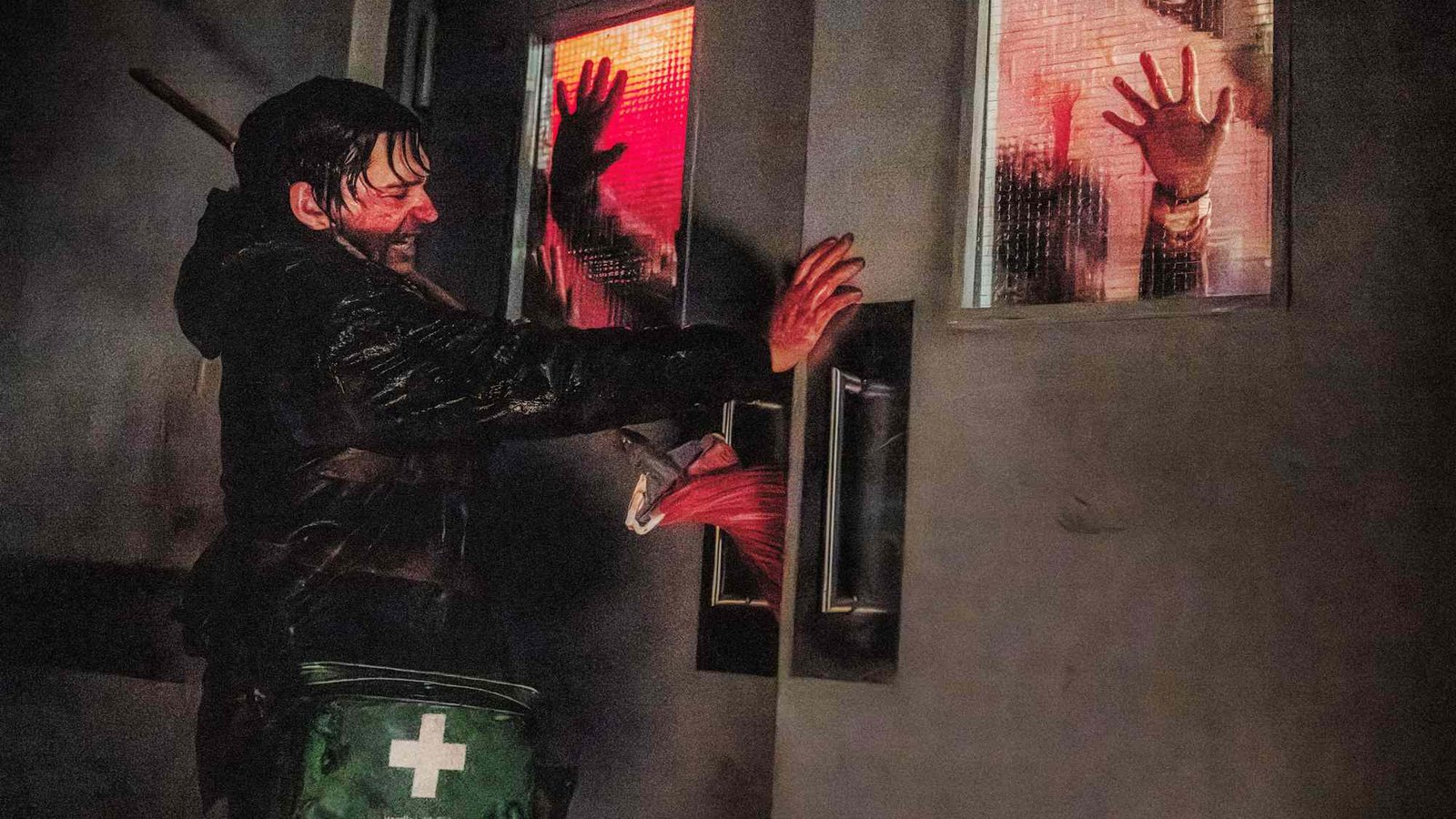
The first reviews for Zach Cregger’s Resident Evil movie have arrived ahead of its September 18 theatrical release, and the initial critical response is unusually strong for the long-running game adaptation series. Reviews published on September 16 broadly praise the film’s combination of horror, gore, dark comedy and video game-inspired storytelling, with several critics describing it as the strongest Resident Evil movie yet. Austin Abrams’ performance as protagonist Bryan has also emerged as a consistent point of praise.
Cregger’s film does not directly adapt one of Capcom’s games or place familiar protagonists such as Leon S. Kennedy, Jill Valentine or Claire Redfield at the center. Instead, it tells an original story about Bryan, a medical courier who becomes trapped in a rapidly escalating nightmare over the course of one night. Sony describes the movie as a reinvention of Resident Evil rather than a direct retelling, with Cregger directing from a screenplay he co-wrote with Shay Hatten.
That decision appears to have worked for many early reviewers. The Guardian awarded the film four out of five stars, praising its relentless pace and the way horror and comedy work together without undermining the tension. The Financial Times also gave it four stars, highlighting the movie’s stripped-down structure and the way Bryan’s journey increasingly resembles progression through a video game.

Variety’s review similarly describes the movie as a fast-moving monster film with a distinctive personality, while TheWrap went considerably further by calling it Cregger’s best film and one of the strongest video game adaptations to date. The San Francisco Chronicle also praised the production’s visual craft, particularly the cinematography and practical creature work. Across the early coverage, critics frequently point to Cregger’s ability to preserve the feel of Resident Evil without simply recreating a specific game.
The film reportedly borrows recognizable ideas from the franchise while building its own characters and narrative. Critics have highlighted limited resources, escalating weaponry, game-like progression, creatures and familiar Resident Evil imagery as ways the movie evokes Capcom’s survival-horror structure. That approach differs from earlier live-action adaptations, which frequently used characters and concepts from the games while constructing largely separate continuities.
Cregger has previously explained that his connection to Resident Evil began with the games rather than the existing film series. He has specifically discussed playing Resident Evil 2 and being drawn to its resource-management systems, an influence that appears to carry into the new film. The director is coming off Barbarian and Weapons, and several reviews argue that Resident Evil retains the unpredictable horror-comedy balance associated with those films despite being a major studio franchise production.
The broader Resident Evil franchise is also particularly active in 2026. Capcom is continuing to expand the games across new platforms, with Resident Evil 2, Resident Evil 3 and Resident Evil 4 heading to Switch 2 on October 16. The new movie exists independently of those games, but its release coincides with the franchise’s 30th anniversary year and renewed attention across both gaming and film.
Austin Abrams leads the cast as Bryan, with Zach Cherry, Kali Reis and Paul Walter Hauser also starring. Sony Pictures lists Zach Cregger and Shay Hatten as the writers, while Constantin Film and Columbia Pictures are among the companies behind the production. The movie carries an R rating for strong bloody violence, gore and language.
The early response is notable because Resident Evil has had a long and uneven history in live-action film. Paul W. S. Anderson’s series ran for six installments, followed by the 2021 reboot Resident Evil: Welcome to Raccoon City, while Netflix also attempted a live-action television adaptation. None produced the kind of near-unanimous early critical enthusiasm now surrounding Cregger’s version.
Audience reception will become clearer once the film receives its wider theatrical release on September 18. For now, however, the first substantial wave of reviews suggests Cregger’s original-story approach has succeeded in capturing aspects of Resident Evil that previous adaptations struggled to translate, while still functioning as a standalone horror movie.
