


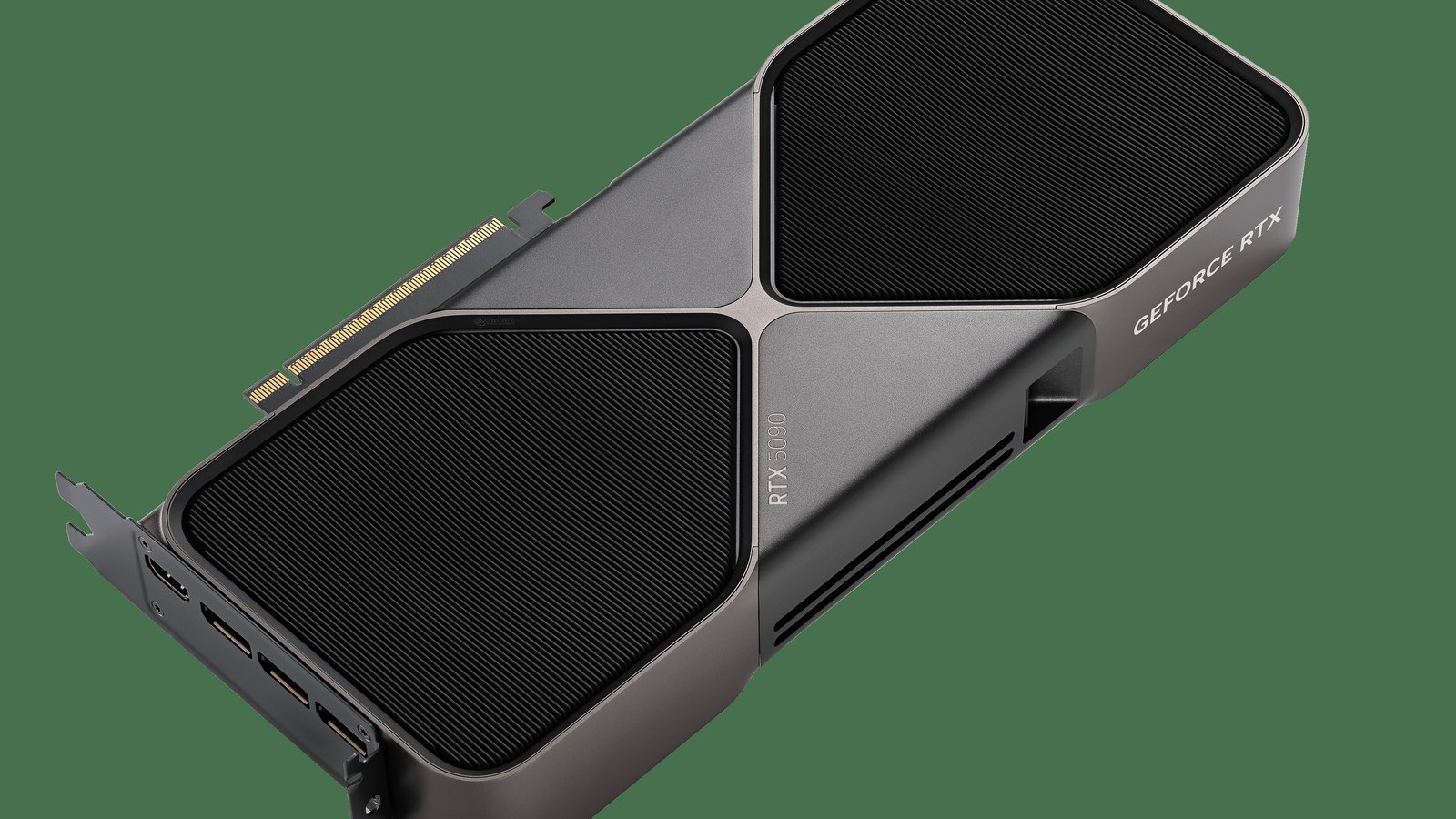
Footage circulating online shows large quantities of NVIDIA GeForce RTX 5090 graphics cards being dismantled and rebuilt into blower-cooled cards intended for AI servers. The videos, shared by Hong Kong hardware publication HKEPC on October 23, 2026, appear to document an organized conversion operation involving retail graphics cards from multiple manufacturers, including NVIDIA’s Founders Edition models.
The footage shows workers removing factory-installed cooling assemblies before extracting the GB202 graphics processors and GDDR7 memory chips from their original circuit boards. These components are then transplanted onto replacement PCBs designed to accommodate more compact cooling systems. The resulting graphics cards use dual-slot blower-style coolers, allowing them to fit more closely together in server configurations.
The apparent scale of the operation has attracted attention because the RTX 5090 is NVIDIA’s flagship consumer gaming graphics card, and availability has already become a concern in several markets. However, although the videos show substantial quantities of hardware, claims that thousands of RTX 5090 cards are being converted have not been independently verified.
The footage includes retail packaging and graphics cards associated with several manufacturers, including ASUS, Gigabyte and NVIDIA. Some units appear to be newly unpackaged, while others are shown at different stages of disassembly.
Unlike conventional graphics card modifications that replace a cooler while retaining the original board, the process shown involves removing the GPU package and memory chips using specialized heating equipment.
The components are subsequently installed on replacement circuit boards equipped with cooling hardware better suited to densely packed systems. Additional footage shows multiple converted cards undergoing testing before packaging.
The RTX 5090’s hardware makes it particularly attractive for demanding computational workloads. Its GB202 GPU and 32GB of GDDR7 memory provide substantial processing capability and memory capacity for applications beyond gaming, including local AI inference and other GPU-accelerated tasks.
Consumer versions of the RTX 5090 typically use large cooling assemblies designed for desktop gaming systems. Depending on the model, these can occupy several expansion slots, limiting how many cards can fit into a single chassis.
Blower-style coolers address this limitation by directing heated air toward an exhaust rather than dispersing it throughout the surrounding case. Combined with narrower circuit-board and cooling designs, this arrangement can make multiple high-performance GPUs easier to accommodate in server environments.
The conversion process does not turn the RTX 5090 into an NVIDIA enterprise GPU. It retains the underlying consumer graphics processor and memory while changing the supporting board and cooling configuration. The reliability, performance and power characteristics of the modified cards have not been independently established.
The reported operation also raises questions about how full-specification RTX 5090 cards are reaching Chinese conversion facilities. The GPU is subject to US export restrictions covering shipments to China, where NVIDIA has offered modified regional variants.
The footage does not establish where the original graphics cards were purchased, how they entered the reported conversion supply chain or whether any export restrictions were violated. The identity and precise location of the workshop have also not been independently confirmed.
For PC gamers, the most immediate concern is whether demand for AI computing is diverting consumer graphics cards away from retail channels.
The RTX 5090 has already experienced severe availability problems in Germany, where limited retail inventory has been accompanied by unusually high asking prices. The newly circulated footage provides another example of the potential commercial demand for RTX 5090 hardware outside traditional gaming applications.
NVIDIA has also maintained that the RTX 5090 has not been discontinued, despite acknowledging supply constraints. The existence of conversion operations does not establish that NVIDIA has reduced gaming GPU shipments to accommodate AI buyers.
Broader component availability remains another consideration. The graphics card market is operating against a backdrop of memory supply constraints driven partly by AI infrastructure demand, although the precise contribution of individual factors to RTX 5090 availability remains unclear.
The October 23 footage provides evidence consistent with an organized process for converting retail RTX 5090 hardware into server-oriented graphics cards. It does not establish the total production volume, the number of units diverted from consumer sales or the extent to which these operations contribute to current retail shortages.
Neither the identities of the conversion operators nor the ultimate buyers of the modified graphics cards have been independently verified.
