


An open-source project called nxnative allows Nintendo Switch games to run natively on Apple’s iPhone, iPad and Mac hardware without conventional console emulation. The software converts Switch game files into standalone applications, using native ARM64 execution and Apple’s Metal graphics API. Its official GitHub repository documents more than 60 tested games, including Super Mario Odyssey, The Legend of Zelda: Breath of the Wild and Metroid Dread.
Unlike traditional Switch emulators, which reproduce the console’s hardware and operating environment, nxnative modifies Nintendo Switch executable code to run directly on compatible Apple processors. The approach takes advantage of the ARM64 architecture shared by Nintendo’s original Switch hardware and modern Apple silicon devices.
The project includes an executable rewriter, a compatibility layer that replaces functionality normally provided by the Switch’s Horizon operating system, and a graphics translation system that converts Nintendo’s NVN graphics operations into Apple’s Metal API. Shader translation uses components from the Ryujinx emulator project, while the broader native-execution approach builds on work originally developed for running Diablo II: Resurrected on Apple devices.
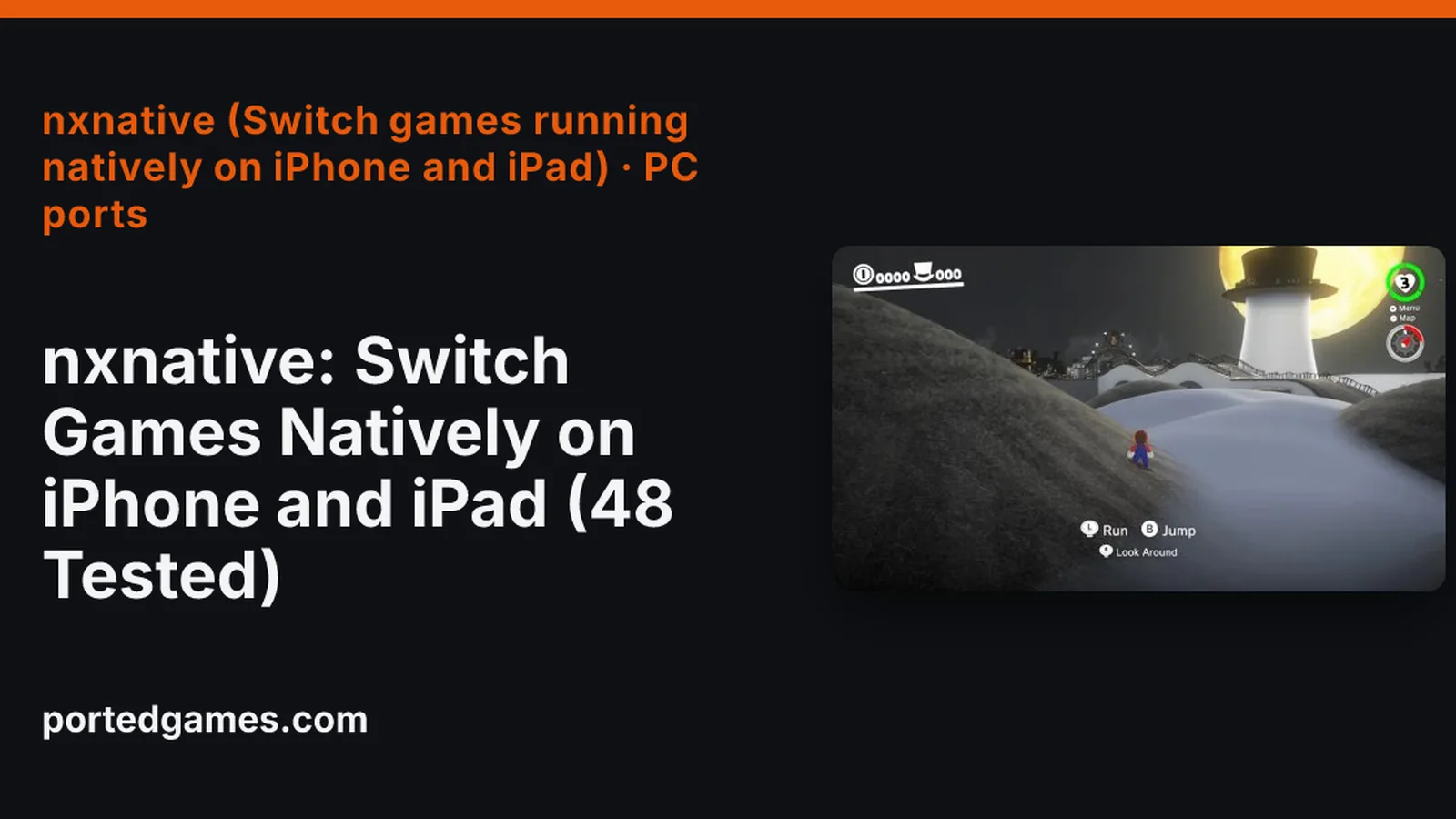
The result is a game application that executes the original Switch game’s code on Apple hardware rather than running it through a conventional CPU emulator. However, system services and graphics operations still require substantial compatibility work, meaning native CPU execution does not guarantee full compatibility or better performance.
The project’s compatibility documentation lists more than 60 games tested on Mac or iPhone. Notable titles include Mario Kart 8 Deluxe, Super Mario Bros. Wonder, Super Mario Odyssey, The Legend of Zelda: Tears of the Kingdom, Animal Crossing: New Horizons, Pokémon Legends: Z-A, Super Smash Bros. Ultimate and Monster Hunter Rise.
Several supported games can also run at higher frame rates than their original Switch versions. The developers list configurations capable of reaching 60 FPS in titles normally limited to 30 FPS, including Breath of the Wild with update 1.9.0, Luigi’s Mansion 3 with update 1.4.0, and Fire Emblem: Three Houses with update 1.2.0.
These improvements are game- and version-specific rather than universal performance upgrades. The project’s documentation identifies particular updates required for its frame-rate modifications, and results can vary depending on the Apple device and game being used. The compatibility listings are developer-reported and do not constitute independent performance benchmarks across all supported hardware.
Running Switch games through nxnative requires considerably more setup than installing a conventional mobile game. Users need a Mac with the required development tools, their own Nintendo Switch game files, and the associated decryption keys. The project’s build script processes the game files and produces an unsigned IPA application for iPhone or iPad, or a standalone Mac application for Apple silicon computers.
Mobile applications can then be installed using sideloading tools such as AltStore or Sideloadly. The developers estimate that an initial build can take approximately 30 to 60 minutes, although subsequent builds can reuse previously generated components.
Hardware compatibility is also restricted. According to the project’s documentation, iPhone support requires an iPhone 15 Pro or newer with an A17 Pro-class processor or later, while supported iPads need an M1 chip or newer. Both platforms require iOS 26 or iPadOS 26, respectively. These requirements reflect the compressed texture formats used by Switch games, which older iPhone graphics hardware cannot handle.
Once installed, supported games provide options for adjusting rendering resolution, frame rate, handheld or docked mode, language and controller settings. The mobile version includes touchscreen controls and support for connected game controllers, with some games also offering motion input and vibration.
Compatibility remains incomplete despite the expanding games list. The developers explicitly state that online functionality and amiibo are unsupported. Individual games can also exhibit graphical or audio problems, while titles outside the documented compatibility list may fail to launch altogether.
Memory restrictions present another challenge on iPhone. The project recommends using Apple’s increased-memory entitlement when signing applications, as demanding games can exceed the memory available to applications without it. Initial gameplay may also experience shader-compilation stutters before the translated graphics are cached.
Nxnative is not affiliated with Nintendo or any game publisher, and its repository does not distribute commercial game files. Users must supply the necessary game data themselves. The project’s open-source availability does not automatically authorize downloading copyrighted games or bypassing applicable copy-protection restrictions.
The project represents another approach to bringing console games to hardware they were never officially released on. Similar preservation and compatibility efforts include the unofficial DriveClub recompilation project for Windows, which uses executable recompilation and graphics translation to run a PlayStation-exclusive game on PC.
For nxnative, the immediate appeal is the possibility of running existing Switch games as independent applications on Apple’s mobile devices and computers. However, its demanding setup process, hardware restrictions and incomplete compatibility mean it remains an experimental option rather than a straightforward replacement for Nintendo Switch hardware.
