


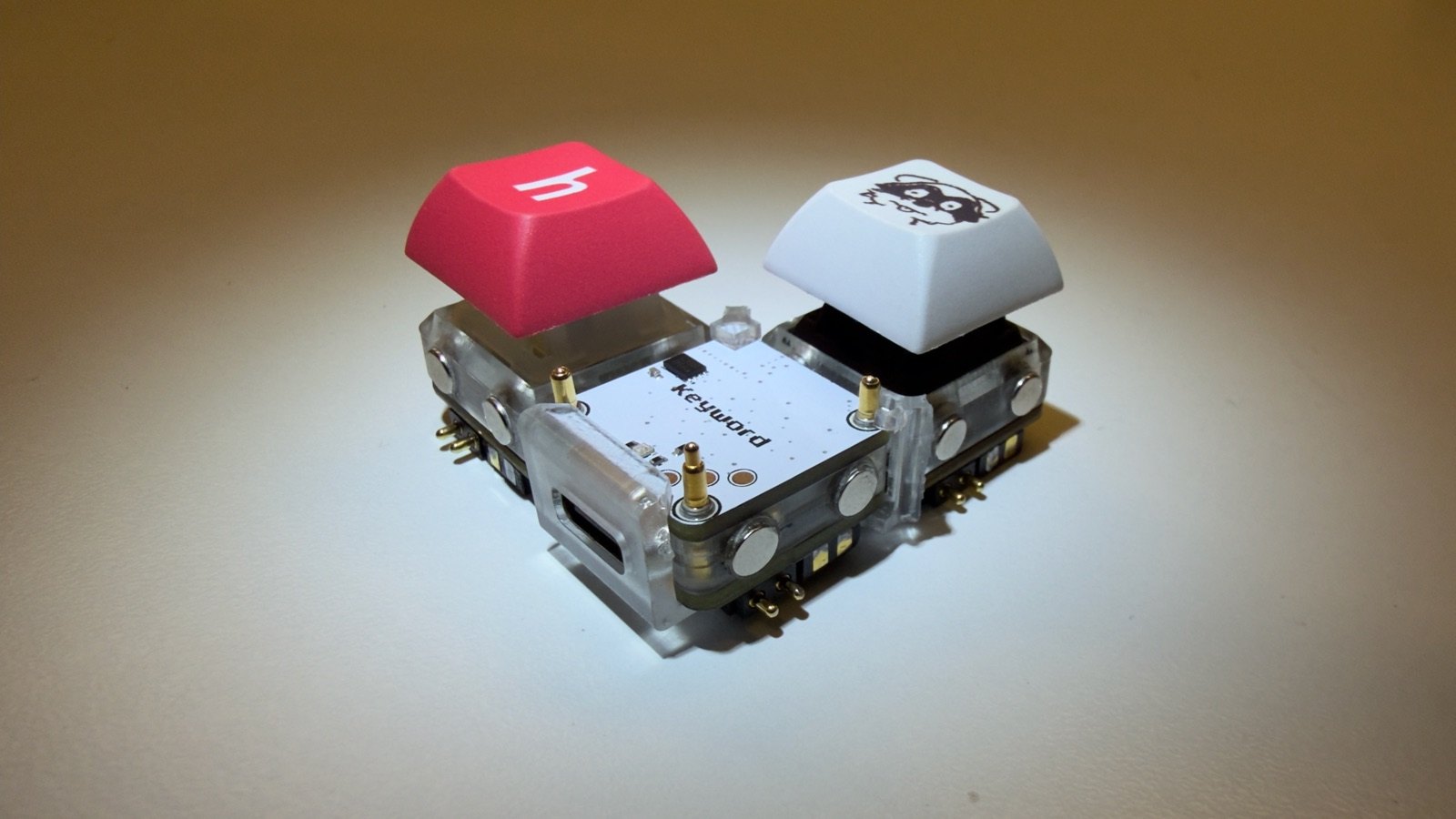
Developer Nathan Alspaugh has created Keybytes, an open-source mechanical keyboard that lets users build and rearrange their own layouts using individual magnetic key modules. Unlike conventional keyboards with fixed arrangements, each Keybytes key has its own printed circuit board and RISC-V microcontroller, allowing modules to connect in different configurations.
The project, published on GitHub under Alspaugh’s NotARoomba username, includes hardware designs, firmware, 3D-printable case files and a video demonstration of the modular system. The early-stage prototype combines individual key modules called Keybits with a central controller called the Keyword, which provides USB and Bluetooth connectivity.
Each Keybit measures 19.05 × 19.05mm, equivalent to one standard keyboard unit, and contains a Cherry MX mechanical switch alongside a CH32V003 RISC-V microcontroller. Spring-loaded pogo pins on all four sides carry 3.3V power, ground and I2C communication signals between adjacent modules.
Magnets embedded in the cases hold the individual keys together, while the electrical contacts allow connected modules to communicate with the main controller. This arrangement enables users to reposition keys or expand a layout without designing an entirely new keyboard PCB.
The central Keyword controller uses an STM32WB55RGV6 microcontroller and consists of two stacked circuit boards. The upper board contains the processor, Bluetooth antenna and flash memory, while the lower board houses the USB-C connection, battery-charging circuitry and power converter.
The design also incorporates 2MB of QSPI flash storage, a BQ25895 battery-charging controller, support for a single-cell lithium-polymer battery and an RGB status LED. Programming connections on the controller allow firmware to be transferred to individual Keybits.
Alspaugh designed the circuit boards using KiCad and created the custom cases in Onshape. The project’s GitHub repository includes the design files under the MIT license, allowing other developers and hardware enthusiasts to examine, modify and build upon the design.
The modular approach could be particularly useful for enthusiasts interested in unusual keyboard arrangements, compact input devices or dedicated macro pads. Rather than purchasing a separate fixed-layout device, builders could assemble a configuration using the number and arrangement of keys they need. However, the project has not established commercial-grade reliability, latency or gaming-performance characteristics.
Cost remains one of the biggest limitations. Alspaugh told The Register that he had spent approximately 100 hours developing Keybytes and estimated that a full-sized keyboard could cost around $900 to produce using his current approach.
His documented manufacturing costs included individual Keybit circuit boards priced at a few dollars each and Keyword controller boards costing approximately $30 each. Manufacturer assembly added substantial expenses, including $69 for Keybit assembly and $203 for Keyword assembly in his prototype orders.
These figures reflect the project’s small-scale custom manufacturing rather than an established retail price. Alspaugh has indicated that independently assembling the boards could reduce costs compared with ordering fully assembled components.
Development has also involved several practical challenges, including securing the magnets, correcting circuit-board designs and refining the 3D-printed enclosures. Alspaugh has documented multiple design revisions as he works toward a more practical system.
The developer is considering selling Keybytes hardware in the future, although he wants to improve and finalize the designs before doing so. Potential additions include more varieties of key modules, with a fingerprint-sensor module among the ideas he has discussed.
For now, Keybytes remains an experimental DIY project rather than a commercially available mechanical keyboard. Its open-source design and demonstrated magnetic connections provide a working foundation for enthusiasts interested in building customizable keyboards from individual electronic key modules.
