


Google DeepMind has unveiled Genie 4, a new AI world model capable of generating interactive environments with real-time audio, responsive characters and natural-language controls. Announced on October 27, 2026, the technology is already being tested by game developers to create explorable prototypes and experiment with gameplay concepts before writing traditional game-engine code.
Unlike conventional AI video generators that produce predetermined footage, Genie 4 simulates environments that respond to user actions as they happen. Players can navigate generated scenes, interact with their surroundings and modify the world through text instructions while the simulation continues running.
Google has introduced Genie 4 through a limited research preview for trusted testers, with broader access planned through Project Genie and developer integrations.
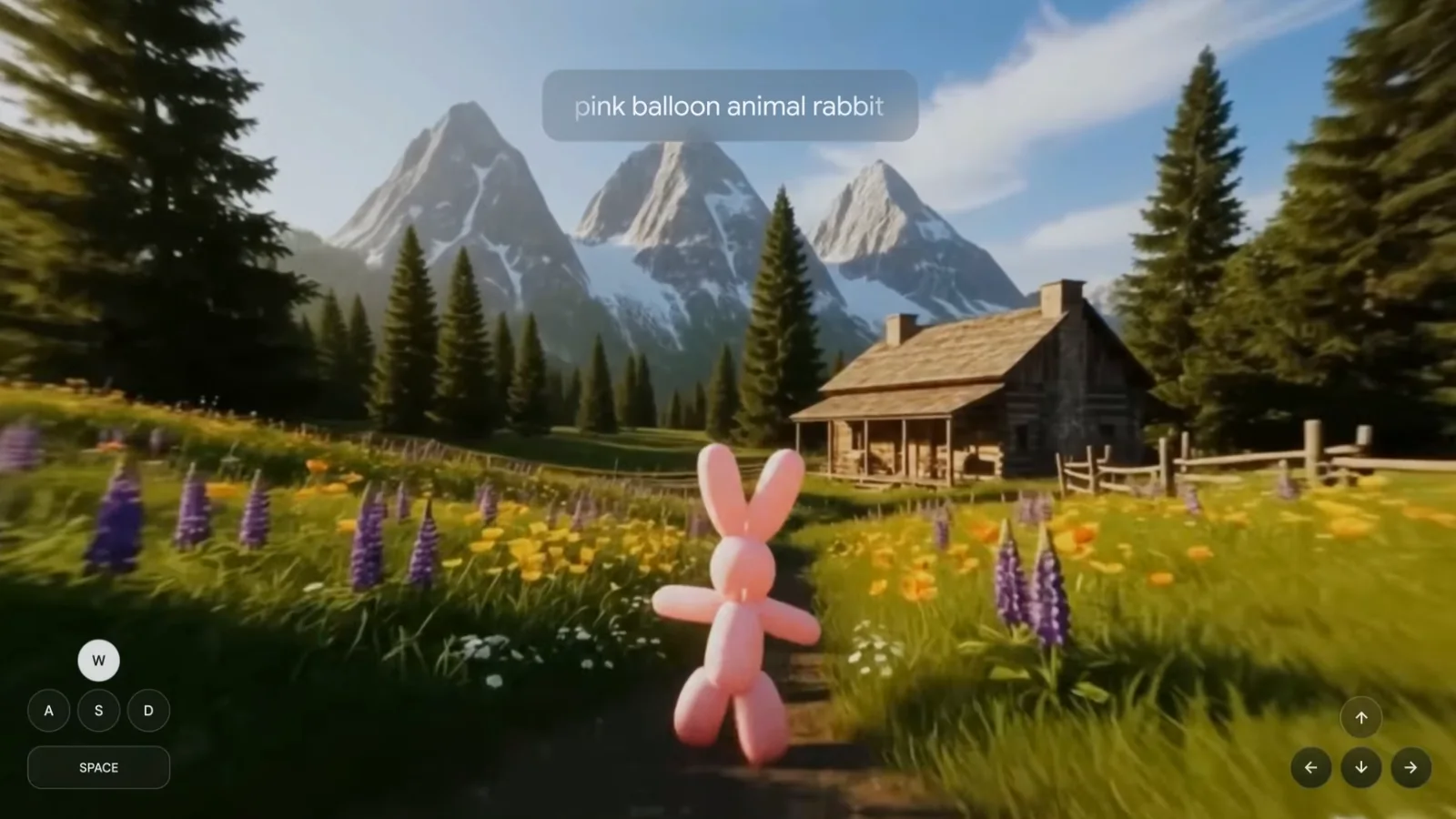
Genie 4 Generates Interactive Worlds With Audio and Dialogue
One of Genie 4’s major advances is its ability to generate sound alongside visual environments. Google describes it as its first real-time world model with native audio generation, allowing simulations to produce ambient sounds, music and interactive dialogue as part of the same experience.
Environmental audio changes to reflect the simulated surroundings, including effects such as wind moving through trees or waves breaking along a coastline.
The model also introduces characters capable of responding to events and user input through dynamically generated speech. Rather than relying entirely on predetermined dialogue sequences, characters can converse and react as situations develop.
Google says Genie 4 improves photorealism, fluid movement and the simulation of physical interactions, including collisions and aerodynamics. Human characters are another focus, with the company demonstrating people moving through environments and responding to changes in real time.
Users can control navigation and camera movement through standard keyboard inputs. Natural-language prompts provide additional control over the simulation itself, including changing weather conditions, repositioning the camera or introducing new objects and characters.
For example, a user could begin exploring an outdoor environment and then instruct the model to change the weather or add another character without restarting the experience. Google’s Gemini models interpret those instructions in the context of the existing scene.
Google Is Testing Genie 4 for Game Development
The gaming application is particularly significant because Google has confirmed that game developers and creative technologists are already experimenting with Genie 4.
According to Google DeepMind’s announcement, testers can turn initial ideas into explorable interactive prototypes within seconds, using natural-language prompts to experiment with visual styles, material appearances and interactive mechanics before implementing them in a conventional game engine.
This approach could help developers evaluate early creative concepts without first constructing detailed environments, programming interactions or producing all the assets required for a traditional prototype.
A developer exploring an environmental concept, for instance, could test different visual materials and scene layouts through prompts before deciding how to implement the idea in a game engine.
However, Google has not demonstrated that Genie 4 can produce complete, production-ready games or replace the development pipelines used for commercial releases. Its currently documented gaming application is primarily early-stage experimentation and interactive concept design.
The announcement arrives as established game developers are also exploring other applications of AI. Capcom, for example, is developing its REX project to introduce AI-assisted capabilities into RE Engine, including development and testing workflows.
Genie 4 takes a different approach by generating interactive simulated environments directly, rather than focusing primarily on improving tools within an existing engine.
Gemini Models Help Keep Simulations Consistent
Genie 4 combines its world-generation capabilities with several models from Google’s Gemini family.
Gemini Omni helps ground generated environments in real-world appearance and behavior, while other Gemini systems provide reasoning intended to maintain continuity as events unfold.
Google specifically identifies Gemini 3.8 Flash as a guiding agent that can continuously observe a running simulation, divide objectives into individual steps and evaluate incoming frames to determine whether those steps have succeeded.
When the environment changes or a user intervenes, the system can adjust its plan in response.
This combination is designed to support more complicated interactions involving multiple actions and cause-and-effect relationships.
Google is also investigating hybrid world models that combine structured reasoning with pixel-level simulation. The goal is to improve how generated environments maintain logical relationships while responding to unpredictable user actions.
Genie 4 Still Has Important Limitations
Despite the improvements, Google acknowledges that Genie 4 remains an experimental technology with significant limitations.
The model can maintain coherent environments during relatively short sessions, but visual details and object permanence can deteriorate as simulations continue.
Objects may change appearance or become inconsistent after extended interactions, particularly when users make multiple complicated modifications or move extensively through an environment.
Google also identifies several areas requiring further development, including complex physics, spatial accuracy, real-time audio precision, readable text and long-term environmental consistency.
These limitations matter for game development because persistent world states, predictable interactions and reliable physics are important requirements for conventional gameplay systems.
Consequently, Genie 4’s ability to generate convincing interactive demonstrations does not establish that it can maintain the consistency needed for lengthy games or complex production environments.
Google has also confirmed that generated video and audio will incorporate SynthID, its digital watermarking technology for identifying AI-generated content.
Genie 4 Availability and Project Genie Access
Genie 4 is currently available only to a limited group of trusted research testers.
Google plans to expand access to Google AI Ultra subscribers through Project Genie, its experimental interactive-world creation platform. Early-access developer integrations are also planned through the Gemini API and Google AI Studio.
A waitlist is available for users interested in accessing Genie 4 through Project Genie, although Google has not announced a specific date for general availability.
For game developers, the immediate opportunity is faster experimentation with interactive concepts rather than a complete alternative to existing engines.
Whether Genie 4 becomes a practical component of mainstream game-development workflows will depend on improvements to simulation consistency, controllability and the reliability of interactions over longer sessions.
