


TUXEDO Computers has introduced the Nano Pro Gen15, a compact Linux mini PC powered by Intel’s Panther Lake Core Ultra X7 358H processor and Arc B390 integrated graphics. Announced on October 29, 2026, the new model replaces the previous AMD-based generation and targets users looking for a small desktop capable of productivity, software development, local AI workloads and lightweight gaming.
The Nano Pro Gen15 is available for preorder, with shipments expected to begin in mid-November 2026. Pricing starts at approximately €1,749 in Germany, including 19% VAT, for a configuration with 16GB of DDR5 memory, a 500GB SSD and TUXEDO OS preinstalled. The equivalent price before taxes is approximately €1,470, excluding shipping.
At the center of the system is Intel’s Core Ultra X7 358H, a 16-core Panther Lake processor featuring four Performance cores, eight Efficient cores and four Low Power Efficient cores. The CPU reaches a maximum clock speed of 4.8GHz and includes 18MB of L3 cache.
Graphics are handled by Intel’s integrated Arc B390 GPU, which features 12 Xe3 graphics cores and operates at up to 2.5GHz. Unlike a conventional gaming desktop, the Nano Pro Gen15 does not require a dedicated graphics card for its intended workloads.
TUXEDO explicitly positions the Arc B390 as suitable for casual gaming under Linux. The manufacturer claims that older games and less demanding modern titles can run at Full HD resolution or higher with relatively high graphics settings. More demanding games may require reduced resolutions, lower visual settings or upscaling.
These are manufacturer performance claims rather than independently verified gaming benchmarks. Actual performance will depend on the game, memory configuration, graphics settings and the thermal limitations of the compact chassis.
The Arc B390 also reflects Intel’s continued expansion of integrated graphics capabilities across compact computers and gaming handhelds. The company has been developing additional graphics configurations for portable gaming devices, including the Intel Arc G3 Extreme graphics confirmed for the GPD Win Mini Ultra.
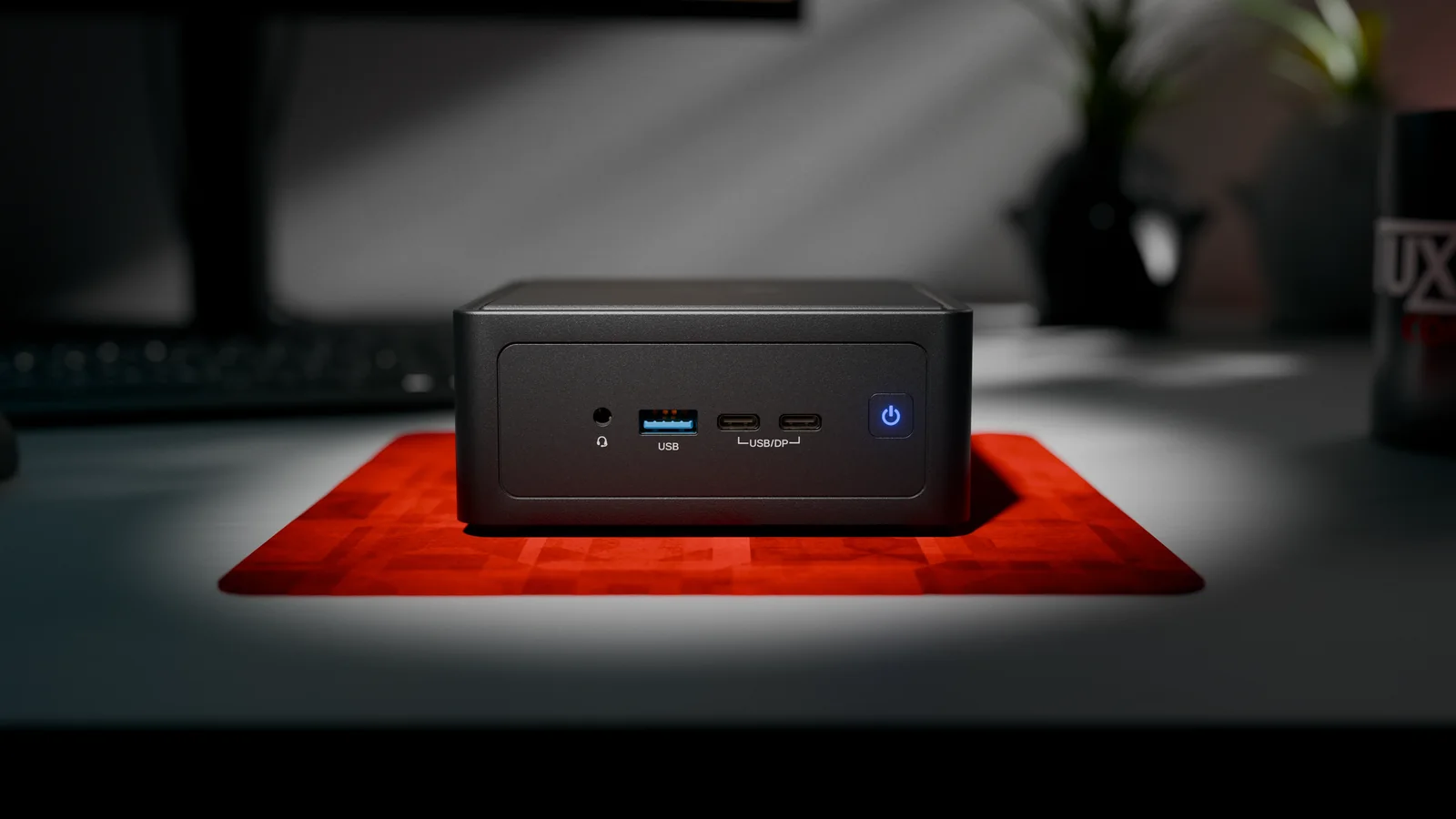
Despite its small dimensions, the Nano Pro Gen15 retains replaceable memory and storage. It measures just 110 × 117.5 × 49mm and weighs approximately 1kg, depending on configuration. The plastic chassis includes a VESA mounting bracket, allowing the computer to be installed behind a compatible monitor.
Internally, TUXEDO provides two DDR5 SO-DIMM slots supporting dual-channel memory with advertised speeds up to DDR5-7200 and a maximum capacity of 128GB. The manufacturer recommends installing matching memory modules to obtain optimal performance, particularly for the integrated GPU.
Storage expansion is handled through two M.2 slots. The primary slot accepts M.2 2242 or 2280 NVMe SSDs using PCIe 5.0 x4, while the secondary slot supports M.2 2242 drives over PCIe 4.0 x4. Both slots are accessible by removing four screws from the underside of the computer, alongside the replaceable wireless networking module.
Connectivity includes a front-facing USB4 Type-C port with DisplayPort 2.1 support, another USB-C port offering USB 3.2 Gen 2×2 and DisplayPort 1.4a, and three USB-A 3.2 Gen 2 ports distributed across the front and rear panels. A combined 3.5mm audio jack is also provided.
Wireless connectivity consists of Intel Wi-Fi 7 and Bluetooth 6.0. Two 2.5Gbps Ethernet connections are included for wired networking, making the mini PC suitable for home lab environments and small server installations alongside conventional desktop use.
The Nano Pro Gen15 can drive up to four displays simultaneously through its two HDMI outputs and two USB-C display connections. However, TUXEDO lists an important difference between operating systems.
Under Windows, the HDMI outputs support HDMI 2.1 operation at up to 4K resolution and 120Hz. Under Linux, the manufacturer currently specifies HDMI 2.0b functionality, limiting those connections to 4K at 60Hz. This restriction is particularly relevant to Linux users planning to connect the mini PC to high-refresh-rate 4K monitors or televisions.
TUXEDO offers the system with its Ubuntu-based TUXEDO OS or Ubuntu itself. The manufacturer states that Intel’s integrated graphics drivers are supported through the Linux kernel and Mesa graphics stack, reducing the need for manual driver installation. Windows is also available as an optional operating system.
The computer ships with a 120W external power adapter, although that rating should not be interpreted as the processor’s sustained power consumption. TUXEDO has not provided independently verified gaming performance or sustained thermal benchmarks for the new chassis.
With upgradeable DDR5 memory, two NVMe storage slots and Arc B390 graphics, the Nano Pro Gen15 offers an alternative to larger desktop systems for Linux enthusiasts who want occasional PC gaming alongside development and everyday computing. Its relatively high starting price and Linux HDMI refresh-rate limitation remain important considerations for buyers evaluating the new mini PC.
