


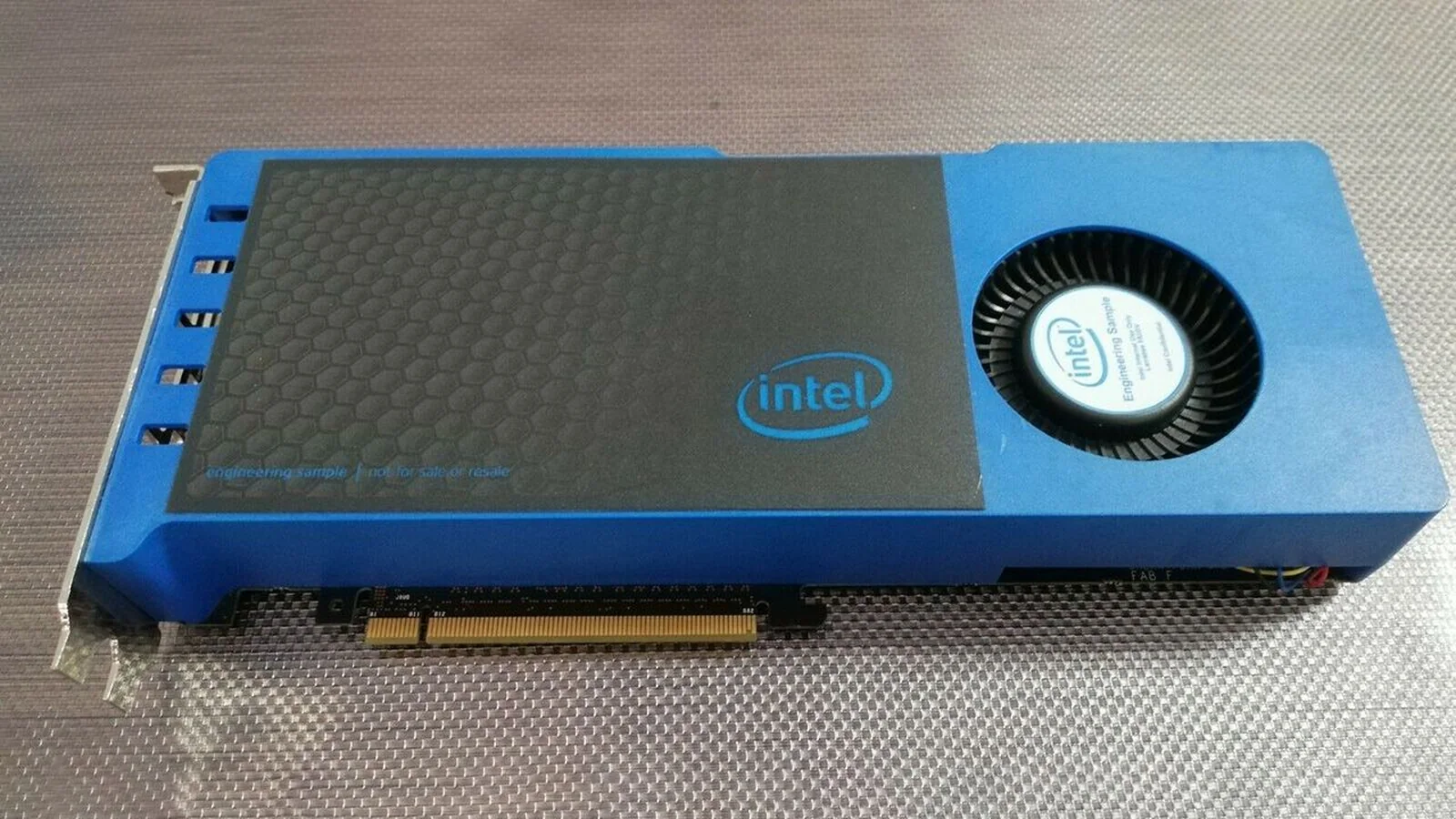
A rare prototype of Intel’s cancelled Larrabee graphics processor has reportedly been brought back into operation using recovered development drivers, allowing the experimental GPU to run Crysis with hardware-accelerated 3D graphics. The discovery provides an unusual look at Intel’s abandoned attempt to compete directly with NVIDIA and AMD in the consumer graphics market more than 15 years ago.
Reddit user pkellythompson discovered the prototype inside equipment purchased at a storage-unit auction. The system was subsequently identified as an Intel Visual Adrenaline development platform containing a C0-stepping Larrabee engineering sample, an Intel DX58SO motherboard and a separate diagnostic board.
More importantly, the recovered equipment included two USB drives containing Intel’s original graphics drivers, development utilities and technical documentation. These files reportedly made it possible to restore Direct3D acceleration on hardware that never reached commercial production.
The owner demonstrated the original Crysis running at 1280×720 resolution with Medium graphics settings and antialiasing disabled. Initial testing reportedly produced more than 17 frames per second, while switching to another recovered driver increased the displayed frame rate to approximately 36 FPS.
These results are based on the owner’s demonstrations and screenshots rather than independently verified benchmark testing. It remains unclear whether the reported frame rates represent sustained performance or individual moments during gameplay.
The recovered system initially presented several technical obstacles. The Larrabee card reportedly failed to produce an image through HDMI but worked when connected to a display using DVI.
The development computer also required adjustments to its motherboard BIOS configuration before Windows 7 could boot. A depleted CMOS battery had reset the storage controller settings, and changing the controller from AHCI to IDE mode resolved the startup problem.
Once the operating system was running, the original development software enabled the prototype to be recognized and used for hardware-accelerated Direct3D applications.
The two recovered software archives, measuring approximately 82 MB and 728 MB, contain drivers, documentation, development tools and instructions for updating the graphics card’s video BIOS. The files have reportedly been preserved on the Internet Archive, potentially allowing researchers and collectors with compatible Larrabee hardware to investigate the abandoned architecture.
Intel first publicly detailed Larrabee in 2008 as an alternative approach to graphics processing. Rather than following the conventional GPU designs used by NVIDIA and AMD, Larrabee combined multiple relatively simple x86-based processor cores with wide vector processing units.
Much of the graphics pipeline was intended to run through programmable software, although the architecture also incorporated dedicated texture-processing hardware. This approach offered considerable flexibility but placed substantial importance on software development and optimization.
Intel abandoned plans to launch Larrabee as a consumer graphics product in December 2009 after development delays and difficulties achieving competitive performance. Elements of the underlying many-core technology subsequently contributed to Intel’s Xeon Phi accelerator family, which targeted high-performance computing rather than consumer gaming.
The company eventually returned to dedicated gaming graphics with its Intel Arc lineup, using a substantially different GPU architecture. Modern Arc hardware continues to attract experimentation, including efforts to run AMD FSR 4.1.2 on Intel Arc GPUs through XMX acceleration.
The recovered Larrabee prototype is particularly significant because surviving hardware alone cannot demonstrate how Intel’s original graphics software performed. Working drivers make it possible to examine the interaction between the architecture and the rendering pipeline using actual PC games.
Although the reported Crysis performance falls well short of what would have been expected from a competitive gaming GPU, the substantial difference between the two recovered driver versions illustrates how software optimization affected the experimental hardware.
No comprehensive independent performance evaluation has yet been established from the reported results. Nevertheless, the recovered development software and working game demonstrations provide new evidence of how far Intel’s original Larrabee project progressed before its cancellation.
