


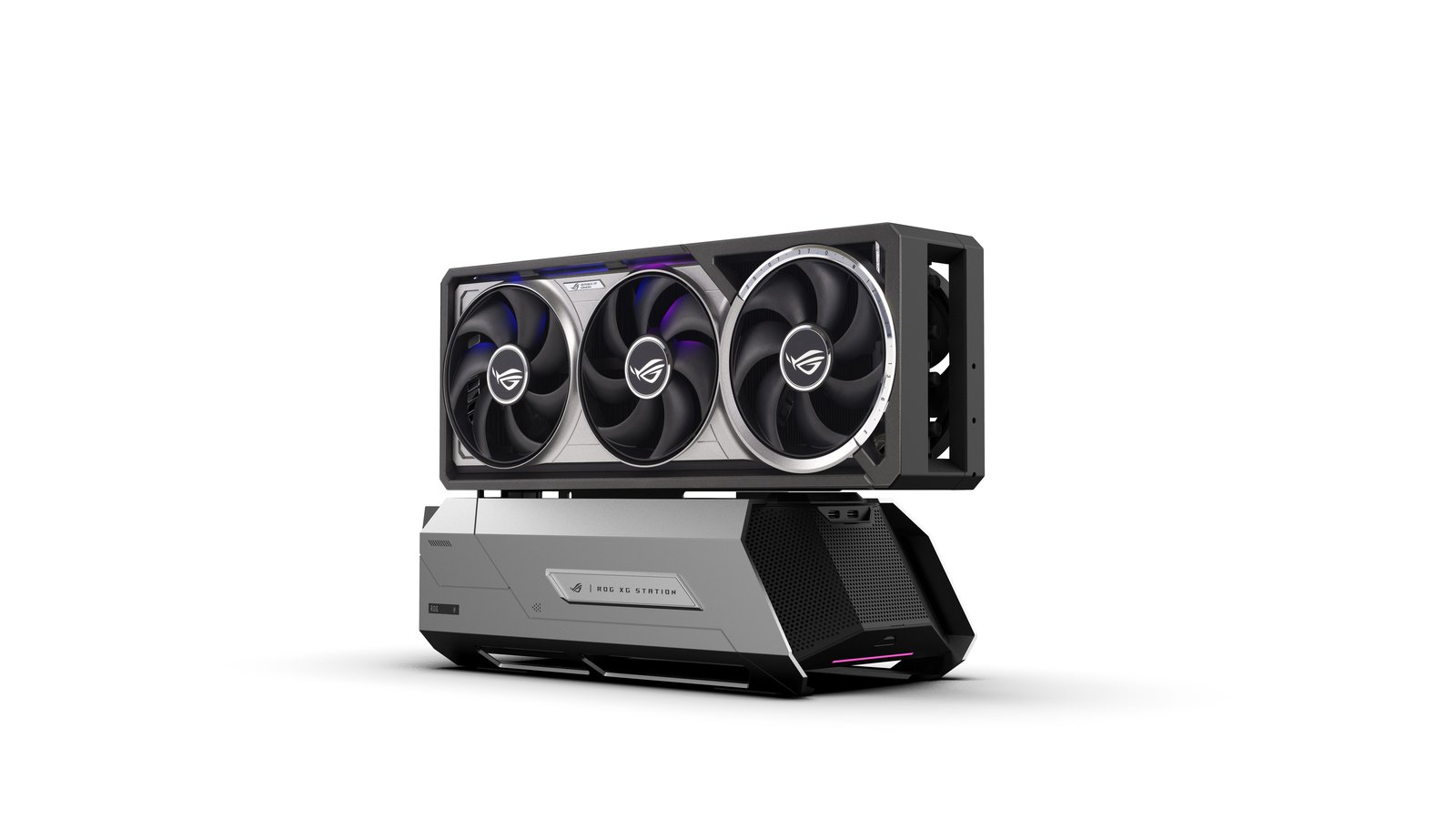
ASUS Republic of Gamers has announced detailed specifications for the ROG XG Station 3, an external graphics card dock that allows compatible Thunderbolt 5 laptops to use desktop GPUs. The dock supports NVIDIA GeForce RTX 50 Series, AMD Radeon RX 9000 Series and Intel Arc graphics cards, offering up to 80Gbps of bidirectional bandwidth through Thunderbolt 5, with a maximum of 120Gbps available through Bandwidth Boost.
The specifications were detailed in an official ASUS press release published on November 4, 2026, following the product’s earlier appearance at Computex 2025. The announcement confirms support for ASUS BTF 2.5 cable-free graphics cards, up to 140W laptop charging, additional Thunderbolt 5 connectivity and an open-frame design intended to accommodate high-performance desktop GPUs.
The ROG XG Station 3 is designed for laptop owners who want access to more powerful graphics hardware without replacing their entire computer. Users can install a supported desktop graphics card in the external enclosure and connect it to a compatible laptop through a single Thunderbolt 5 cable.

Thunderbolt 5 provides the main connection between the laptop and external GPU. Its standard 80Gbps bidirectional bandwidth is twice that of Thunderbolt 4, while Bandwidth Boost can increase bandwidth in one direction to 120Gbps for demanding display and video workloads.
However, these figures represent the Thunderbolt interface’s capabilities rather than guaranteed gaming performance. An external GPU must communicate with the laptop over the Thunderbolt connection, which can introduce bandwidth limitations compared with installing the same graphics card directly in a desktop motherboard. Actual performance will depend on the graphics card, laptop, game and workload.
ASUS has confirmed compatibility with graphics cards from NVIDIA’s GeForce RTX 50 Series and RTX PRO 6000 Series, AMD’s Radeon RX 9000 Series and Intel’s Arc lineup. This gives users several GPU options across gaming and professional workloads.
For Radeon buyers, the dock arrives amid reports of potential Radeon GPU price increases in November 2026, which could affect the overall cost of building an external graphics setup.
One of the XG Station 3’s distinguishing features is support for ASUS BTF 2.5 graphics cards. The dock includes a GC-HPWR connector that allows compatible graphics cards to receive power without conventional visible PCIe power cables.
ASUS specifically identifies the TUF Gaming GeForce RTX 5080 BTF OC Edition and ROG Astral GeForce RTX 5090 BTF Edition as supported examples. Standard graphics cards can also be installed, although their traditional PCIe power cables will remain visible.
The enclosure uses an open-frame construction rather than a fully enclosed chassis. This exposes the installed graphics card and gives its cooling system unobstructed access to surrounding air. ASUS has also incorporated metallic exterior elements and Aura Sync RGB lighting for integration with compatible gaming peripherals.
Beyond graphics acceleration, the ROG XG Station 3 functions as a laptop connectivity hub.
Its primary Thunderbolt 5 connection supports up to 140W USB Power Delivery, allowing compatible laptops to receive power while connected to the external GPU. Whether this is sufficient to replace a laptop’s original power adapter will depend on that laptop’s charging requirements.
A separate downstream Thunderbolt 5 port supports up to 36W USB Power Delivery for connected devices. ASUS says this connection can also support up to three daisy-chained 4K displays, providing additional monitor connectivity beyond the physical display outputs on the installed graphics card.
Two front-facing USB-C ports, each supporting 10Gbps data transfer, provide connections for peripherals such as gaming accessories and external storage.
The ability to use modern desktop GPUs also gives compatible laptops access to the graphics features supported by those cards. For example, NVIDIA’s RTX 50 Series supports technologies including DLSS 5 neural rendering, which is scheduled to reach additional PC games throughout November.
ASUS positions the XG Station 3 as an upgrade option for users who want to retain a portable laptop while accessing more powerful graphics hardware at a desk. Its modular design also allows users to replace the installed graphics card without purchasing an entirely new computer, provided the replacement remains compatible with the dock.
The November announcement establishes the dock’s connectivity features and supported GPU families, but ASUS has not provided confirmed retail pricing or a specific availability date in its press release. Independent gaming benchmarks will also be needed to determine how closely different graphics cards approach their desktop performance when connected through Thunderbolt 5.
