


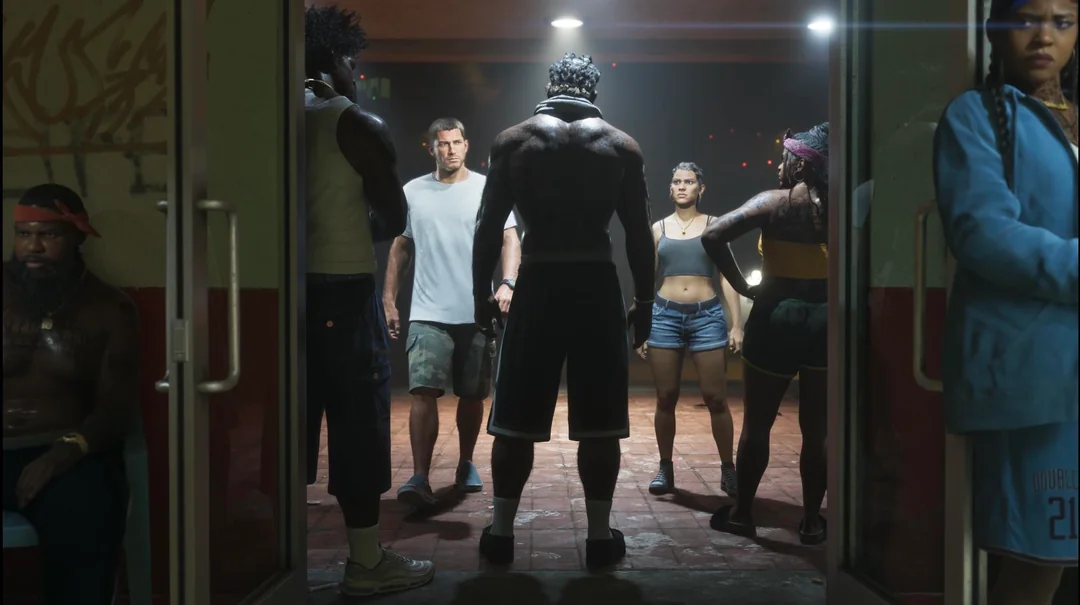
Grand Theft Auto VI will make both pedestrians and police more reactive to player behavior, with Rockstar North confirming that NPCs will no longer simply flee whenever Jason or Lucia causes trouble.
Rockstar North’s Rob Nelson discussed the changes in a new interview with IGN, explaining that GTA VI is designed to make the surrounding world feel less passive than in earlier Grand Theft Auto games. In previous entries, most civilians would panic and run once the player became violent, while police provided the main organized resistance.
Nelson said that will not always be the case in GTA VI. Some NPCs may still try to escape, but others can stand their ground or escalate an altercation depending on what is happening around them.
That means ordinary encounters could become less predictable. Starting a confrontation with someone on the street will not necessarily produce the same reaction every time, and players may have to consider how nearby characters respond instead of assuming they are harmless background figures.
Rockstar is also expanding the way police respond to crimes.
According to details from Nelson’s interview, GTA VI introduces Criminal Profiles that can give law enforcement information about a suspect after a crime has been witnessed. Police may receive descriptions covering the player’s appearance, clothing, vehicle and whether Jason and Lucia were seen operating together.
That creates more ways for the wanted system to persist beyond the initial crime scene. Escaping the immediate area may not always be enough if police already know what the suspect looks like or what vehicle they were using.
Players can potentially respond by changing clothing or switching vehicles, while Jason and Lucia can separate after committing a crime together in an attempt to make it harder for police to track both of them.
The system appears designed to make police encounters feel more like investigations rather than simply spawning officers near the player once a wanted level begins.
That is a significant change from GTA V, where losing the police is primarily based on breaking line of sight and remaining outside the search area until the wanted level expires. GTA VI appears to layer additional information on top of that familiar structure.
Nelson also said the physical design of Vice City contributes to the challenge. Streets are narrower and traffic is denser than in previous GTA games, which can make high-speed escapes more demanding.
The new Extended Look released on August 27 supports that direction. Rockstar showed several police pursuits through crowded streets, along with sequences where vehicles move through tight urban spaces rather than the wider roads commonly found across large parts of Los Santos.
NPC behavior is part of Rockstar’s broader effort to make Leonida feel more believable. The studio has repeatedly emphasized increased population density and greater variation between people throughout the world.
Rather than relying entirely on pedestrians as scenery, GTA VI appears to give them more ways to respond to what Jason and Lucia are doing nearby.
The increased reactivity also fits with other systems Rockstar has shown in the Extended Look, including more detailed character interactions, open-world activities and environmental behavior across Vice City and the wider state of Leonida.
Rockstar has not yet detailed every possible NPC response or exactly how long police descriptions remain active, so it is unclear how persistent Criminal Profiles will be during normal gameplay.
Still, Nelson’s comments provide one of the clearest explanations so far of how GTA VI intends to make its open world respond more convincingly to player actions.
Grand Theft Auto VI launches November 19, 2026 for PlayStation 5 and Xbox Series X|S.
With civilians capable of reacting more aggressively and police tracking more than a simple wanted level, GTA VI’s law-enforcement and NPC systems appear to be moving toward a more dynamic version of Rockstar’s traditional open-world formula.
