


Ashes of the Singularity 2 is proving demanding at higher resolutions, with new PC GPU benchmarks showing that powerful Nvidia GeForce and AMD Radeon graphics cards are needed to maintain playable frame rates at 1440p and 4K. The real-time strategy sequel also launches without Nvidia DLSS, AMD FSR, Intel XeSS or modern frame generation technologies, leaving players with fewer options to improve performance.
Independent testing published by German hardware publication ComputerBase on November 11, 2026, identifies the GeForce RTX 5070, RTX 4070 Ti, Radeon RX 9070 GRE and RX 7900 GRE among the graphics cards capable of meeting its 45 FPS benchmark threshold at 2560 × 1440. At 3840 × 2160, the hardware requirements increase to GPUs including the RTX 5070 Ti, RTX 4090 and RX 7900 XTX.
The findings provide an early indication of how Oxide Games’ large-scale strategy sequel performs across modern PC hardware following its November 10 release.
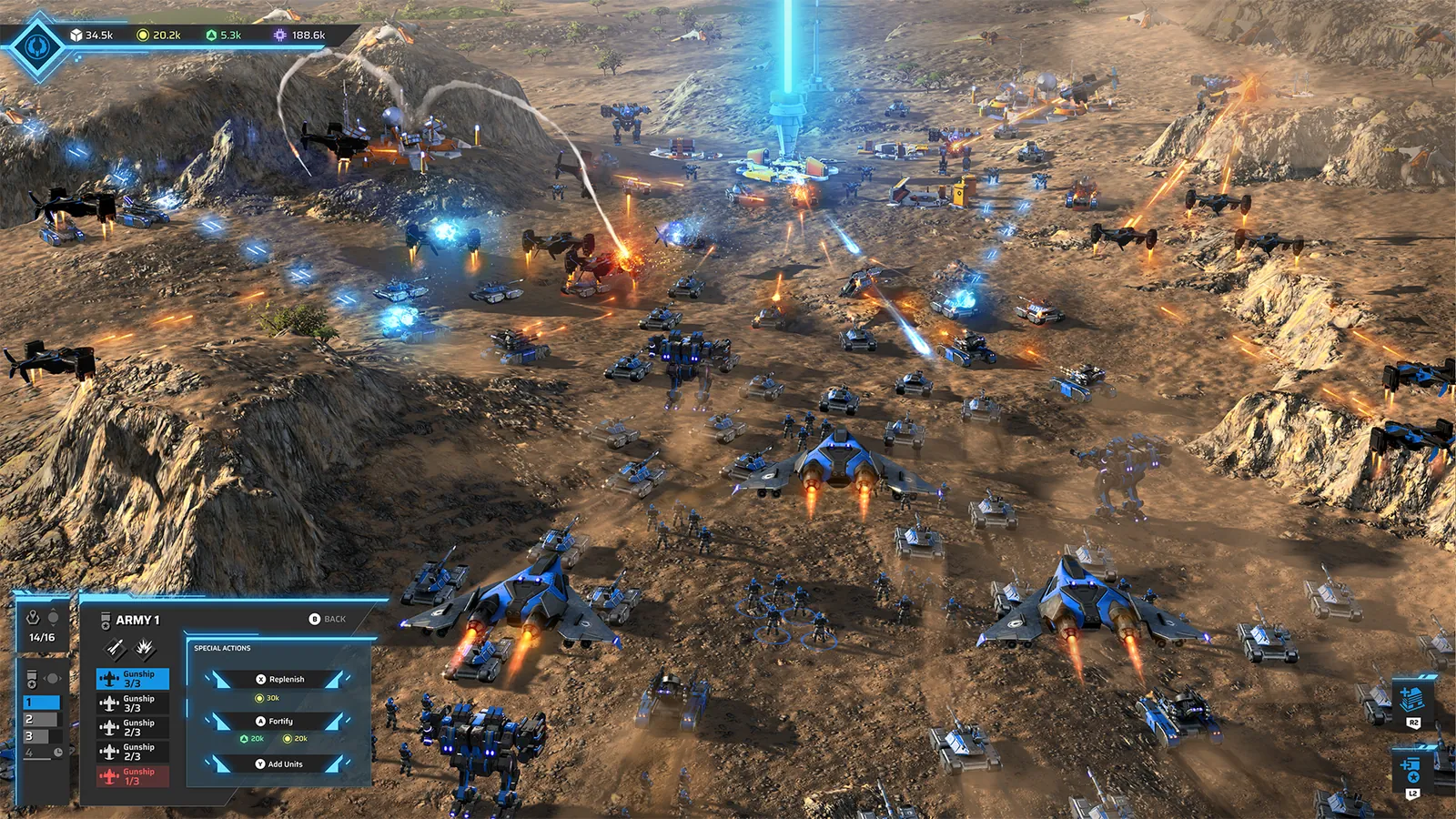
Ashes of the Singularity 2 runs on the Nitrous 3 engine and uses DirectX 12, continuing the original game’s emphasis on rendering large numbers of combat units simultaneously. The first Ashes of the Singularity became particularly well known for its DirectX 12 performance testing, making the sequel’s graphics requirements especially relevant to PC hardware enthusiasts.
Unlike many recent PC releases, however, the sequel does not provide modern temporal upscaling technologies to help graphics cards handle demanding resolutions.
ComputerBase’s technical analysis confirms that the game relies on multisample anti-aliasing (MSAA) rather than temporal anti-aliasing. As a result, players cannot use DLSS Super Resolution, FSR upscaling or XeSS Super Resolution to render the game internally at a lower resolution and reconstruct the image for higher-resolution displays.
Frame generation is also absent across Nvidia, AMD and Intel technologies. The game does not offer dynamic resolution scaling or its own internal upscaling system.
These omissions are significant because players cannot rely on the performance-enhancing features available in many modern PC games. For comparison, Anno 117's support for DLSS, FSR and frame generation demonstrates the broader range of graphics options available in another contemporary strategy title.
ComputerBase also identifies potential image-quality limitations associated with the game’s anti-aliasing implementation, noting that image stability could be better even at Ultra HD resolutions.
The publication’s 45 FPS benchmark threshold provides a useful reference for comparing graphics cards, although it should not be interpreted as a universal minimum requirement. Actual performance depends on the selected graphics preset, resolution, battle complexity and hardware configuration.
For players targeting 1440p, the results suggest that relatively powerful midrange and previous-generation high-end GPUs are needed to reach the publication’s performance target under its test conditions.
At 4K, the hardware demands are more substantial. ComputerBase identifies the RTX 5070 Ti, RTX 4090 and RX 7900 XTX as capable of reaching its 45 FPS threshold, indicating that moving to Ultra HD can place considerable pressure on GPU performance.
Separate testing by Notebookcheck illustrates the demands at different settings and hardware levels. In a demanding battle, a laptop GeForce RTX 5090 delivered approximately 46 FPS at 4K using the Extreme preset. A laptop RTX 3060 achieved 50 FPS at 1080p Medium and 40 FPS at 1080p High in another test scenario. These laptop results should not be compared directly with ComputerBase’s desktop GPU findings because the systems and testing conditions differ.
Intel Arc users may also encounter graphics compatibility problems. PC Games Hardware found substantial rendering corruption at maximum graphics settings on Arc hardware, although switching the shading quality to Performance and restarting the game resolved the issue in its testing. Notebookcheck separately encountered missing textures and launch problems on Intel integrated graphics.
The graphics menu includes Extreme, High, Medium and Low presets, alongside individual options and an FPS limiter. However, ComputerBase found no integrated benchmark, native FPS counter or VRAM usage indicator.
The sequel also lacks proper 21:9 and 32:9 ultrawide display support. Although the corresponding resolutions can be selected, the game displays black bars instead of expanding the image across the entire screen.
Official system requirements are considerably lower than the hardware identified in the higher-resolution benchmarks. The minimum specifications include a Radeon RX 580 8GB or GeForce GTX 1660, alongside 8GB of RAM. The recommended requirements list a Radeon RX 6750 XT or GeForce RTX 3070 and 16GB of RAM.
Those specifications should not be confused with a guarantee of smooth 1440p or 4K performance. The independent results show that considerably stronger graphics hardware may be necessary depending on the player’s target resolution and settings.
For PC gamers, the main limitation is the combination of demanding native-resolution rendering and the absence of modern upscaling tools. While improvements to AMD's FSR technology continue to expand upscaling capabilities across supported hardware, Ashes of the Singularity 2 currently offers no built-in access to those features.
Players experiencing low frame rates will therefore need to rely primarily on reducing graphical settings or display resolution rather than enabling DLSS, FSR, XeSS or frame generation. Oxide Games has not established a confirmed timeline for adding these technologies.
