


AMD has released FSR SDK 2.4, expanding its machine-learning upscaling technology to Radeon RX 6000 graphics cards and selected Ryzen processors while introducing Vulkan support for modern FSR upscaling and frame generation. The update, announced on October 28, 2026, also includes improvements to frame pacing on Radeon RX 9000 GPUs.
According to AMD’s official GPUOpen announcement, the new SDK brings FSR Upscaling 4.1.2 to Radeon RX 6000, RX 7000, and RX 9000 discrete graphics cards. The RX 6000 expansion is particularly significant because these RDNA 2 GPUs can now use AMD’s newer neural-network-based upscaling model through supported game integrations.
AMD previously expanded FSR 4.1 support to Radeon RX 7000 graphics cards in June 2026. Version 2.4 extends that compatibility another generation backward while delivering the previously outlined expansion of FSR 4 to Ryzen APUs, gaming laptops, and handhelds.
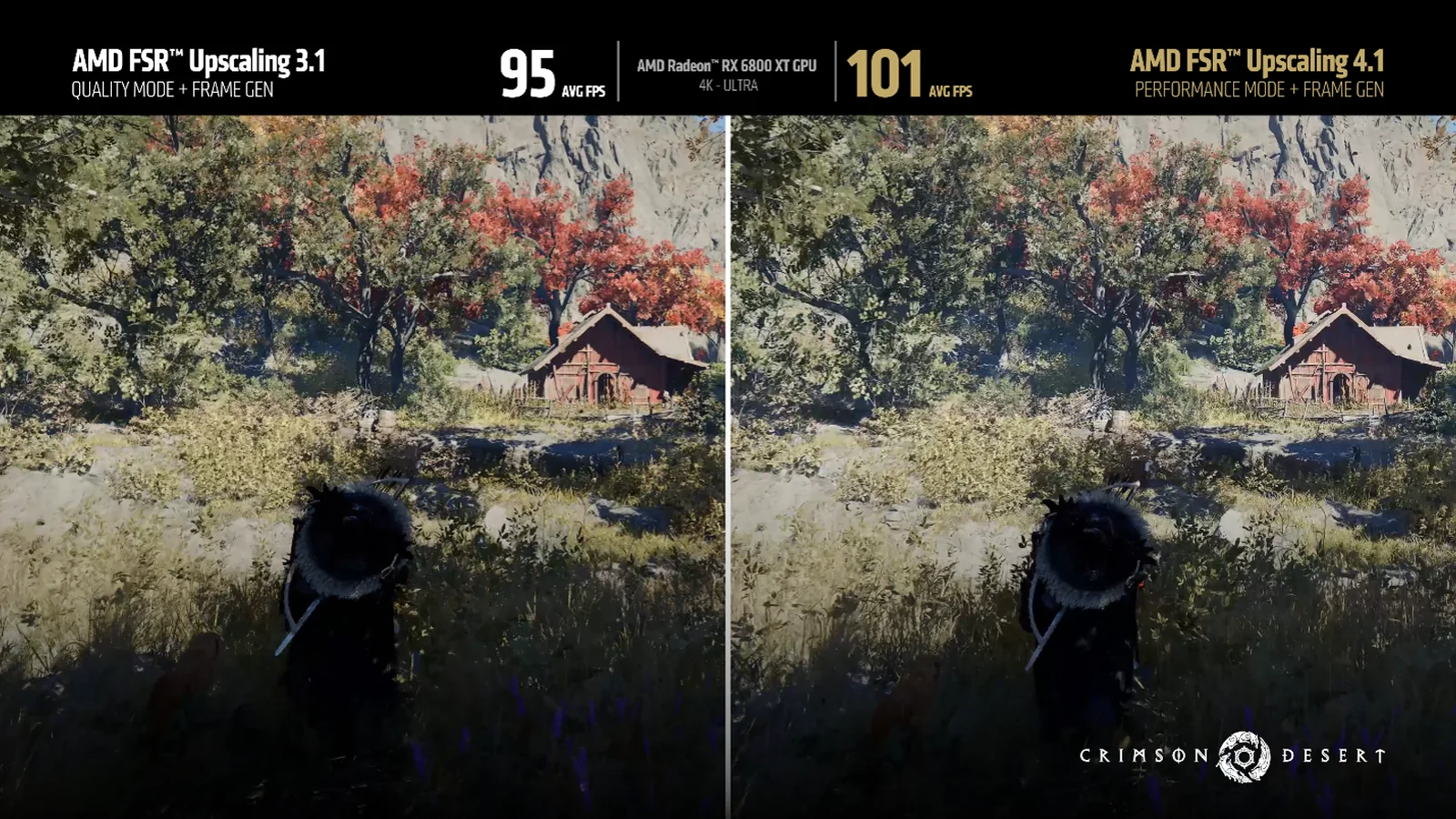
For Radeon RX 6000 cards, AMD uses the full INT8 version of its machine-learning model. The same model is supported on Ryzen AI Max 300 and 400 processors, which feature integrated Radeon 8000S graphics. Radeon RX 9000 GPUs continue using the FP8 model, while RX 7000 cards retain their full INT8 implementation.
The SDK also introduces a smaller INT8 model specifically optimized for integrated graphics with tighter performance and memory constraints. AMD says this model is less than half the size of the full INT8 version.
Processors receiving this lightweight implementation include Ryzen AI 9 300 and 400 series chips, Ryzen AI Z2 Extreme, Ryzen Z2 Extreme, and Ryzen Z2 A. These processors are used across gaming handhelds, laptops, and compact PCs.
AMD automatically selects the appropriate upscaling model depending on the supported hardware. However, the company notes that results can vary according to game settings, resolution, memory bandwidth, and device power limits.
One of the other major additions is Vulkan 1.2 support for FSR Upscaling and Frame Generation, bringing these features to functional parity with their DirectX 12 counterparts, apart from Intel PresentMon reporting.
FSR SDK 2.4 includes Vulkan implementations of FSR Upscaling 4.1.2, FSR Frame Generation 4.0.2, FSR Frame Generation Swapchain 4.0.0, and the corresponding analytical FSR 3.1 upscaling and frame generation technologies.
This expansion allows developers working with Vulkan to integrate AMD’s newer upscaling and frame generation effects directly into their games.
However, AMD makes an important distinction regarding existing Vulkan titles. Games currently using FSR 3.1 will not automatically receive machine-learning FSR Upscaling or Frame Generation through Radeon driver updates. Developers must integrate the newer SDK into their games first.
Once a Vulkan game includes FSR Upscaling 4.1.2 or the relevant newer frame generation implementations, it can become eligible for automatic future version upgrades through AMD Software: Adrenalin Edition.
The new SDK support also differs from unofficial experiments involving FSR 4.1.2 running on Intel Arc graphics through XMX acceleration. AMD’s release establishes official compatibility for additional Radeon GPUs and specific Ryzen processors, while older analytical FSR implementations remain available for other supported graphics hardware.
Beyond upscaling, FSR SDK 2.4 updates machine-learning frame generation to version 4.0.2 and introduces Driver-Assisted Frame Pacing through Frame Generation Swapchain 4.0.0.
This feature allows the Radeon display driver to manage final frame presentation timing rather than relying entirely on a user-mode timing mechanism. AMD says the approach can deliver smoother frame presentation while reducing CPU overhead.
Driver-Assisted Frame Pacing requires a Radeon RX 9000 series GPU or newer, AMD Software: Adrenalin Edition 26.10.1 or later, and a supported presentation configuration. Additional requirements include fullscreen or qualifying borderless fullscreen operation, disabled VSync, frame presentation within the display’s variable refresh rate range, and the appropriate swapchain implementation.
AMD recommends Windows 11 with Hardware-accelerated GPU Scheduling enabled for the validated configuration. Frame pacing falls back to the existing implementation when its requirements are not met.
The update also improves FSR Ray Regeneration 1.2.1 with standalone ambient occlusion and specular occlusion denoising. These machine-learning ray-tracing features remain limited to Radeon RX 9000 series GPUs and DirectX 12.
Developers using Unreal Engine should note that AMD’s current FSR plugin still ships with Upscaling 4.1.1 and Frame Generation 4.0.1. Updated plugin versions supporting the newer implementations are planned but have not yet been released.
For developers, the SDK provides the new Ryzen APU compatibility and Vulkan upscaling features through its included libraries without requiring a specific Radeon driver version. The newer driver requirement applies specifically to features such as Driver-Assisted Frame Pacing.
AMD FSR SDK 2.4 is available now through GPUOpen and GitHub, with binaries and limited source code provided for developers. Although the release expands the range of hardware capable of running machine-learning FSR upscaling, actual availability in individual games still depends on developer integration and supported rendering configurations.
