


Gears of War: E-Day can reduce system RAM usage by approximately 2GB when installed on an NVMe SSD, according to new independent testing published by Tom’s Hardware on November 14. The investigation also recorded storage streaming speeds reaching 3.7 GB/s, highlighting how heavily the game relies on fast storage to manage its detailed environments.
The results come from benchmarks conducted by Tom’s Hardware contributor Dan Mateescu, who examined the game’s storage activity, memory consumption, visual quality and performance across SATA and PCIe 3.0, 4.0 and 5.0 SSDs. The testing provides measurable evidence of how The Coalition’s asset-streaming technology works on PC, particularly for systems with limited RAM.
At 4K resolution with DLSS Quality enabled, the game reached a peak SSD read speed of 3.7 GB/s using its highest Ludicrous graphics preset. Average throughput was approximately 1.3 GB/s, indicating substantial sustained storage activity rather than occasional bursts during loading.
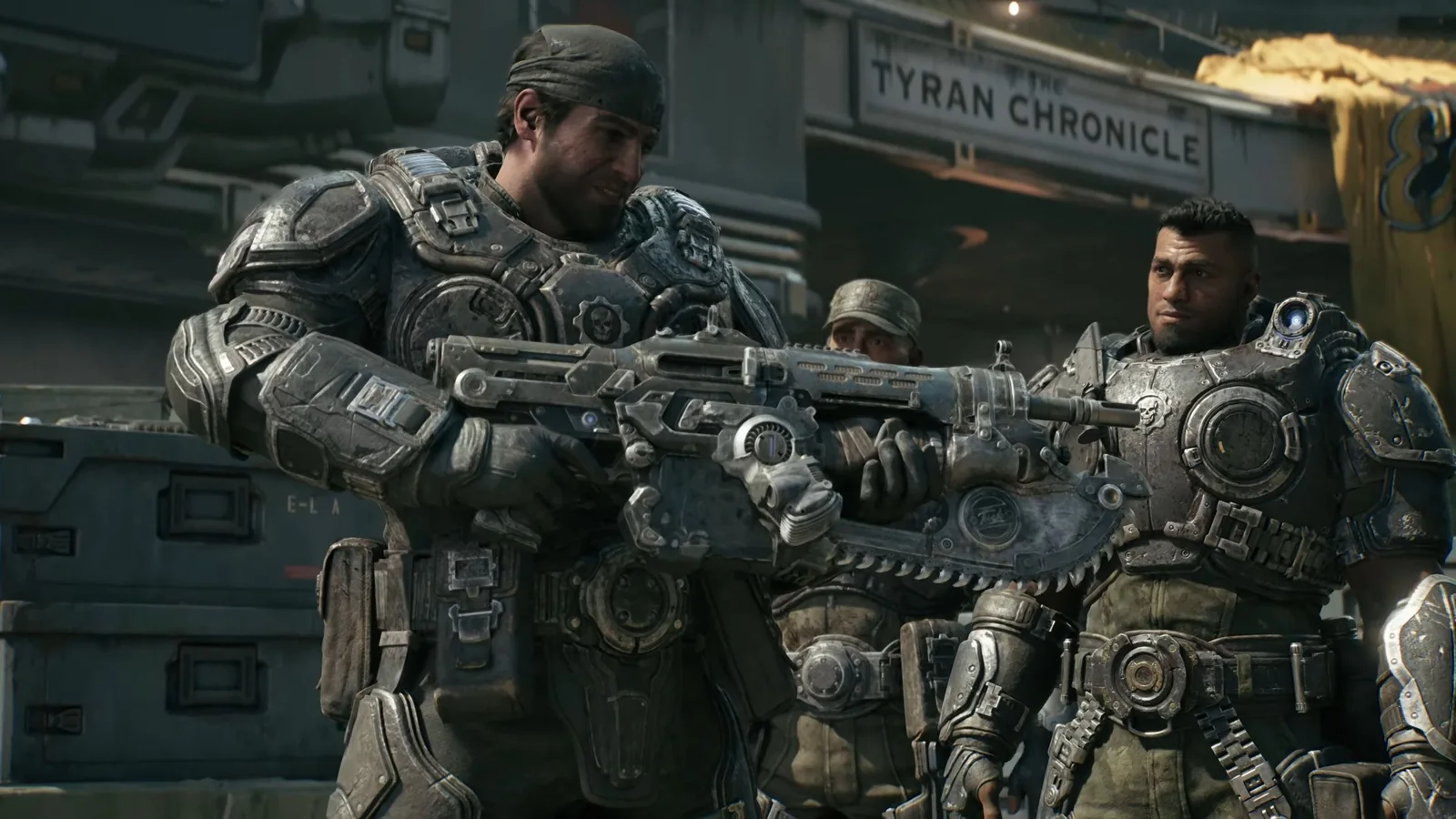
Reducing the graphics settings lowered storage demands. The Ultra preset recorded peaks of 2.8 GB/s and an average of 1.2 GB/s, while High reached 2.5 GB/s with an average of 1.05 GB/s. Even at Medium settings, peak throughput reached 1.5 GB/s.
These figures are unusually high compared with the outlet’s earlier gaming storage benchmarks. Its previous testing recorded average SSD bandwidth of up to 366 MB/s in Forspoken at maximum settings, considerably below the sustained activity measured in Gears of War: E-Day.
The Coalition previously explained the underlying technology during an interview with Digital Foundry. Originally developed to help the Xbox Series S handle the game’s memory-intensive environments, the system uses fast SSD storage to hold selected game data that would otherwise occupy system memory.
Rather than keeping all environmental assets in RAM, the game dynamically transfers data between storage and memory as needed. This allows detailed environments to be maintained without requiring every asset to remain resident in physical RAM.
The approach is particularly relevant to hardware with restricted memory capacity, including the Xbox Series S, which has 10GB of shared memory compared with 16GB on Xbox Series X.
Tom’s Hardware found that the same general approach provides measurable benefits on PC. Its high-end test system, equipped with an AMD Ryzen 7 9800X3D, GeForce RTX 5090 and 64GB of DDR5 memory, consumed approximately 2GB less system RAM when the game was installed on an NVMe SSD instead of a SATA drive.
Importantly, the memory savings were observed across PCIe 3.0, 4.0 and 5.0 NVMe SSDs. This suggests that players do not necessarily need the latest PCIe 5.0 storage hardware to benefit from the game’s memory-management system.
However, the difference between SATA and NVMe storage becomes noticeable in visual quality.
When running from a Samsung 870 EVO SATA SSD, the game exhibited delayed texture loading. Some environmental surfaces initially appeared at reduced detail, while lighting and shadow effects took additional time to render correctly.
The missing details eventually appeared, but the delayed asset streaming produced visible interruptions that were not observed in the same way with faster NVMe storage.
Interestingly, the high-end desktop showed no measurable frame-rate disadvantage when running the game from SATA storage, despite the visual degradation. This demonstrates that average FPS alone does not necessarily reveal storage-related problems.
The performance implications became more significant on a laptop equipped with an Intel Core i7-13620H, GeForce RTX 4060 Laptop GPU and 16GB of DDR5 RAM.
Comparing its PCIe 4.0 NVMe SSD with a SATA drive, Tom’s Hardware found that average frame rates remained largely unchanged. However, the NVMe configuration delivered better 1% low frame rates at higher graphics settings, indicating more consistent frame delivery and fewer noticeable performance dips.
This distinction matters for systems with smaller memory capacities. Although 16GB RAM remains a common gaming PC configuration, memory-intensive titles can place additional pressure on hardware when high-resolution textures and detailed environments are loaded.
The findings also demonstrate that upgrading storage can improve certain aspects of gaming performance without increasing the amount of installed RAM. However, the approximately 2GB memory reduction is specific to the tested game and configurations, rather than a universal benefit that applies to all PC games.
For Gears of War: E-Day, the clearest distinction is between SATA and NVMe storage. The benchmarks establish measurable advantages for NVMe drives in memory consumption, asset-loading quality and frame-time consistency on memory-limited hardware, without demonstrating that a PCIe 5.0 upgrade is necessary for those benefits.
