


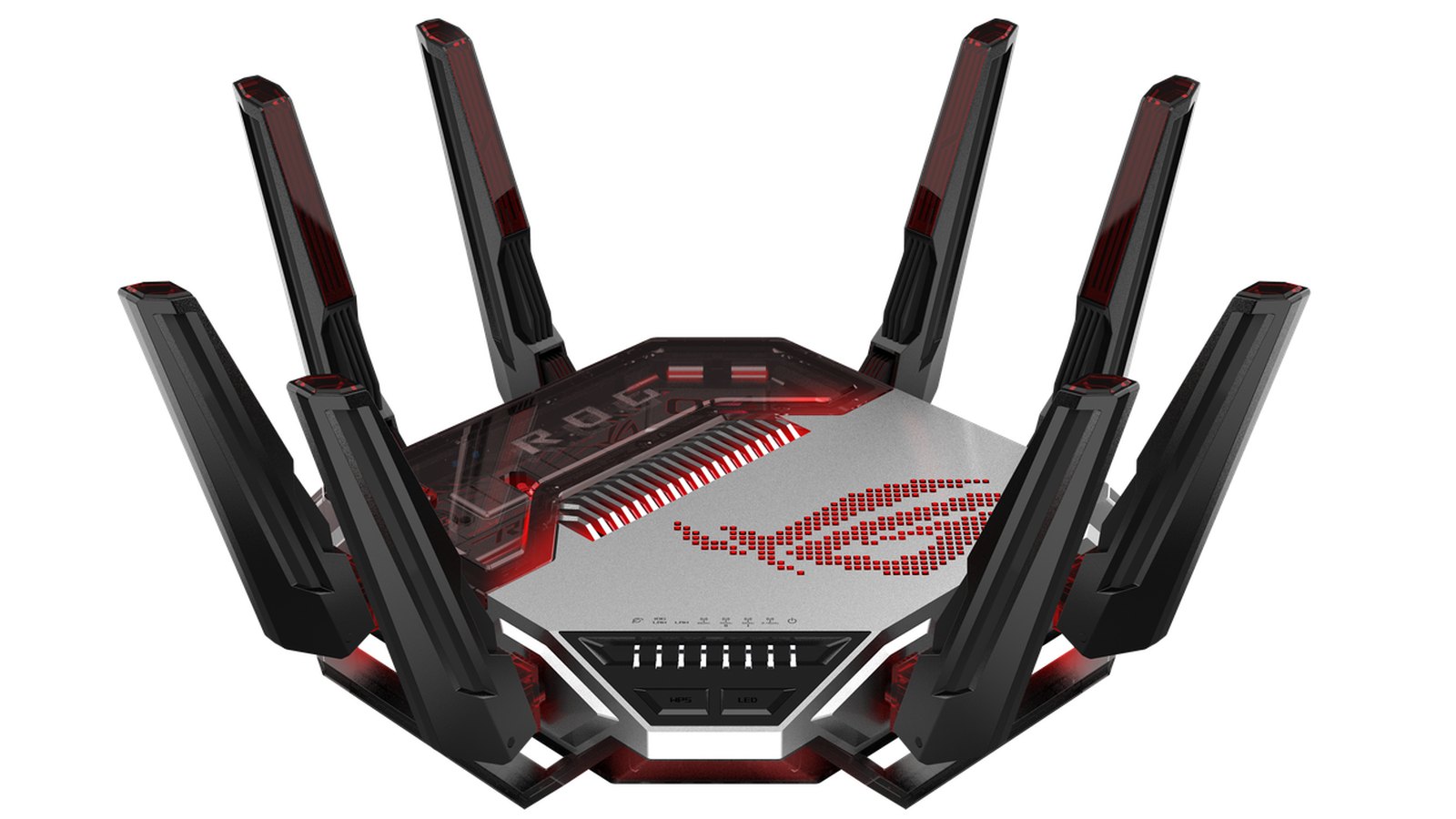
ASUS Republic of Gamers has begun shipping the ROG Rapture GT-BN98, its new quad-band Wi-Fi 8 gaming router. The flagship networking hardware supports aggregate wireless throughput of up to 25,000Mbps and combines Wi-Fi 8 features with dual 10Gb Ethernet, four 2.5Gb Ethernet connections and gaming-specific traffic management. ASUS announced the wider shipping rollout on October 6 following earlier availability in select markets.
The GT-BN98 uses the draft IEEE 802.11bn Wi-Fi 8 standard across four wireless bands. ASUS rates the 2.4GHz band at up to 1,376Mbps, each of its two 5GHz bands at up to 5,764Mbps and the 6GHz band at up to 11,529Mbps. The latter supports channels up to 320MHz wide, while the router also supports 4096-QAM and a 4×4 transmit-and-receive configuration across each band.
Wi-Fi 8 is being positioned differently from recent generations that concentrated heavily on increasing theoretical peak speeds. ASUS says the new standard focuses more on reliability, maintaining higher throughput at medium and longer distances, reducing interference and improving performance when many devices share the same network. Full use of those features will require Wi-Fi 8-compatible client hardware, and ASUS notes that the standard remains in draft form and has not yet been finalized.
Gaming traffic management is one of the GT-BN98’s main selling points. Its three-level Game Acceleration system starts by detecting gaming devices connected through Wi-Fi, LAN or the dedicated gaming port, then prioritizes relevant traffic. Adaptive Quality of Experience monitors application demands and live network conditions to dynamically divide available bandwidth between gaming, streaming, downloads and other traffic rather than relying entirely on static QoS rules.
The router also bundles GTNet, a third-party routing service designed specifically around connections to game servers. Instead of automatically using the shortest route, GTNet analyzes latency and congestion before selecting what it considers the most reliable path. ASUS claims its complete gaming acceleration system can reduce latency by up to 34% under its own bandwidth-constrained laboratory tests, although real-world results will depend on the internet connection, server location and network conditions.
Wired connectivity is unusually extensive for a consumer router. The GT-BN98 provides two 10Gbps Ethernet ports, including a 10G LAN connection that can function as a dedicated gaming port and automatically prioritize traffic from a connected device. Another 10G connection can serve as WAN or LAN, while one of four 2.5Gbps ports can also function as WAN, allowing multi-WAN configurations and automatic connection detection.
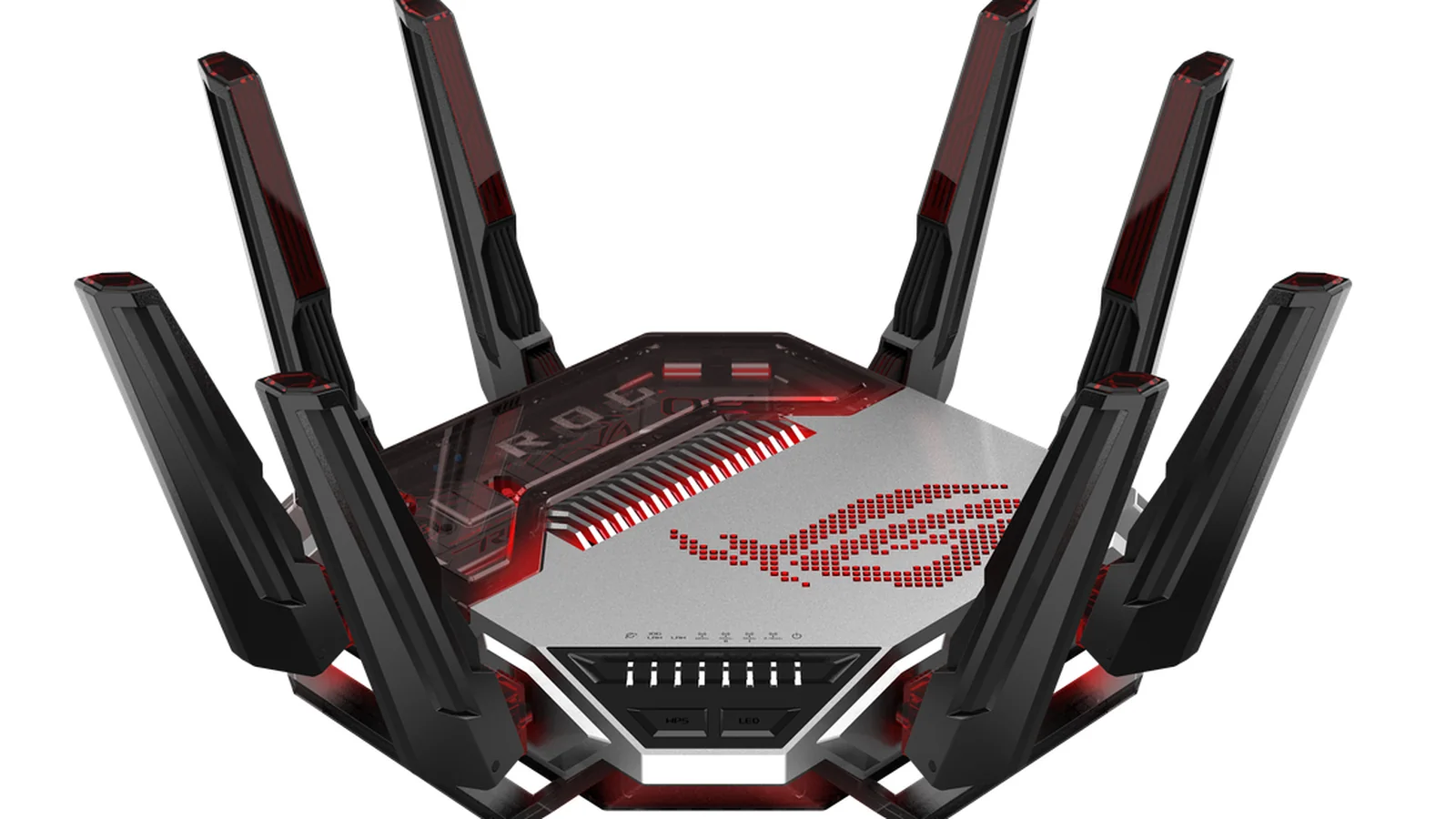
ASUS additionally supports link aggregation at up to 20Gbps for compatible local-network setups. The hardware is driven by a 2.6GHz quad-core processor with 2GB of RAM and 256MB of flash storage, while eight external antennas handle its quad-band wireless configuration. The router’s cooling design uses an aluminum top plate, nanocarbon material, internal heat spreading and an elevated chassis intended to improve airflow during sustained workloads.
Network monitoring is handled through a feature called WiFi Insight. It continuously scans for both Wi-Fi and non-Wi-Fi interference across the router’s bands, maintains a 24-hour event history and can automatically adjust channel use in response to changing conditions. Users can also inspect connected clients, bandwidth consumption and signal strength from the router interface.
The GT-BN98 includes ASUS AiProtection with malicious-site filtering, infected-device blocking, tracker and advertisement blocking, alongside security scanning and parental controls. Guest Network Pro allows separate SSIDs to be created for uses such as IoT devices, children, VPN connections and gaming, helping isolate different parts of a home network without requiring separate physical hardware.
ASUS is marketing the GT-BN98 as one of the first consumer gaming routers built around Wi-Fi 8 rather than as a simple bandwidth upgrade over Wi-Fi 7. Its appeal will depend heavily on how quickly compatible client hardware becomes available, since many of the standard’s most important improvements require support on both ends of the connection. For buyers building around multi-gigabit wired hardware or preparing for next-generation wireless devices, the GT-BN98 is now moving from demonstration hardware into commercial availability.
