


Blender 5.3 is officially available, bringing a major update to the free, open-source 3D creation software used by game developers, artists and animation studios. Released by the Blender Foundation on November 10, 2026, the update makes Vulkan the default graphics backend on supported Windows and Linux systems, introduces NVIDIA DLSS viewport denoising and adds native support for 3D Gaussian Splats.
The release also expands GPU-accelerated rendering, procedural modeling, asset management and animation capabilities. According to the Blender Foundation’s official announcement, the new features are intended to improve workflows across 3D content creation, from scene reconstruction and material design to rendering and post-production.
Vulkan Becomes the Default Graphics Backend
One of the most significant technical changes in Blender 5.3 is the transition to Vulkan as the default graphics backend on Windows, excluding ARM-based systems, and Linux.
Vulkan provides a modern graphics API for communicating with compatible GPUs. Blender’s implementation now has lower minimum requirements, expanding the range of supported hardware configurations.
The update also introduces hardware ray-traced shadows in the Workbench renderer when using Vulkan or Apple’s Metal graphics API. This allows supported GPUs to accelerate shadow rendering within Blender’s solid viewport environment.
For developers building 3D environments and assets, these changes affect the software’s underlying graphics infrastructure and viewport capabilities. They are particularly relevant to artists using Linux workstations or Windows PCs equipped with modern graphics cards.
The release arrives alongside broader improvements to the Linux graphics ecosystem, including the desktop and graphics updates introduced with Fedora Linux 45.
NVIDIA DLSS Adds Viewport Denoising
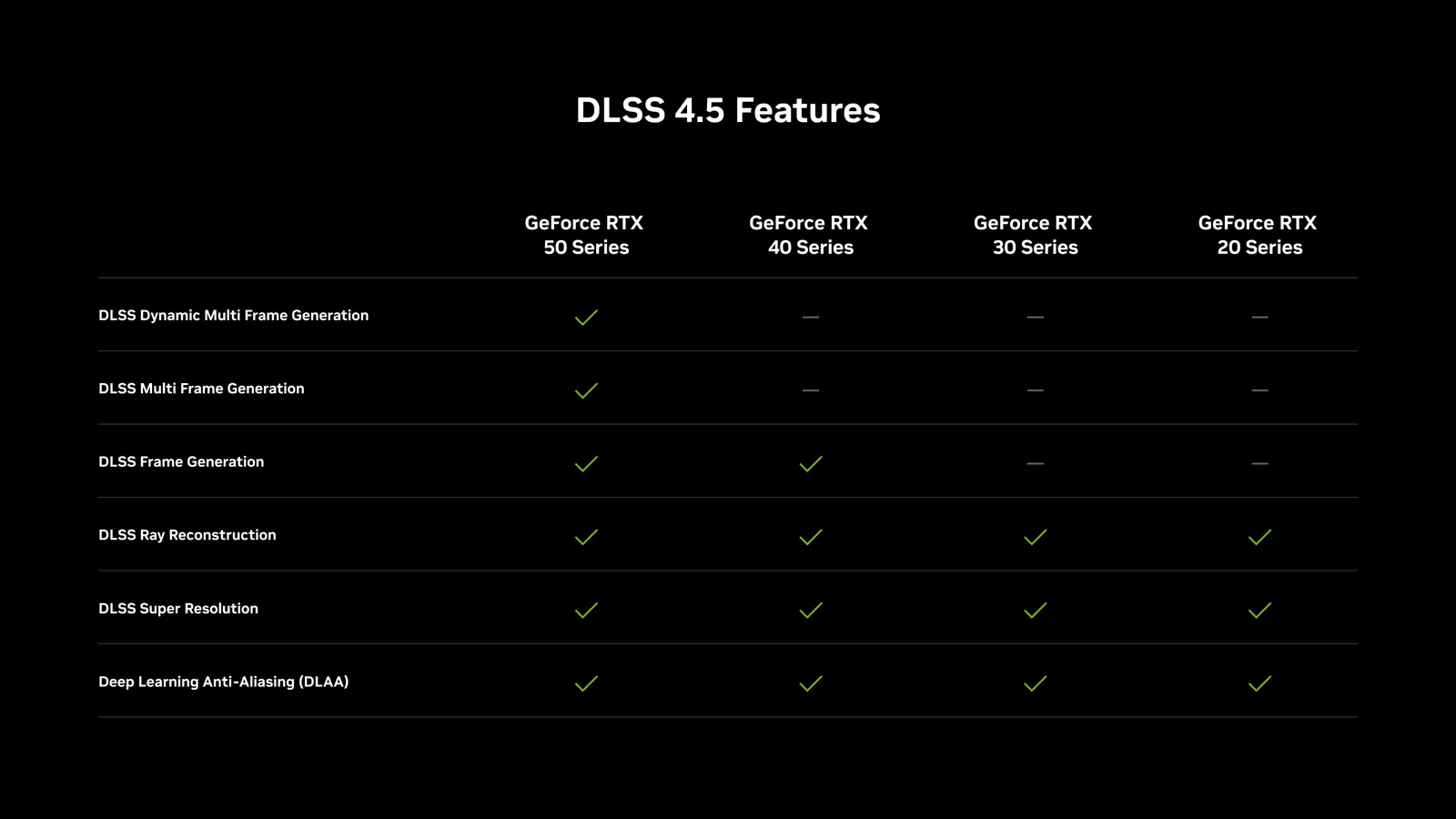
Blender 5.3 introduces NVIDIA DLSS 4.5 Ray Reconstruction as a viewport denoising option in the Cycles rendering engine.
Unlike DLSS implementations designed to improve frame rates in games, Blender’s integration focuses on producing cleaner interactive rendering previews. It uses upscaling and information from previous frames to reduce visual noise while artists adjust lighting, materials and scene composition.
The Blender Foundation says the technology can bring viewport previews closer to final-render quality while improving responsiveness and reducing flickering during animation playback.
The feature is available on supported NVIDIA GPUs and requires NVIDIA driver version 620 or newer. Users can access the DLSS denoiser through the Sampling settings in Cycles.
The implementation represents a different application of NVIDIA’s neural rendering technology from the gaming-focused DLSS 5 rollout planned for several PC games in November 2026.
Blender 5.3 also adds native support for NVIDIA RTX Spark devices running Windows 11, including memory optimizations for those systems.
Native 3D Gaussian Splat Support Arrives
Another major addition is native support for 3D Gaussian Splats, a technique commonly used to reconstruct detailed three-dimensional scenes from photographs or video footage.
Rather than representing an environment through conventional polygon meshes, Gaussian Splatting uses collections of small, semi-transparent elements to reproduce captured geometry, color and lighting information.
Blender 5.3 can import Gaussian Splats from PLY, SPZ and glTF files, store them as point clouds and process them using Geometry Nodes.
Artists can preview these scenes in Workbench and render them using EEVEE or Cycles. The implementation also offers basic relighting functionality by allowing users to replace the default emissive shading with other supported materials.
This expands the possibilities for incorporating reconstructed environments into 3D visualization and asset-production workflows.
However, Blender acknowledges that Gaussian Splat rendering performance remains under development. Certain scenes can also display visual inaccuracies because of differences between the color spaces used by capture tools and Blender’s internal rendering pipeline.
EEVEE and Cycles Receive Rendering Improvements
Blender 5.3 expands material and lighting controls across its two major rendering engines.
Cycles introduces dispersion and anisotropic roughness for transmissive materials, allowing artists to reproduce effects such as the separation of light into rainbow colors when passing through glass or gemstones.
These additions offer more flexibility when creating transparent materials, reflective objects and detailed surfaces.
EEVEE gains Material Lighting Nodes, allowing artists to control how individual materials respond to scene lighting. The functionality supports both physically based effects and non-photorealistic rendering styles.
Other EEVEE improvements include panoramic camera support and the ability to display the sun disc from the Sky Texture.
Together, these features provide additional controls for artists designing stylized environments, cinematic scenes and detailed game assets.
Geometry Nodes, Asset Libraries and Editing Tools Expand
Beyond rendering, Blender 5.3 introduces several workflow improvements.
Geometry Nodes receives new volume grid nodes that provide initial building blocks for custom fluid simulations. A lower-level node also allows users to create curves with custom topology, extending the procedural modeling system.
Asset Libraries can now be distributed as Blender extensions, making it easier to share reusable content. Blender’s Extensions platform also supports asset libraries containing public-domain CC0 resources.
The Compositor introduces a stack-based effects system in which individual node groups process an image sequentially. Built-in effects include Bloom, Chromatic Aberration, Film Grain and Vignette.
Grease Pencil receives additional selection tools, a new Carver Tool for subtractive shape editing and improvements to filling multiple regions simultaneously.
Video editing also benefits from a broader ripple-editing framework, a rewritten blade tool and initial OpenTimelineIO support for exchanging editing timelines.
Meanwhile, animation and rigging tools gain world-space animation copying, rotation-mode conversion and playback improvements.
An optional project system also allows Blender to manage information beyond individual project files, supporting workflows that involve multiple related assets and scenes.
Blender 5.3 is available for Windows, Linux and macOS through the Blender Foundation’s official distribution channels. The release remains free and open source, with the latest version bringing substantial new functionality for game asset creators, 3D artists and GPU-assisted production workflows.
