

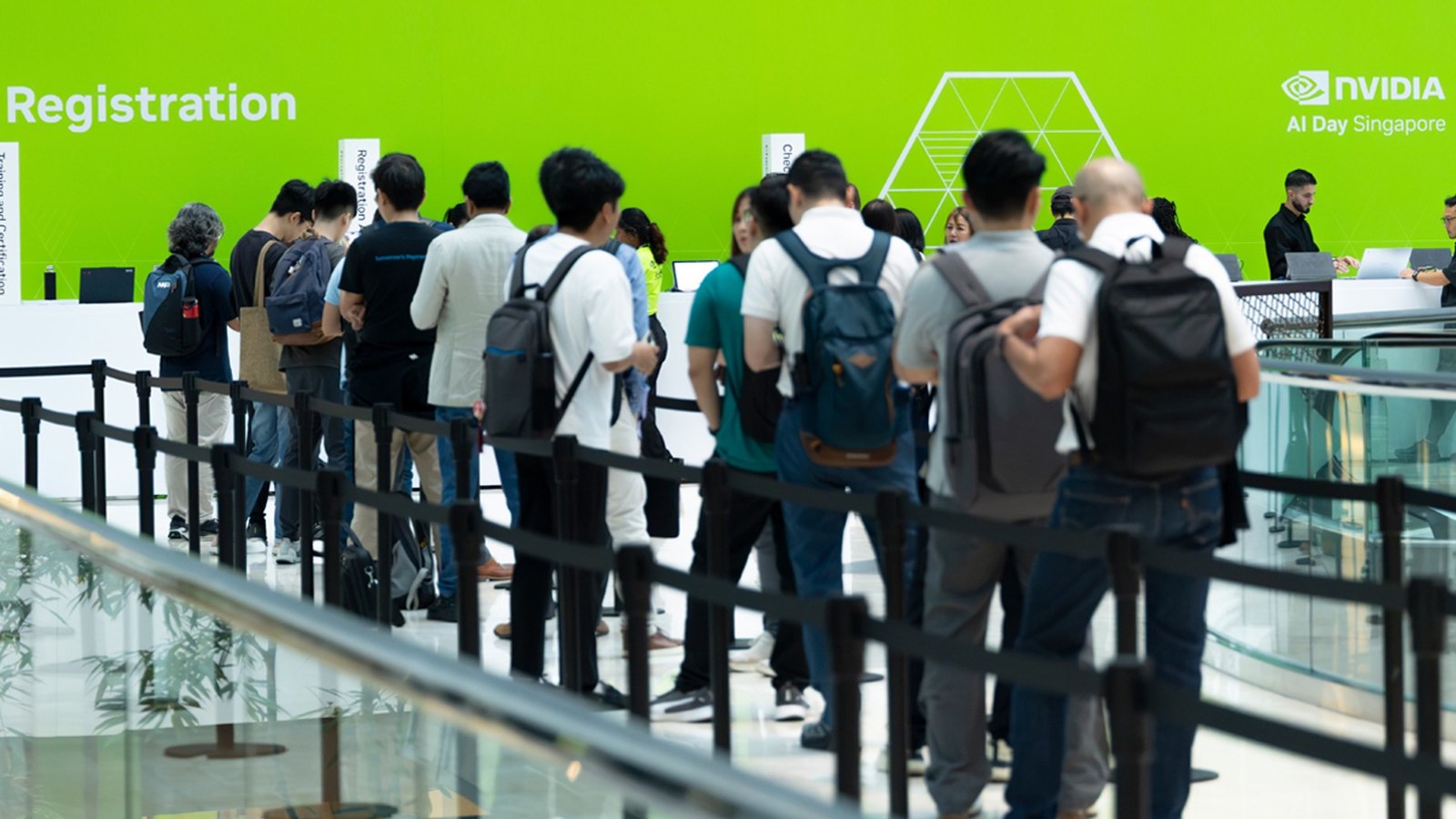
Sea Limited is becoming the first enterprise in the ASEAN region to adopt NVIDIA’s Vera Rubin platform, as NVIDIA expands its AI infrastructure and open-model ecosystem across Southeast Asia. The announcement was made during NVIDIA AI Day Singapore, held September 22-23 at the Raffles City Convention Centre. Sea plans to use Vera Rubin to scale AI models and intelligent agents across businesses including Shopee, Monee and Garena.
NVIDIA says Sea already uses AI across its major consumer platforms and now intends to expand those deployments with Vera Rubin infrastructure. Shopee is using AI to help sellers create product listings, improve product discovery and support customer engagement, while Monee applies AI to areas including fraud detection and credit-risk assessment. Garena, Sea’s digital entertainment division, is also using AI to support gaming experiences across its services.
Vera Rubin is NVIDIA’s next-generation AI computing platform designed for large-scale training, reasoning and inference workloads. The system combines NVIDIA’s Vera CPU and Rubin GPUs with networking, data-processing hardware and the company’s software stack. Recent performance disclosures have also shown Vera Rubin NVL72 delivering major inference gains over NVIDIA’s previous GB300 NVL72 platform in early MLPerf testing.
Sea’s adoption is only one part of a broader regional push announced at AI Day Singapore. NVIDIA says public-sector agencies, enterprises, research groups and technology providers across Singapore, Vietnam, Thailand, Malaysia and Brunei are deploying or evaluating its Nemotron open models and related AI tools. The company is positioning those models as a foundation that organizations can customize around local languages, regulations and operational requirements.
In Singapore, the Home Team Science and Technology Agency is beginning research with Nemotron 3 Super and Nemotron 3 Nano Omni for public-safety applications. NVIDIA says the models could support reasoning, agentic workflows and multimodal systems using vision, audio and language while allowing deployment under local control. NCS is also using Nemotron models and NVIDIA’s video search and summarization blueprint for enterprise and public-sector applications, while ST Engineering is developing agentic AI systems with NVIDIA NeMo and cuOpt.
AI Singapore is separately expanding its SEA-LION model family to incorporate NVIDIA Nemotron open models and NeMo tools. SEA-LION is designed specifically around Southeast Asian languages and cultures, making localization a central part of the project rather than adapting a general-purpose model after deployment. Hummingbird Bioscience and LynxKite are also building a toxicity knowledge graph using Nemotron 3.5 Lightning and NeMo Retriever for drug-discovery research.
Regional Nemotron development extends beyond Singapore. Viettel AI has been fine-tuning Nemotron 3 Super for Vietnamese-language and agentic workloads, with NVIDIA saying the resulting model ranked first on both the VMLU benchmark and Viettel’s internal product benchmark. FPT Smart Cloud has also codeveloped a Vietnamese Nemotron-Personas dataset designed to help developers train and evaluate locally specialized models.
Thailand’s Big Data Institute and iApp Technology are exploring Nemotron through the ThaiLLM Collaboration. iApp is adapting Nemotron 3 Nano using Thai legal data for OpenThai 2.0 Legal, which powers its Thanoy legal-assistant chatbot serving around 43,000 users. Malaysia’s YTL AI Labs is similarly fine-tuning Nemotron for enterprise and citizen-service applications, reflecting NVIDIA’s broader effort to make regional customization a core part of its open-model strategy.
That strategy mirrors other recent Nemotron deployments, including Salesforce’s Koa CRM reasoning model, which is built on NVIDIA Nemotron technology for enterprise agent workflows. NVIDIA is increasingly positioning Nemotron not as a single model, but as a family of open models, datasets and development tools that organizations can adapt to specific sectors and languages.
NVIDIA also highlighted physical-AI and smart-city projects during the event. Malaysia’s ITMAX is using NVIDIA Cosmos models with the company’s video search and summarization technology for traffic operations, while Thailand’s AS-TECH is applying the same stack to airport passenger-flow systems. These deployments sit alongside NVIDIA’s broader expansion into robotics and autonomous systems, including new agentic robotics tools in Isaac ROS 5.0.
The announcements show NVIDIA extending its Southeast Asian strategy across both computing infrastructure and localized software. Sea’s Vera Rubin deployment represents the highest-profile infrastructure adoption announced at the event, while Nemotron projects demonstrate how the company is trying to establish its models throughout regional governments, enterprises and research institutions. Together, they give NVIDIA a broader foothold in Southeast Asia as organizations move from AI experimentation toward production-scale deployments.
