



Activision has published a detailed look at how Team RICOCHET is targeting the wider Call of Duty cheating business rather than focusing only on individual players. The company says it has disrupted more than 375 cheat reseller operations, issued over 80 cease-and-desist demands and helped shut down 31 primary cheat vendors. The update also outlines how cheat developers, resellers, stolen-account sellers and evasion services form an interconnected commercial ecosystem.
Team RICOCHET says the cheating market is structured in layers, with developers at the top and primary vendors and resellers handling distribution underneath them. Many cheat developers deliberately keep their distance from customers, allowing resellers to handle sales, support and marketing while the original creators remain less visible. Activision says it tracks hundreds of these vendors and often finds supposedly different products are simply the same cheat repackaged under different names and storefronts.
The company is combining technical detection with legal pressure to disrupt those networks. Beyond account bans, Team RICOCHET says legal action is aimed at the revenue streams, payment channels and business relationships that allow cheat sellers to remain operational. Activision has also publicly served cease-and-desist demands to sellers, including a recent case in Ohio where a representative delivered paperwork directly to a Call of Duty cheat vendor.
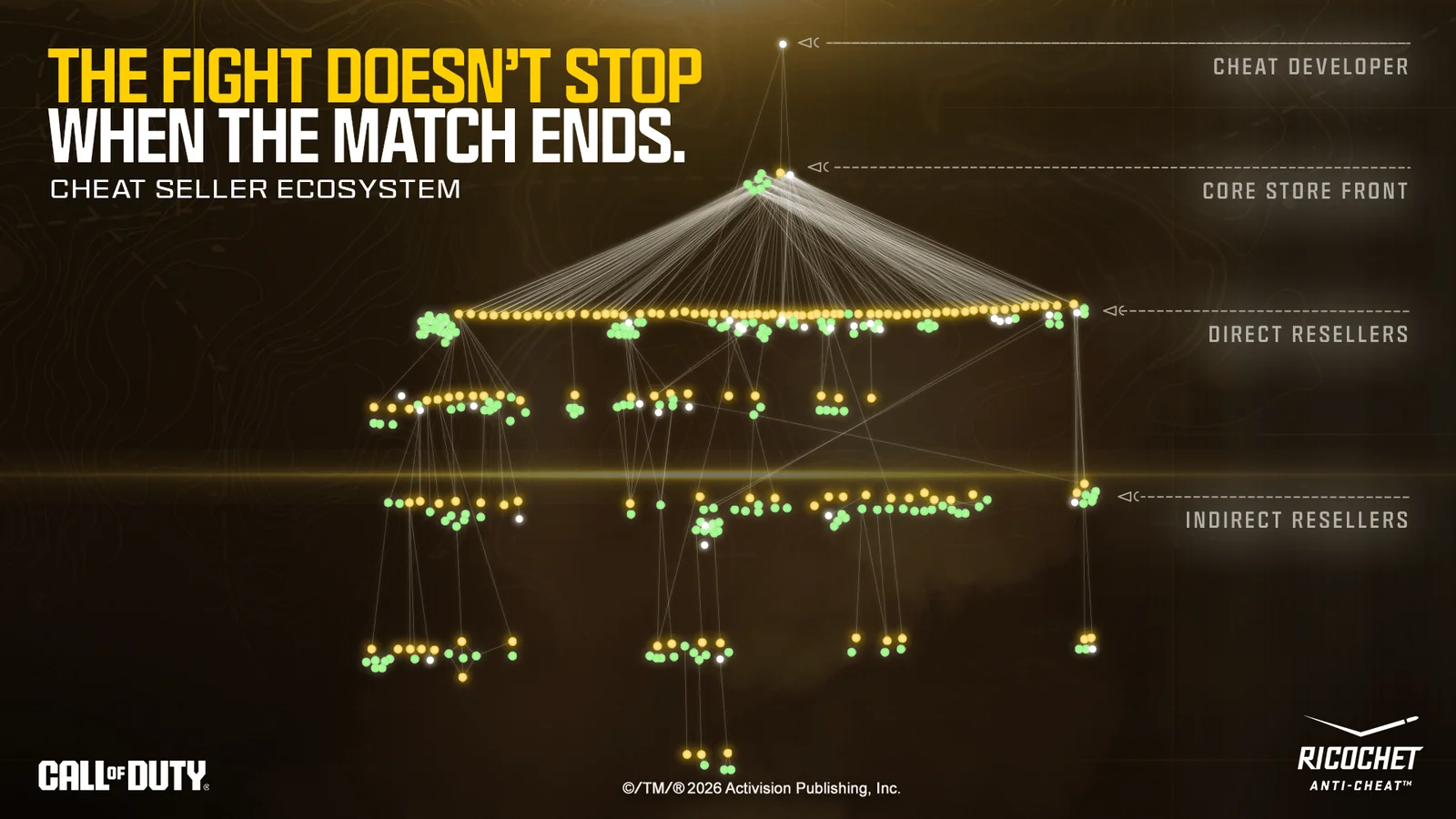
RICOCHET divides the market into three main areas: cheats, accounts and evasion. The first includes traditional aimbots and wallhacks alongside rage cheats, unlock tools, DMA hardware and external devices such as Cronus, XIM and Titan. The account market then supplies stolen, aged, Ranked Play-ready and boosted accounts to players who need replacements after enforcement actions.
Evasion services form the third part of the system. Cheat sellers offer spoofers and other tools intended to bypass hardware bans or disguise repeat offenders, while Activision responds with systems including TPM 2.0, Secure Boot, Microsoft Azure Attestation and stronger hardware enforcement. Team RICOCHET says it issued more than 70,000 new hardware bans last month alone as part of that effort.
Activision argues that these layers support one another, meaning pressure on one section of the market can create problems elsewhere. Making stolen accounts harder to obtain increases replacement costs, while stronger hardware checks make spoofing more difficult. Taking distributors offline can also reduce the reach of cheat developers even when the underlying software itself still exists.
The financial scale behind the market is substantial. Activision cites analysis from threat-intelligence company Intorqa estimating that cheat subscriptions across 15 games generate around $3.5 billion annually, with the wider ecosystem of account sales, boosting, spoofing and related services potentially reaching about $8.5 billion per year. Team RICOCHET says individual cheat subscriptions commonly cost around $40 per month and can exceed $100, while additional spoofing services and replacement accounts can push yearly spending beyond $1,000 for a single user.
The company also warns that customers can expose significant personal information to cheat providers. Some sellers require users to disable security protections or provide authentication data that can reveal IP addresses, Discord accounts, hardware details, email addresses and payment information. Others reportedly ask for photo identification, while Activision says some cheat developers have also distributed malware alongside their products.
RICOCHET’s strategy therefore extends beyond detecting unauthorized software running during a match. Technical systems examine software interactions and player behavior, while account protections, hardware verification, investigations and legal action target the surrounding infrastructure that allows cheating operations to continue. Activision’s latest report presents that broader approach as an attempt to make running and using cheat services increasingly expensive and difficult to sustain.
The update arrives as Call of Duty continues expanding its PC security requirements and enforcement systems across Black Ops 7, Warzone and the upcoming Modern Warfare 4. Recent updates have also changed how Call of Duty is distributed on some platforms, including a Season 06 PlayStation file reorganization, while Team RICOCHET continues focusing on the underlying cheating economy across the franchise.
