



An Alabama man has been arrested by the FBI after Epic Games provided federal investigators with Fortnite voice-chat recordings containing alleged threats to kill people and shoot law-enforcement officers. According to a federal affidavit first reported by Aftermath, 29-year-old Edward Lee Frith used the Fortnite account name WagesOfNinja and made a series of threatening statements that were later reviewed by investigators. Frith has pleaded not guilty, and the allegations have not yet been tested at trial.
Epic Games made what the affidavit describes as a voluntary emergency disclosure to the FBI on September 20, 2026. The company provided account information, transcripts and audio files associated with the Fortnite account, while investigators used additional records to connect the account to Frith. Court records cited in subsequent reporting state that the account had been accessed more than 1,700 times from IP addresses located in Alabama.
The recordings allegedly included statements about wanting to kill someone, thinking about murder regularly and potentially killing a police officer if arrested. One transcript quoted in the filing also attributes Frith with saying that if FBI agents came to his home, he would shoot them. An FBI agent said in the affidavit that the supplied audio was reviewed and that the transcriptions accompanying the recordings accurately reflected what was said.
Frith was arrested and indicted on September 23 on a federal charge of transmitting threatening communications in interstate commerce. He entered a not-guilty plea the following day. A detention order issued on September 29 kept him in custody pending trial, which reporting based on the court docket says is currently expected in December.
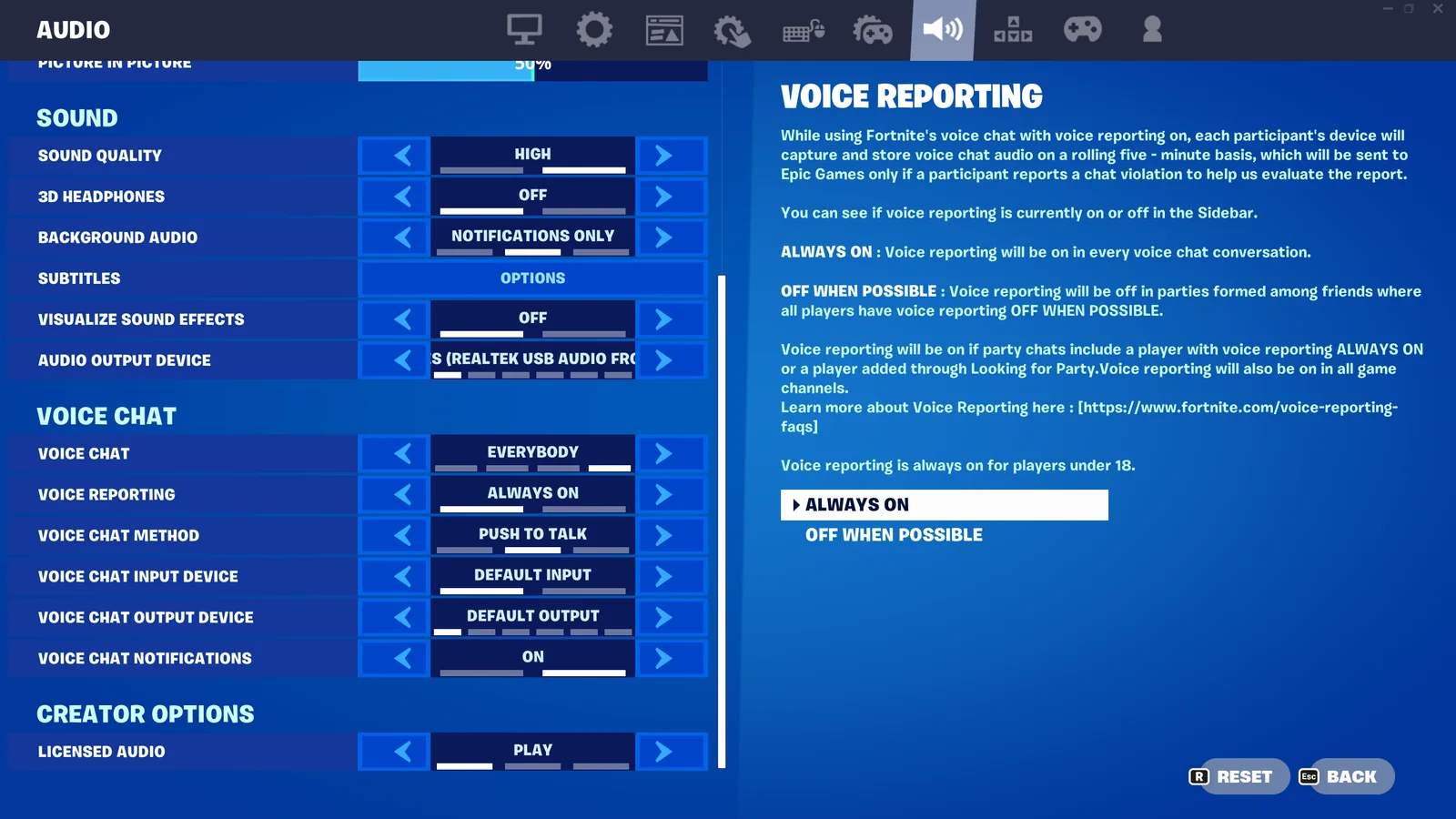
The case also provides a real-world example of how Fortnite’s voice-reporting system can become evidence outside the game when reported speech is considered potentially criminal. Epic introduced voice reporting in Fortnite in 2023, allowing players to submit recent voice-chat audio alongside reports of suspected rule violations. The company says the system keeps a rolling buffer of approximately the last five minutes of voice chat on participating players’ devices rather than continuously storing every conversation on Epic’s servers.
When a player submits a voice report, the relevant portion of that recent audio is uploaded to Epic and sent to moderators for review. Epic says it cannot simply listen to Fortnite voice chat on demand; the audio must be captured while voice reporting is enabled and then submitted through a report. That distinction is important because the federal affidavit does not establish that Epic was conducting continuous surveillance of Frith’s conversations.
Epic’s own technical documentation says uploaded voice reports are cryptographically tied to participants so moderators can determine which account produced individual parts of a conversation. The company also states that reported audio can be retained longer when necessary to comply with legal obligations. Its safety policies separately note that potentially illegal conduct can be escalated beyond ordinary moderation actions such as warnings, restrictions or account bans.
The affidavit does not fully describe who initially reported the conversation or the exact moderation steps that occurred before Epic contacted federal authorities. It does, however, state that Epic supplied the recordings and account information that became part of the FBI investigation. The case therefore moves beyond the more typical outcome of an in-game voice-chat report, where consequences generally remain within Epic’s moderation system.
Epic has increasingly built moderation tools around Fortnite’s large social ecosystem as the game has expanded beyond traditional Battle Royale matches into user-created experiences and other shared spaces. Voice chat is a major part of that ecosystem, particularly in public Game Channels and team-based play. The Alabama case shows that when reported speech contains what authorities consider credible threats of real-world violence, the consequences can extend well beyond a Fortnite account sanction.
Frith remains presumed innocent unless proven guilty. The federal case is ongoing, and no final determination has been made regarding the allegations contained in the affidavit. What is confirmed is that Epic provided Fortnite voice-chat evidence to federal investigators, and that evidence became part of a criminal case that resulted in Frith’s arrest and indictment.
