


Intel’s Arc B580 gaming graphics card could be discontinued as the company shifts its attention toward higher-margin professional GPUs designed for workstation and AI inference workloads. The possibility was raised by hardware leaker Haze (@Haze2K1) on November 2, 2026, who suggested that Intel might move the consumer Battlemage GPU to end-of-life status while prioritizing products such as the Arc Pro B50.
The claim remains an unverified rumor. Intel has not announced plans to discontinue the Arc B580, and no official product discontinuation notice has been identified. The original claim also presents the potential change as a possibility rather than a confirmed production decision.
The Arc B580 launched in December 2024 with a $249 suggested retail price, 12GB of GDDR6 memory and 20 Xe2 cores. It became a notable option for budget gaming PCs because of its relatively generous memory capacity compared with competing graphics cards offering 8GB of VRAM.
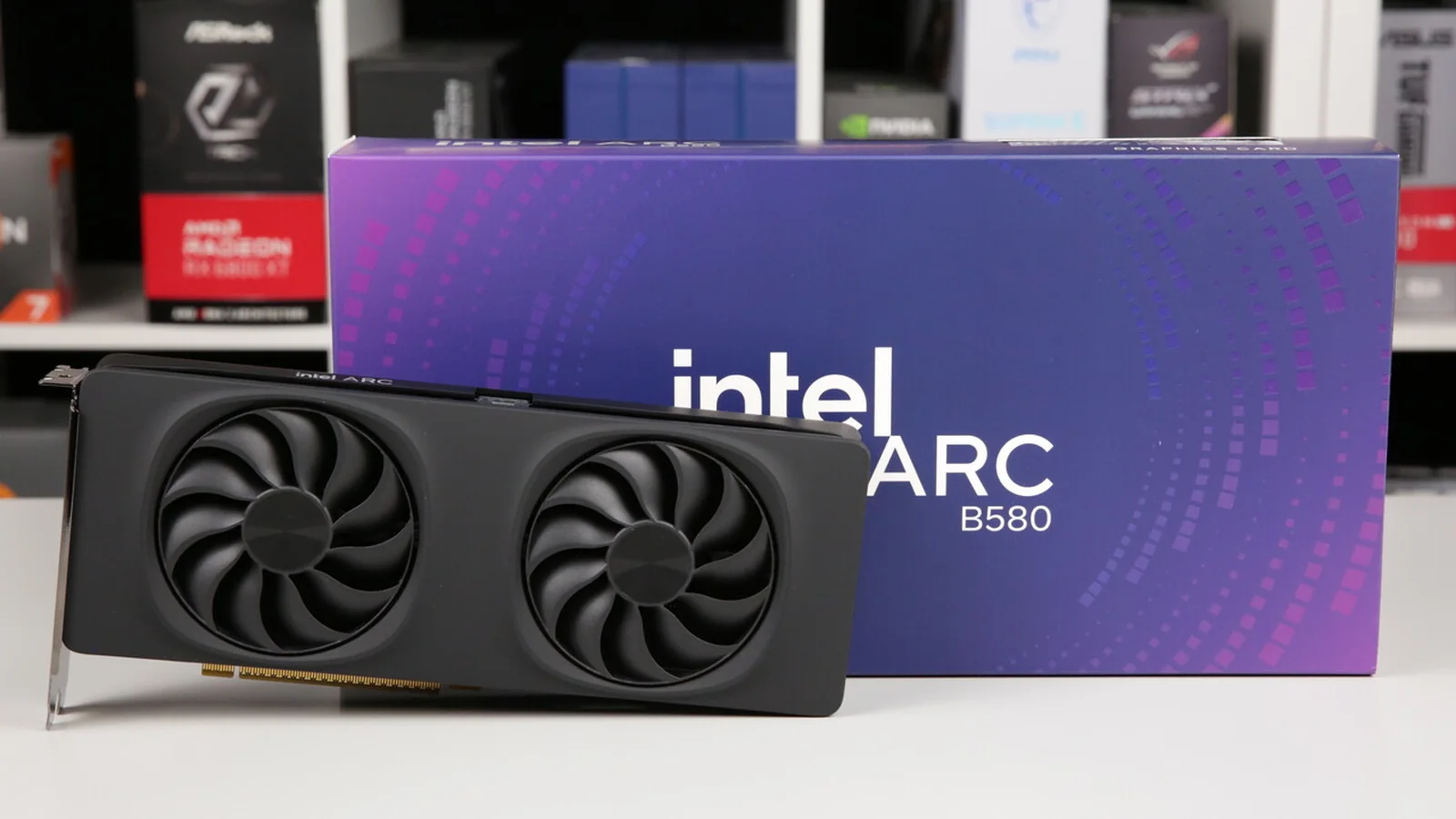
However, availability has become increasingly limited at its original price. Recent US retail listings have placed available models around $330, while some UK listings have approached £500. These elevated prices and reported inventory shortages have raised concerns about the card’s future, although neither establishes that Intel has reduced or ended production.
The rumored shift toward professional GPUs has a technical explanation. Intel’s Arc B580 and Arc Pro B50 use the same underlying BMG-G21 Battlemage graphics processor, allowing suitable chips from the same silicon family to serve different markets.
The consumer Arc B580 features 20 Xe2 cores and 12GB of GDDR6 memory on a 192-bit interface. By comparison, the Arc Pro B50 has 16 Xe2 cores, 16GB of GDDR6 memory, a 128-bit interface and a 70W board power rating. Intel positions the professional model for workstation applications and workloads including local AI inference.
The Arc Pro B60 also uses BMG-G21 silicon, combining 20 Xe2 cores with 24GB of GDDR6 memory. Intel introduced the B50 and B60 in May 2025 as part of its expansion into professional graphics and AI development hardware.
These shared components mean Intel could potentially allocate more suitable GPU chips toward professional products if commercial demand justified doing so. However, the B50’s reduced core configuration also allows it to use chips that do not meet the B580’s full specifications. Increased Arc Pro B50 production therefore would not automatically require Intel to discontinue its gaming counterpart.
Intel has continued expanding its professional graphics portfolio, including the newer Arc Pro B70 with 32GB of ECC memory. Unlike the B50 and B60, the B70 uses the larger BMG-G31 processor, making it a separate development rather than direct evidence of B580 production being redirected.
For PC gamers, a potential B580 discontinuation would matter most in the affordable graphics card segment. The GPU’s 12GB memory configuration provides an alternative to lower-memory models, particularly for users building systems around demanding modern games and higher-resolution textures.
Its possible departure would also come amid wider concerns about graphics card pricing and availability. Reports of further AMD Radeon GPU price increases and tightening GeForce RTX 50-series inventory have highlighted the supply pressures facing PC hardware buyers.
The original rumor does not indicate whether Intel’s less powerful Arc B570, which launched with 10GB of memory at $219, could face a similar change. There is also no confirmed timeline for any potential Arc B580 discontinuation.
For now, Intel continues to list the Arc B580 as a launched product in its official specifications database. The reported shift toward Arc Pro production remains unconfirmed, and existing retail shortages alone are insufficient to establish that the gaming GPU has reached end-of-life status.
