


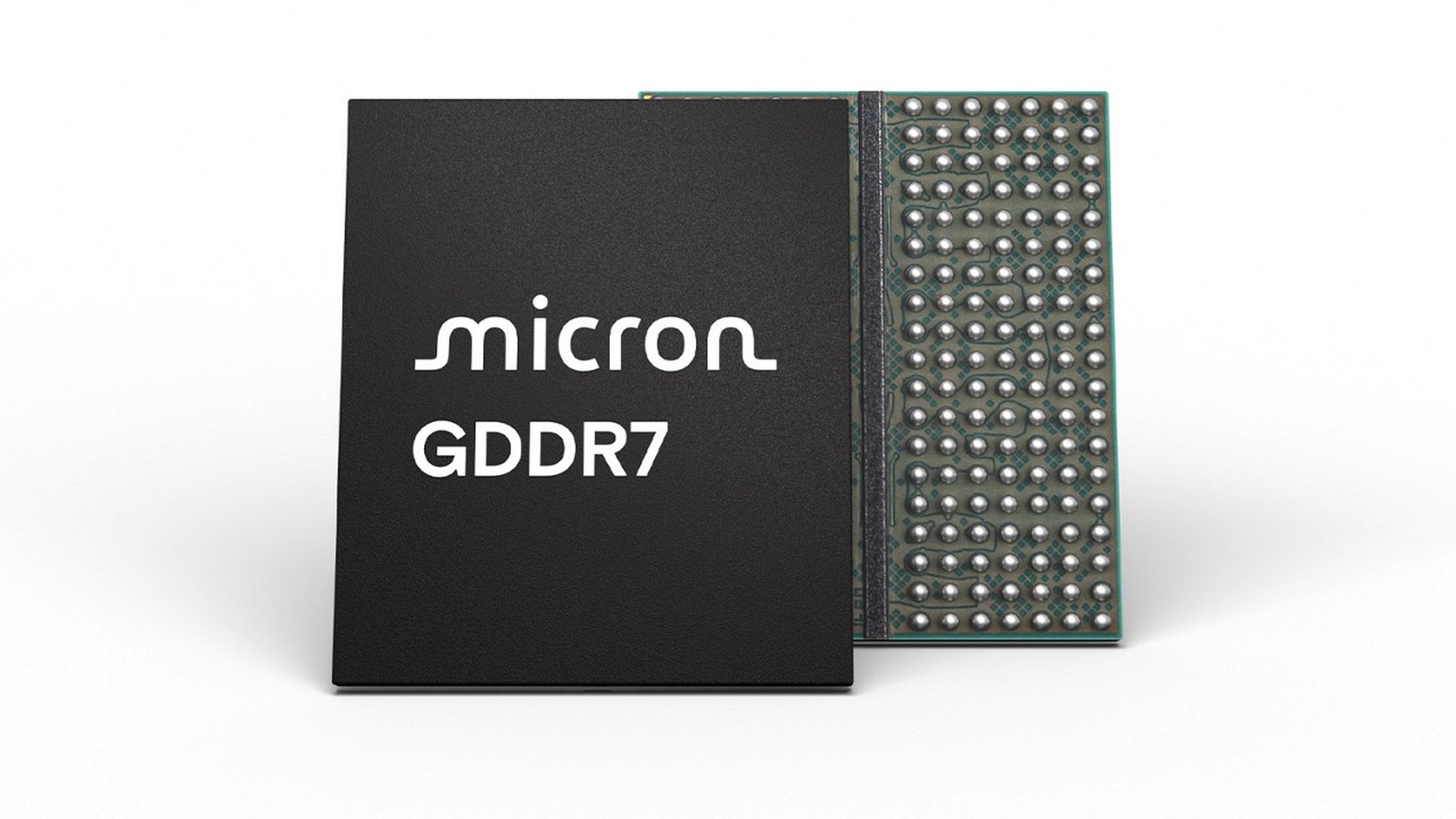
Micron has reportedly ended production of its 2GB GDDR7 memory chips, including a 28Gbps part that has already appeared on some GeForce RTX 50-series graphics cards. UNIKO’s Hardware identified Micron’s D8FHL chip, officially listed as MT68A512M32DF-28:A, as having reached end of life. Micron’s own product page for that 16Gb component now returns “No results found,” although the company has not publicly explained the change.
The affected MT68A512M32DF-28:A is a 16Gb, or 2GB, GDDR7 device built with a 32-bit interface and rated for 28Gbps operation. Micron had also offered a 32Gbps 16Gb variant in the same generation. The company’s GDDR7 product documentation previously described 16Gb devices at up to 32Gbps, confirming that these parts formed part of its original GDDR7 portfolio.
The 28Gbps chip has already appeared on shipping GeForce hardware rather than existing only as a development sample. Earlier this year, a GALAX GeForce RTX 5060 was spotted using four Micron D8FHL packages, providing the card’s standard 8GB of VRAM. That made Micron another GDDR7 supplier for Nvidia’s current GeForce generation alongside Samsung and SK hynix.

A disappearing catalog entry does not by itself establish why Micron is retiring the component, so the reason for the reported end-of-life status remains unclear. Micron has not announced that Nvidia is abandoning 2GB GDDR7 packages or that existing RTX 50 graphics cards will be redesigned around larger chips. Current cards can also source GDDR7 from other memory manufacturers, meaning Micron’s reported change does not imply that 8GB or 16GB GeForce models are suddenly losing their existing memory configurations.
Micron has meanwhile been emphasizing denser GDDR7 technology. The company recently detailed 24Gb, or 3GB, GDDR7 devices capable of reaching 36Gbps, positioning higher memory capacity as increasingly useful for gaming, neural graphics and local AI workloads. A 3GB package allows a four-chip board to provide 12GB of VRAM instead of 8GB, while eight packages could provide 24GB instead of 16GB without increasing the number of memory devices.
Those denser packages are already relevant to Nvidia’s broader Blackwell family. 24Gb GDDR7 has been used in professional RTX PRO products and the GeForce RTX 5090 Laptop GPU, where higher per-package capacity enables memory configurations that are difficult to achieve with 16Gb devices alone. That does not necessarily mean desktop GeForce cards will immediately migrate to 3GB modules, particularly because component pricing and board design remain important factors.
The reported change could nevertheless matter for future graphics-card configurations if Micron no longer supplies 16Gb GDDR7. Board partners using Micron memory would either need alternative suppliers for 2GB devices or move toward Micron’s denser products where economically and technically appropriate. Samsung and SK hynix continue to manufacture GDDR7, so the wider market is not dependent on Micron alone for current 2GB-class configurations.
Micron’s public GDDR7 material still describes the technology as supporting gaming, AI and high-performance computing, with current specifications reaching 32Gbps in its established product documentation. More recent company material promotes 24Gb density and 36Gbps performance as part of the next phase of its graphics-memory roadmap. That direction is consistent with a shift toward higher-capacity devices, but Micron has not explicitly said that this strategy is the reason for retiring its 16Gb chips.
For now, the strongest evidence is the combination of UNIKO’s Hardware’s report and Micron’s own missing 16Gb product listing. The MT68A512M32DF-28:A page no longer returns specifications, while the same chip remains documented by distributors and historical Micron material as a 16Gb GDDR7 component. Until Micron publishes an end-of-life notice or broader product-roadmap statement, the production change should therefore be treated as reported rather than formally announced.
