



Riot Games says it has taken action against exactly 296,416 League of Legends and VALORANT accounts for rank manipulation since late 2025. The figure comes from a new Vanguard Anti-Boost update published by Riot anti-cheat lead Phillip Koskinas on September 17. Riot says the enforcement covers boosting, purchased smurf accounts and players who repeatedly benefit from teaming with boosters, with the system still being expanded across both games.
Vanguard’s Anti-Boost technology first launched privately in League of Legends in September 2025 before being adopted by VALORANT after nearly a year of testing. The system attempts to identify situations where a higher-skilled player logs into someone else’s account and performs substantially above the account owner’s usual level. Riot refers to the account being raised as the “boostee,” the stronger player as the “booster,” and lower-rated players who repeatedly queue alongside them as “hitchhikers.”
When Vanguard determines that an account was boosted, Riot can remove ranked points and rewards gained through the activity and return the account toward its previous rating. The boosted account also receives a temporary suspension, with penalties increasing for repeat offenses. Purchased accounts or smurf accounts that Riot determines have no legitimate owner can instead receive permanent bans, while known boosters can also have punishments applied to their main accounts.
Players who repeatedly queue with boosters or smurfs are not exempt simply because someone else was operating the manipulated account. Riot says those players can also lose undeserved rank and face penalties, particularly when the behavior forms a repeated pattern. Its published examples include paying a booster to queue on a smurf, lending a lower-rated account to a stronger friend, deliberately deranking accounts and using accounts that the player does not actually own.
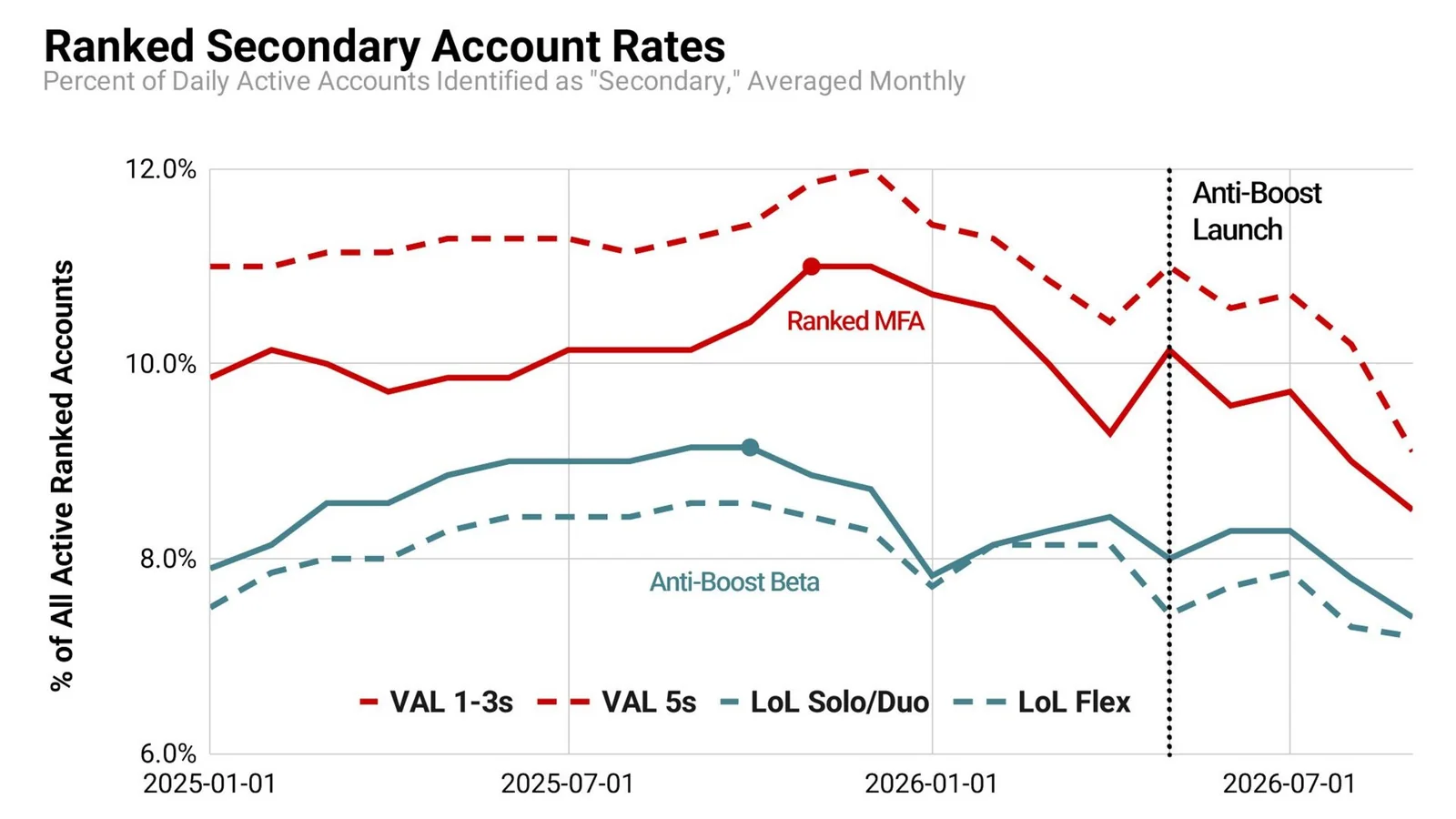
Riot says roughly 9% of daily accounts used in Ranked across League and VALORANT are secondary accounts, although it does not treat all of them as malicious. About half fall into categories Riot considers relatively harmless alternate accounts, such as players practicing another role, preserving their personal-best rank or maintaining an account of roughly comparable skill. Anti-Boost instead focuses primarily on account purchases, account sharing and situations where alternate accounts are used to manipulate matchmaking or boost other players.
The company says that distinction is important because simply owning another account is not automatically punishable. Riot considers an account relatively legitimate if the player created and leveled it personally, does not share it and does not exploit it to elevate lower-ranked friends. Problems arise when a stronger player uses an account whose matchmaking rating does not reflect their actual ability, creating matches in which the ranking system is working with inaccurate information.
Riot says its enforcement has already reversed what had been a growing trend in the use of secondary accounts for rank manipulation. The company published data showing boosts detected and reverted over the past year, with activity spread across multiple ranked tiers in both games. Riot argues that making purchased accounts and boosting services less useful should also make those services more expensive and reduce the incentive for players to use them.
The next stage of the crackdown will extend beyond detecting suspicious ranked performance. Riot says it plans to accelerate the use of multi-factor authentication restrictions and TPM 2.0 hardware requirements as part of a broader effort to establish that competitive accounts are being used by their legitimate owners on trusted hardware. Vanguard hardware attestation is intended to make repeated account creation and punishment evasion more difficult.
Riot has not presented the 296,416 figure as the endpoint of the campaign. Koskinas said Anti-Boost is not yet operating at full capacity, with further rank removals and enforcement expected as the system expands. For League of Legends and VALORANT players, Riot’s guidance is straightforward: play ranked on accounts they actually own and avoid repeatedly queuing with players using borrowed, purchased or manipulated accounts.
