



The “Don’t Kill the Disc” campaign is approaching 350,000 verified signatures, turning a retailer-led protest into the most visible challenge yet to Sony’s plan to end physical releases for new PlayStation games. At the time of publication, Change.org showed approximately 344,700 verified signatures and almost 14,000 public comments.
Sony Interactive Entertainment announced on July 1 that physical-disc production for all newly released PlayStation games will end in January 2028. Games released before the cutoff will remain playable from disc, but subsequent titles will be distributed through the PlayStation Store or sold by retailers in digital formats rather than on playable media.
The petition was created the following day by Jade Pearce, owner of Canadian specialist retailer PNP Games. Its central demand is not the rejection of digital distribution, but the preservation of physical releases as an additional purchasing option.
Reaching nearly 350,000 signatures in less than a month demonstrates that Sony’s decision has activated a sizable and highly engaged section of its audience. The petition has also attracted thousands of comments and sustained coverage across gaming and mainstream media.
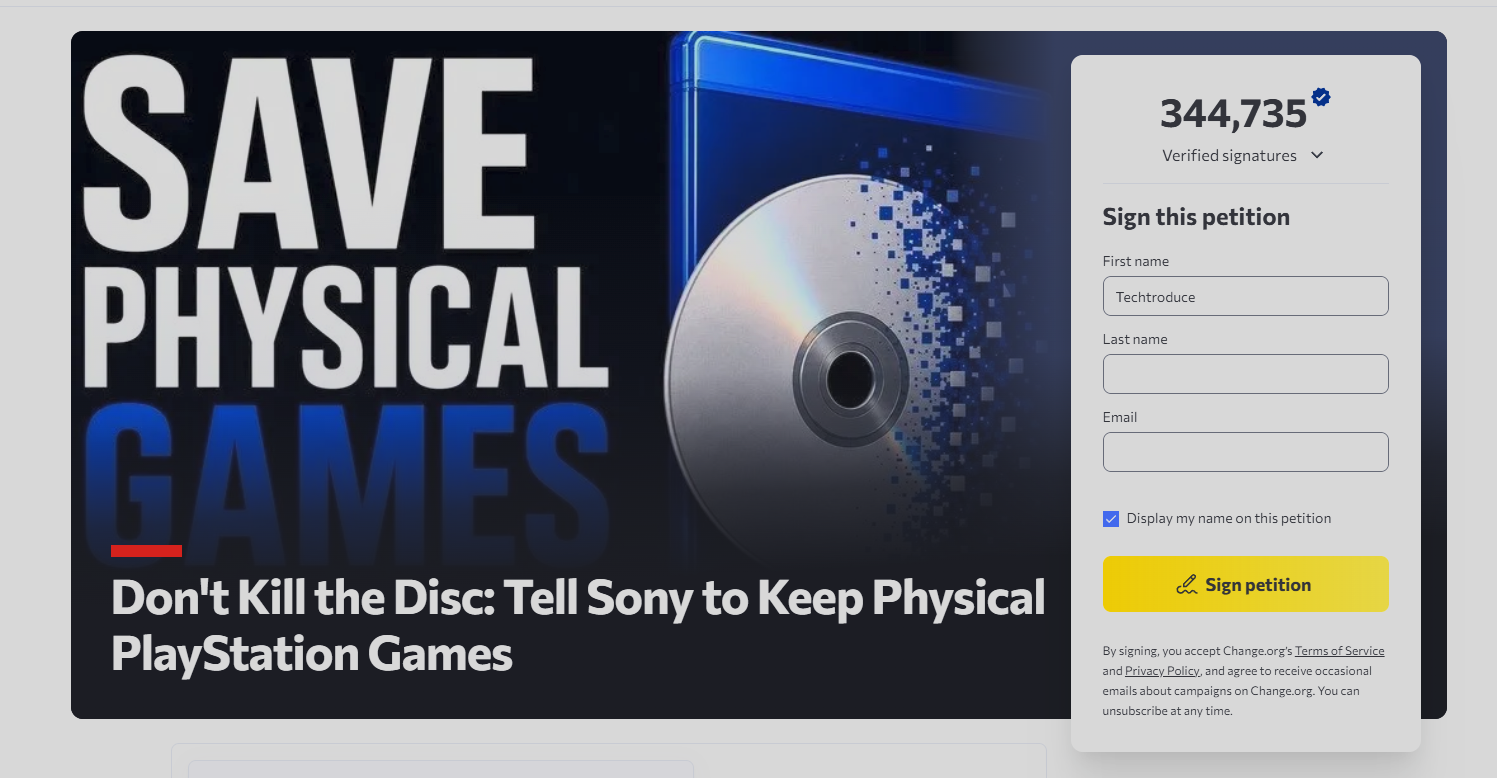
However, its significance should not be overstated. A Change.org petition does not compel Sony to respond, initiate a review or change its policy. Although Change.org describes the names as verified signatures and says it uses systems intended to confirm that participants are real people, the total is not equivalent to a representative consumer survey or a forecast of future physical-game purchases.
The organizer also has a clear commercial interest in the outcome. PNP Games sells physical products, including new and pre-owned games, so an all-digital PlayStation ecosystem would directly affect its business. That does not invalidate the campaign’s arguments, but it is important context when evaluating claims about jobs, consumer demand and the health of physical retail.
Sony’s move is supported by a pronounced shift in purchasing behaviour. In its fiscal 2025 results, the company reported 317.9 million PS4 and PS5 full-game software sales, with digital downloads representing 78% of annual units. The digital share reached 85% during the final quarter.
Those figures suggest that roughly 70 million full-game units were still sold through non-digital channels during the year. That is no longer the dominant format, but it is also not a negligible market.
Sony additionally reported 125.1 billion yen in physical-software revenue during fiscal 2025, slightly above the 121.2 billion yen recorded the previous year. Digital-software revenue was considerably larger at approximately 1.06 trillion yen, although the two categories use different accounting definitions and should not be treated as a simple comparison of consumer spending.

Sony has framed the 2028 transition as a response to changing consumer preferences and the broader entertainment industry’s movement toward digital distribution. The financial logic is also straightforward: digital products avoid disc manufacturing, packaging, shipping, inventory management and retailer margins. Joost van Dreunen, a professor at New York University’s Stern School of Business, told Reuters that removing discs should improve margins, while also increasing consumers’ need for storage capacity.
The wider market is moving in the same direction. U.S. spending on subscriptions increased by 20% during 2025, helping total video-game spending reach a revised $60.8 billion, according to the Entertainment Software Association, Circana and Sensor Tower.
Sony’s 78% figure is important, but it does not answer every question raised by the campaign.
The company calculates its digital ratio by dividing all PS4 and PS5 full-game downloads by total full-game units. Its public disclosure does not separately identify games that were available in both formats, titles released exclusively through digital storefronts or products that received only small physical print runs.
Consequently, the figure measures the overall composition of PlayStation software sales, not necessarily what consumers choose when an equally available disc and download are presented side by side.
That distinction supports one part of the petition’s criticism, although it does not prove that maintaining physical production for every release would be commercially sustainable. Smaller publishers may find minimum manufacturing quantities, certification, distribution and unsold stock prohibitively expensive. Digital storefronts have also made it possible for independent developers to reach global audiences without establishing a physical supply chain.
Recent U.S. retail data strengthens Sony’s position. Circana industry analyst Mat Piscatella reported that only seven PlayStation games had sold more than 100,000 physical copies in the United States during 2026 by mid-July. Only two exceeded 10,000 physical units during the week ending July 11.
Those numbers indicate a serious decline, but they also have limits: they cover one country, use sales thresholds rather than complete worldwide totals and do not show whether limited stock constrained individual releases.

For consumers, the most immediate change would be the disappearance of the secondary market for newly released PlayStation games. A disc can usually be resold, traded, borrowed, gifted or purchased from competing retailers. A digital purchase is generally tied to an account and cannot be transferred to another player.
That distinction has practical financial consequences. Physical buyers can recover part of a game’s cost by reselling it, purchase discounted used copies or compare prices across multiple retailers. In a digital-only environment, the platform holder controls the primary storefront, its discount schedule and the conditions under which access is provided.
Physical media can also offer an additional route to long-term access. For games that remain fully playable from the data contained on the disc, the owner retains an installable copy even if the title is later removed from sale. Digital-only access depends more heavily on continuing account access, compatible servers and the platform’s ability to provide downloads.
Discs are not a complete preservation solution, however. Modern console games may depend on updates, online authentication or active multiplayer infrastructure. Even Sony’s detachable PS5 disc drive requires an internet connection when it is initially paired with a compatible console.
The impact would also extend beyond collectors. Retailers would lose new PlayStation software sales and much of the future supply feeding their used-game businesses. Distributors, packaging suppliers and logistics companies would similarly handle fewer products. The precise number of threatened jobs has not been independently established, so broad employment claims made by campaign supporters should be treated as advocacy rather than confirmed estimates.
Sony has not announced a reversal or modification. Its official PlayStation pages continue to display the January 2028 deadline, meaning the petition has so far generated public pressure rather than a measurable policy change.

The campaign could still influence how the transition is implemented. Sony could theoretically preserve limited physical editions, permit specialist publishing partners to manufacture discs, maintain discs for selected major releases or offer additional guarantees concerning long-term access to digital purchases. None of those compromises has been announced.
The petition’s approach to 350,000 signatures is therefore an important reputational milestone, but the decisive evidence will be commercial. Sony and publishers will be watching whether supporters continue buying discs through 2027, whether physical editions sell through their available stock and whether opposition affects future console purchasing decisions.
For now, the campaign has established that physical PlayStation games retain a committed audience. The unresolved question is whether that audience is large—and commercially active—enough to persuade Sony that preserving consumer choice is worth the continuing cost of producing discs.
More News:
Microsoft Adds Achievements to Some Old Original Xbox Games After 21 Years
Warzone Restores Standard Buy Stations After Backlash From Season 5 Drone Experiment
Tomb Raider: Catalyst Appears Delayed to 2028, but Amazon Stops Short of Formal Confirmation
