

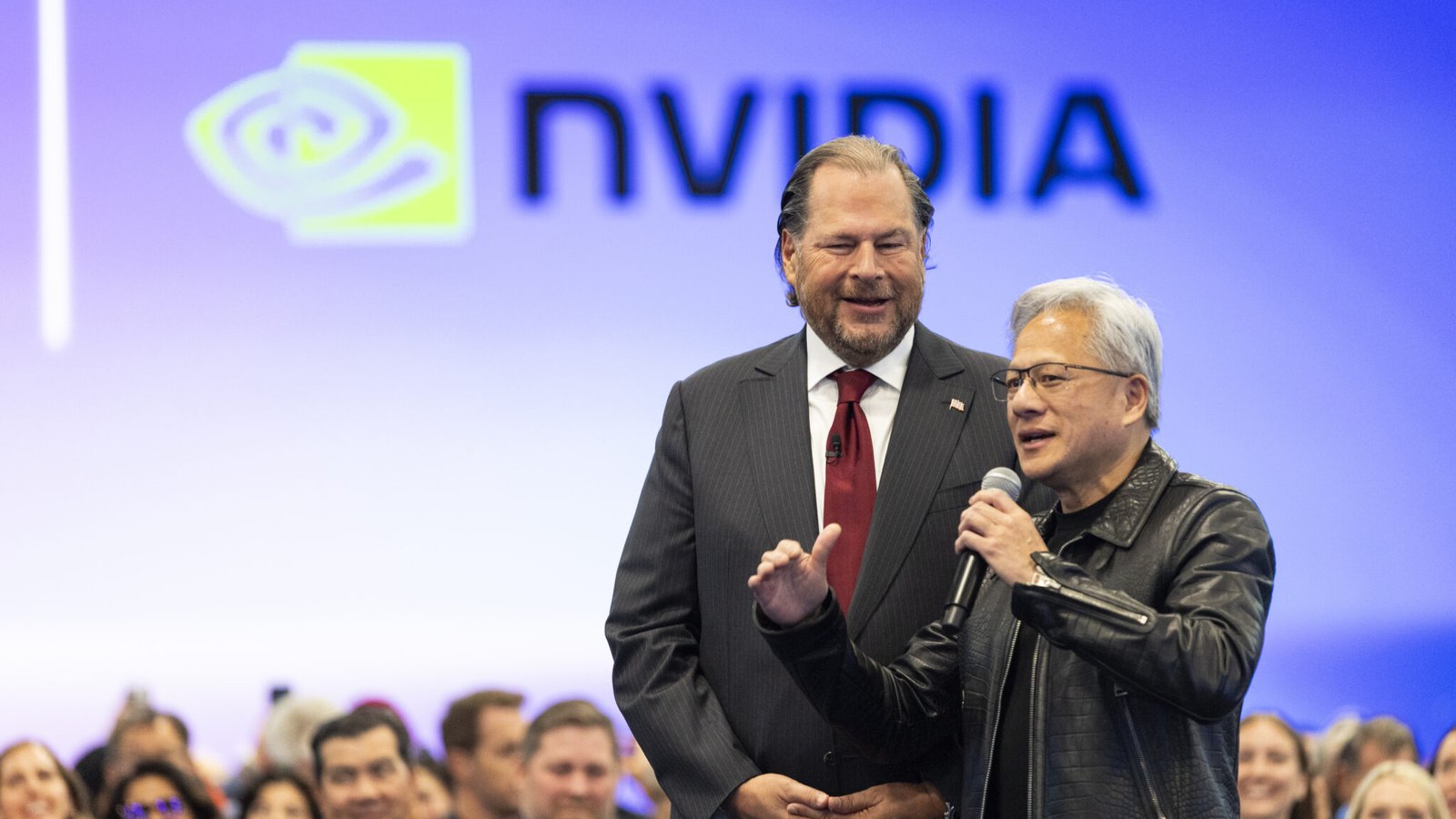
Salesforce has unveiled Koa, its first CRM-specific reasoning model for Agentforce, built on NVIDIA’s Nemotron 3 Super and designed to handle complex, multistep enterprise workflows. The announcement came during Dreamforce 2026, where NVIDIA CEO Jensen Huang joined Salesforce CEO Marc Benioff onstage to discuss the expanding role of AI across business. Koa is already running internally at Salesforce and is moving into customer pilots before a broader U.S. release expected this winter.
Koa was created by post-training Nemotron 3 Super on a proprietary synthetic dataset modeled on nearly three decades of Salesforce CRM experience. Rather than using real customer information, Salesforce says the training data consists entirely of synthetic scenarios that simulate tasks such as qualifying sales leads, resolving service cases and navigating company policies. Those scenarios span more than 14 industries, including healthcare, manufacturing, financial services and travel.
Salesforce says the model was trained not just to generate answers but to select tools and complete actions in the correct sequence. The company used supervised fine-tuning alongside reinforcement learning with NVIDIA NeMo RL, NeMo Gym and NeMo AutoModel. That approach is intended to make Koa more specialized for enterprise operations than a general-purpose chatbot, with the model reasoning through workflows such as updating sales opportunities, routing cases and scheduling follow-ups.
The companies are also emphasizing control over data and deployment. Salesforce controls Koa’s model weights and runs both post-training and inference within its own infrastructure, meaning customer data does not need to leave Salesforce’s trust boundary. NVIDIA’s open Nemotron foundation is central to that approach, allowing Salesforce to modify and operate the model itself rather than relying entirely on an externally hosted closed model.
Salesforce claims Koa already matches or exceeds leading models on its internal CRM Bench while making three times fewer errors on CRM actions. The company also reports that the model is 11% more precise when selecting the correct action, recalls customer context with 2.1 times greater reliability and performs 15% better at maintaining context during longer conversations. Those figures come from Salesforce’s own testing and have not been independently benchmarked.
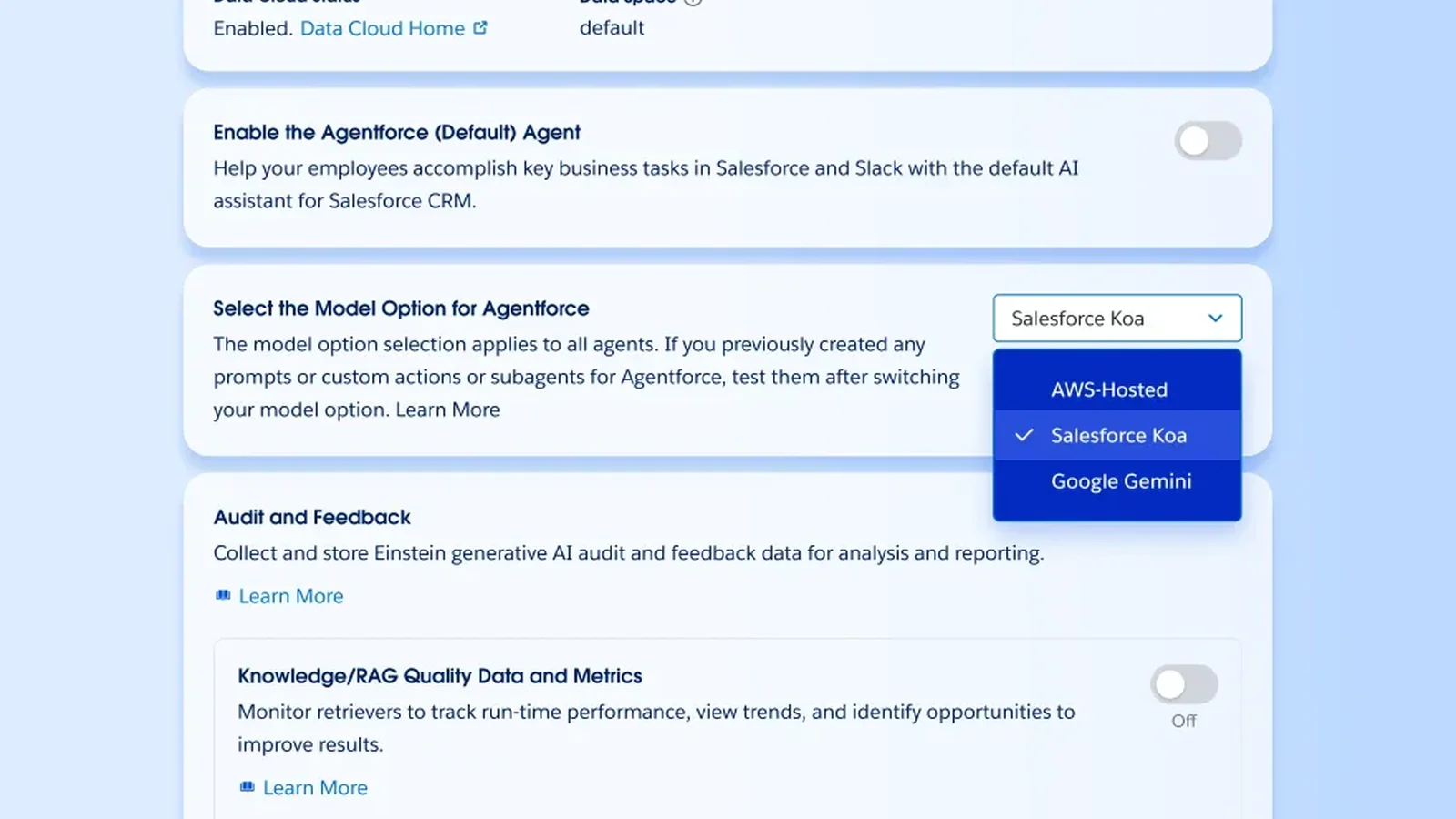
Koa is already powering an employee agent inside Slack, where Salesforce workers can use it to locate information and complete routine tasks. Customer pilots are beginning with organizations including Formula 1, UChicago Medicine, Baxter Credit Union, 1-800Accountant, Engine and Xero. Salesforce expects general availability in U.S. regions during winter 2026, with Koa selectable inside Agentforce as a managed model at the organization, agent or sub-agent level.
The partnership also extends beyond commercial CRM. Salesforce and NVIDIA are bringing Nemotron-based models and accelerated computing into Missionforce, Salesforce’s platform for government and regulated organizations. The companies say customers will be able to train, tune and deploy specialized AI inside private clouds, classified networks and fully air-gapped environments, where sending sensitive information to public infrastructure may not be acceptable.
That broader push reflects how NVIDIA’s open models are increasingly being used as foundations for specialized enterprise systems. CrowdStrike, for example, recently introduced an agentic cybersecurity system built with NVIDIA Nemotron models, applying the same broader strategy of adapting open reasoning models to narrowly defined professional workloads. Salesforce is taking a similar approach by embedding CRM-specific knowledge directly into Koa.
Huang used his Dreamforce appearance to argue that AI is becoming another fundamental layer of computing infrastructure. He said businesses should view safety and rapid development as compatible goals rather than opposing choices, while predicting that companies across industries will increasingly become “agentic enterprises.” NVIDIA itself is already using Salesforce across sales, service, marketing and operations while testing Agentforce for customer-support workflows.
For Salesforce, Koa represents a move toward owning more of the intelligence layer behind Agentforce rather than relying exclusively on general-purpose models from outside providers. The company is positioning its accumulated CRM workflows and operational knowledge as the differentiator, with Nemotron supplying the underlying open model foundation. If Salesforce’s pilot results translate into production environments, Koa could become one of the clearest examples yet of large enterprise software vendors building specialized reasoning models around their own domain expertise.
