


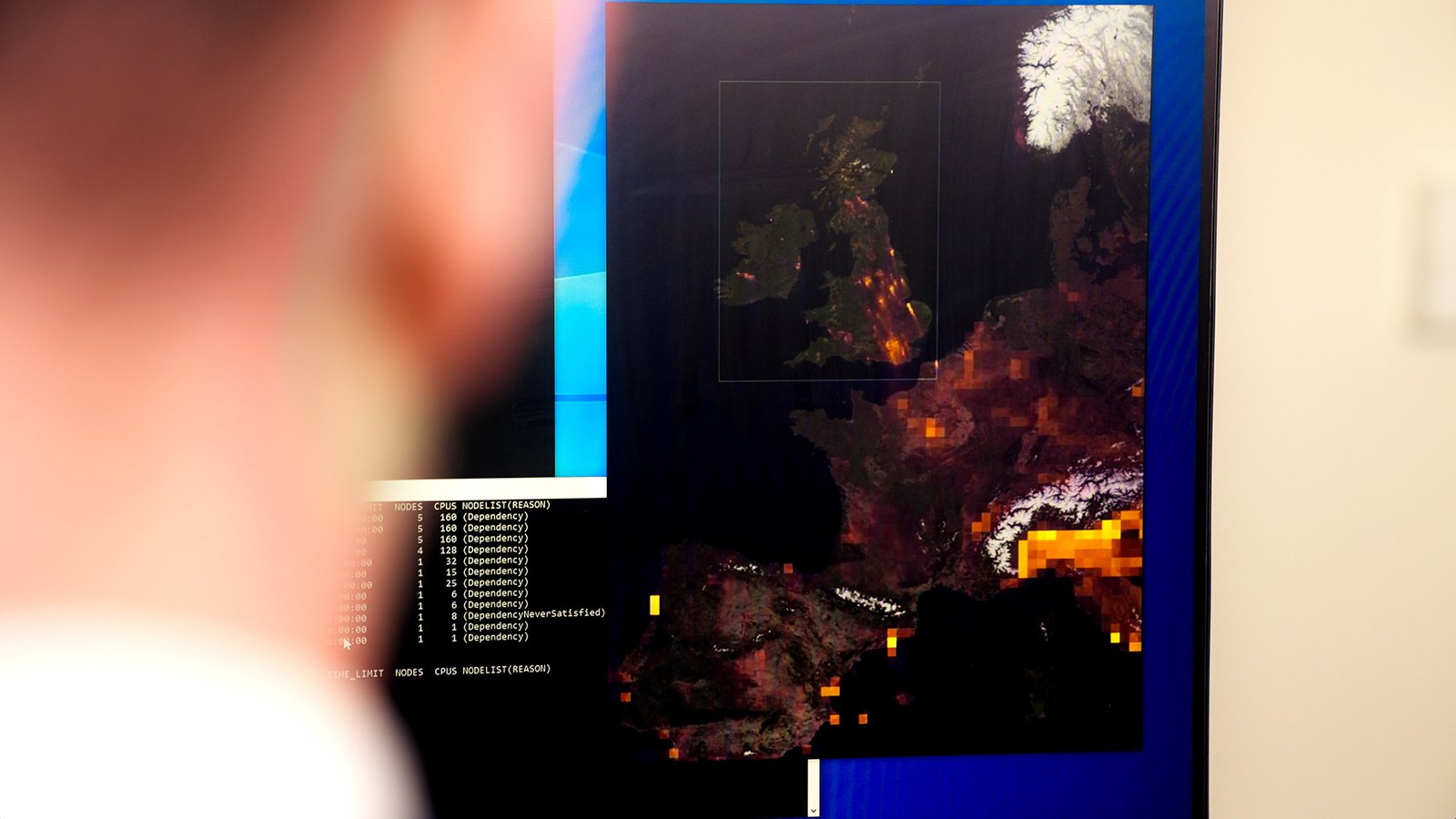
University of Manchester researchers are using NVIDIA Earth-2 to accelerate air pollution forecasting across the UK, applying generative AI techniques originally developed for weather and climate modeling. The project uses Earth-2 models to turn computationally expensive chemistry simulations into faster, higher-resolution pollution forecasts that could eventually support public-health warnings and policy analysis. NVIDIA detailed the work on September 15 alongside researchers David Topping and Hao Zhang.
Traditional air-quality forecasting combines atmospheric physics with complex chemistry, making the models expensive to run frequently at high resolution. Topping, a professor in the University of Manchester’s Department of Earth and Environmental Sciences, worked with NVIDIA’s Earth-2 team to test whether generative weather-modeling techniques could be adapted for pollution fields. The researchers generated training data from existing chemistry-climate simulations and trained NVIDIA’s CorrDiff generative downscaling model on the UK’s Isambard-AI supercomputer.
The initial model used a full year of simulated UK pollution data recorded at hourly intervals. Training was completed in two days on a single eight-GPU node of Isambard-AI, producing a nationwide pollution model with a spatial resolution of roughly two to three square kilometers. NVIDIA says the same workflow can now perform inference and smaller training runs on a DGX Spark desktop system powered by the GB10 Grace Blackwell superchip.
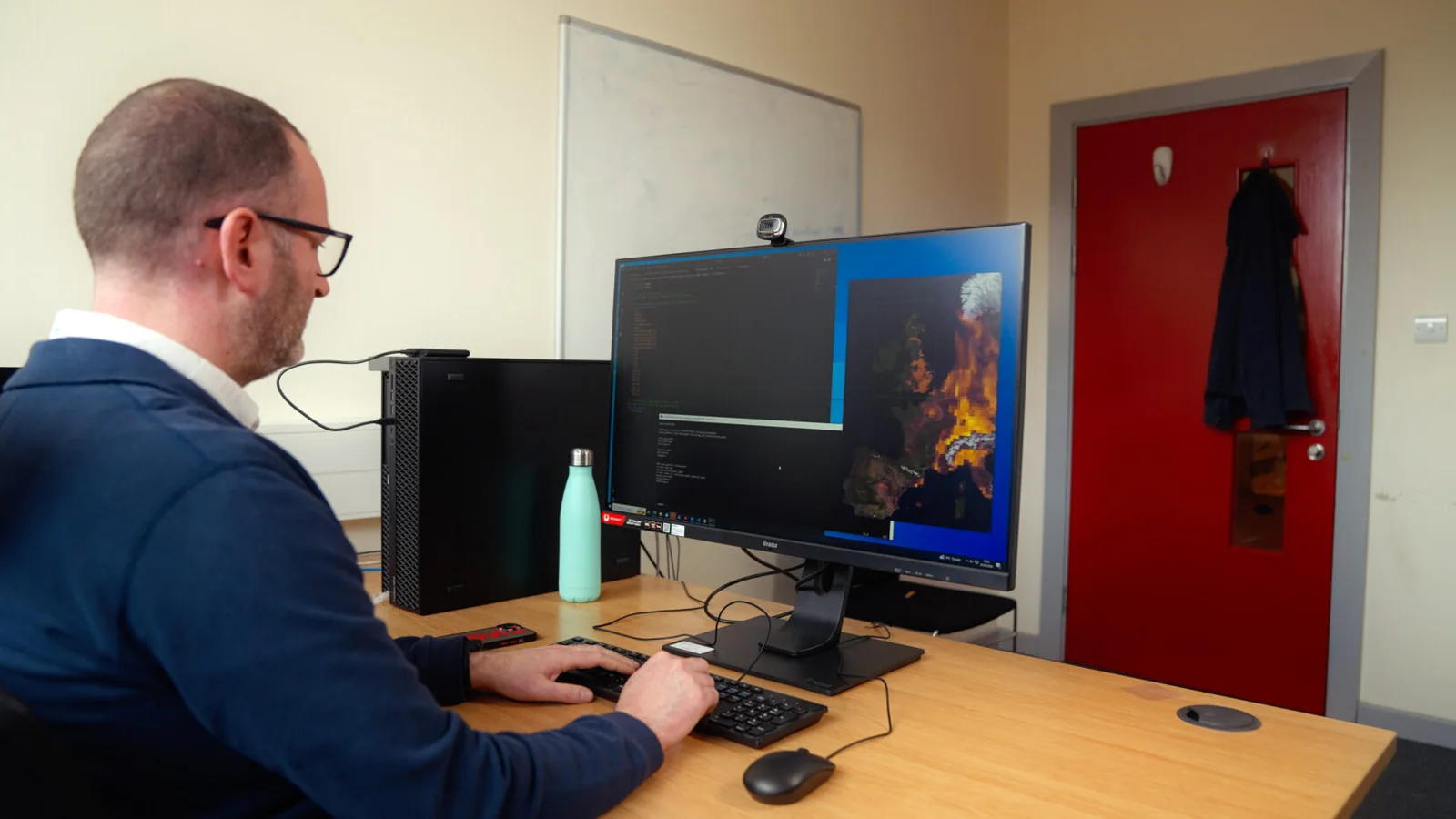
The team has also incorporated Earth-2 StormCast, allowing the system to produce time-dependent forecasts that make direct use of air-quality observations. Doctoral researcher Hao Zhang trained the StormCast implementation on Isambard-AI, while the researchers demonstrated that the resulting workflows could run locally on DGX Spark hardware. That shift from a national supercomputer to a desktop system could make experimentation and deployment more accessible to smaller research groups.
One potential use is providing healthcare organizations with earlier warnings when pollution levels are expected to become dangerous. Topping described a future scenario in which health services could proactively contact people with conditions such as asthma when poor air quality is forecast in their area. The researchers are also investigating how real-time readings from edge devices could feed into the system during fast-changing events such as wildfires.
The technology can also be used to explore policy scenarios rather than only predict short-term conditions. The University of Manchester team says its UK-wide model could estimate how pollution patterns might change under different government policies, giving researchers a way to test possible interventions computationally. Future versions are planned to incorporate additional open datasets so the model can eventually move from regional resolution toward street-level air-quality predictions.
The project is built around Earth-2 CorrDiff, which NVIDIA designed to downscale relatively coarse weather or climate information into much higher-resolution regional fields. NVIDIA has previously said CorrDiff can generate regional forecasts hundreds of times faster than traditional downscaling approaches. In this case, the Manchester team is adapting that architecture from weather variables to chemically complex pollution data rather than building an entirely new forecasting system from scratch.
NVIDIA says the researchers plan to release their pollution-model training data and workflows as open source. The longer-term goal is to allow other countries and cities to create similar models using their own local pollution observations and relatively short bursts of supercomputer training time. Once trained, those models could potentially run on far smaller systems for routine forecasting and experimentation.
Topping ultimately envisions an agent-based interface capable of connecting air-quality observations, trained models and downstream applications automatically. A clinician or government agency could ask for expected pollution conditions in a particular neighborhood, with the system handling the modeling workflow behind the request. That remains a longer-term goal, but the current project demonstrates that Earth-2’s generative weather frameworks can already be adapted to nationwide air-quality modeling while sharply reducing the computing required to use them.
