


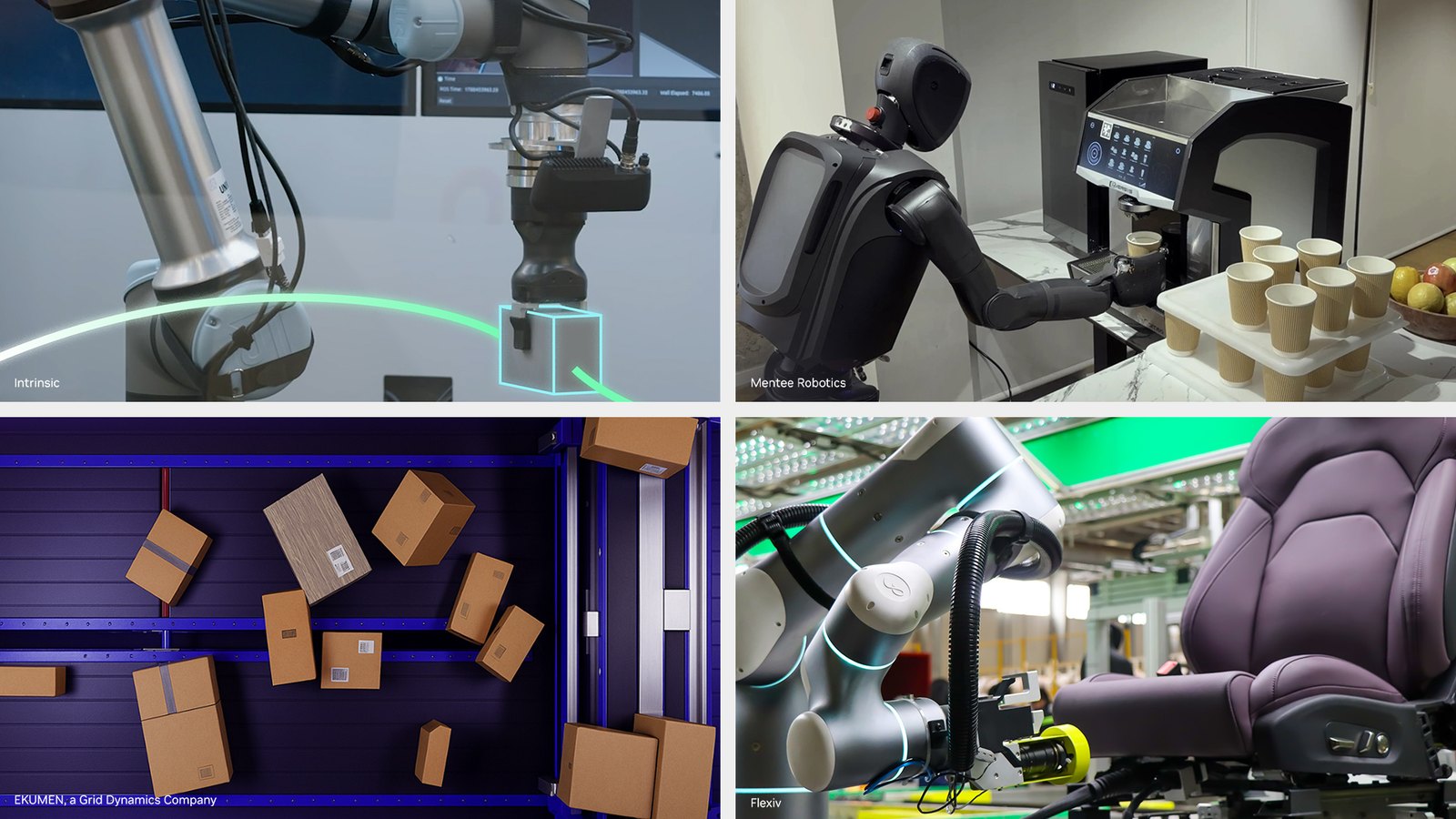
NVIDIA has released Isaac ROS 5.0, a major update to its open-source robotics software stack that adds agent-ready development workflows, support for the latest ROS platform and significant changes to how GPU-accelerated ROS messages are handled. The release debuted at ROSCon in Toronto and is available now as a free, open-source package collection. NVIDIA says the update is intended to help both developers and AI agents build and deploy robotics applications more efficiently.
Isaac ROS 5.0 moves to ROS 2 Lyrical Luth and Ubuntu 24.04 as its supported software foundation. NVIDIA worked with the Open Source Robotics Alliance on a standard data-handling interface designed to let ROS software operate efficiently across different computing hardware, including GPUs. CUDA serves as one implementation for GPU acceleration, while the broader interface is available to the ROS community rather than being limited to NVIDIA-specific packages.
The underlying messaging architecture has also changed substantially. NVIDIA rebuilt its accelerated data path around the standard ROS 2 rosidl::Buffer interface and a CUDA buffer backend, allowing supported ROS messages containing array fields to be backed by GPU memory. That replaces much of the previous NITROS-specific architecture and means developers whose applications directly use NITROS APIs or data types will need to migrate source code for Isaac ROS 5.0.
As part of that transition, several standalone NITROS packages have been removed, including isaac_ros_nitros, isaac_ros_managed_nitros, isaac_ros_pynitros and associated NITROS type packages. NVIDIA has retained the NITROS bridge package temporarily but marked it as deprecated, with removal planned in a future release. Applications relying only on standard ROS interfaces should be less affected than code built directly around older NITROS APIs, but NVIDIA has published migration guidance for developers who need to update existing projects.
Agentic development is another major focus of the release. NVIDIA has introduced reusable Isaac skills for tasks including setup and manipulation, alongside documentation structured so AI agents can more easily understand Isaac ROS tools and development procedures. A new FoundationStereo fine-tuning skill can guide an agent through adapting the stereo perception model to a particular camera setup, environment or robotics application.
FoundationPose also receives an agent-ready inference library, with NVIDIA claiming object pose estimation and tracking can run up to 5.5 times faster in supported workflows. Pick-and-place functionality is now available as a standalone agent-ready skill as well, separating the workflow from larger Isaac ROS application structures and giving developers more flexibility when assembling manipulation systems. The broader direction mirrors NVIDIA’s push to apply AI reasoning tools across other technical workloads, including real-time AI production and media workflows.
NVIDIA is also expanding hardware coverage across its Jetson line. Isaac ROS 5.0 supports systems ranging from Jetson Orin Nano through higher-performance Jetson Thor hardware, allowing developers to use a shared robotics software foundation across different performance tiers. Companies including Mentee Robotics, Universal Robots, ROBOTIS, Flexiv, Magna and FieldAI are highlighted by NVIDIA as users or integrators of Isaac ROS technologies for perception, manipulation, navigation and industrial robotics.
The release includes practical fixes alongside the architectural changes. NVIDIA says it resolved a GPU buffer leak affecting Segment Anything 2 live-camera segmentation pipelines, where memory usage could grow until CUDA ran out of available memory. Other fixes address RealSense segmentation-mask workflows, occupancy-grid localization launch failures and several deployment and debugging issues.
Isaac ROS 5.0 also arrives as NVIDIA continues broadening the role of its AI models and infrastructure beyond traditional GPU computing. Its Nemotron family is already being used for specialized reasoning systems such as Salesforce’s Koa CRM model, while Isaac ROS applies similar agent-oriented concepts directly to physical systems and robotics development.
NVIDIA Isaac ROS 5.0 is available now through the project’s open-source repositories. For existing developers, the biggest practical consideration is the move away from direct NITROS APIs toward standard ROS 2 buffer interfaces, while new projects gain access to agent-ready workflows, updated ROS support and a broader path from development systems to deployed Jetson-based robots.
