


A hardware researcher has demonstrated a method of unlocking 80GB of high-bandwidth memory and additional computing capabilities on NVIDIA’s CMP 170HX cryptocurrency mining GPU, transforming an originally 8GB card into an accelerator with capabilities comparable to the A100 80GB. The modification uses voltage fault injection to bypass hardware restrictions and permanently alter the GPU’s fuse configuration.
The researcher, known as Kate, published the findings on November 10, 2026, documenting how the technique enables approximately 120 to 126 functional streaming multiprocessors (SMs), PCIe Gen4 connectivity and NVLink support. In a published FP16 compute benchmark, a modified CMP 170HX achieved 85.861 TFLOP/s, approximately 18% higher than the 72.488 TFLOP/s recorded for a retail NVIDIA A100.
The results represent a substantial change for a graphics processor originally designed for cryptocurrency mining. However, the modifications require specialized electronics, physical changes to the circuit board and irreversible fuse programming. The reported performance figures come from the researcher’s own testing and have not been independently verified.
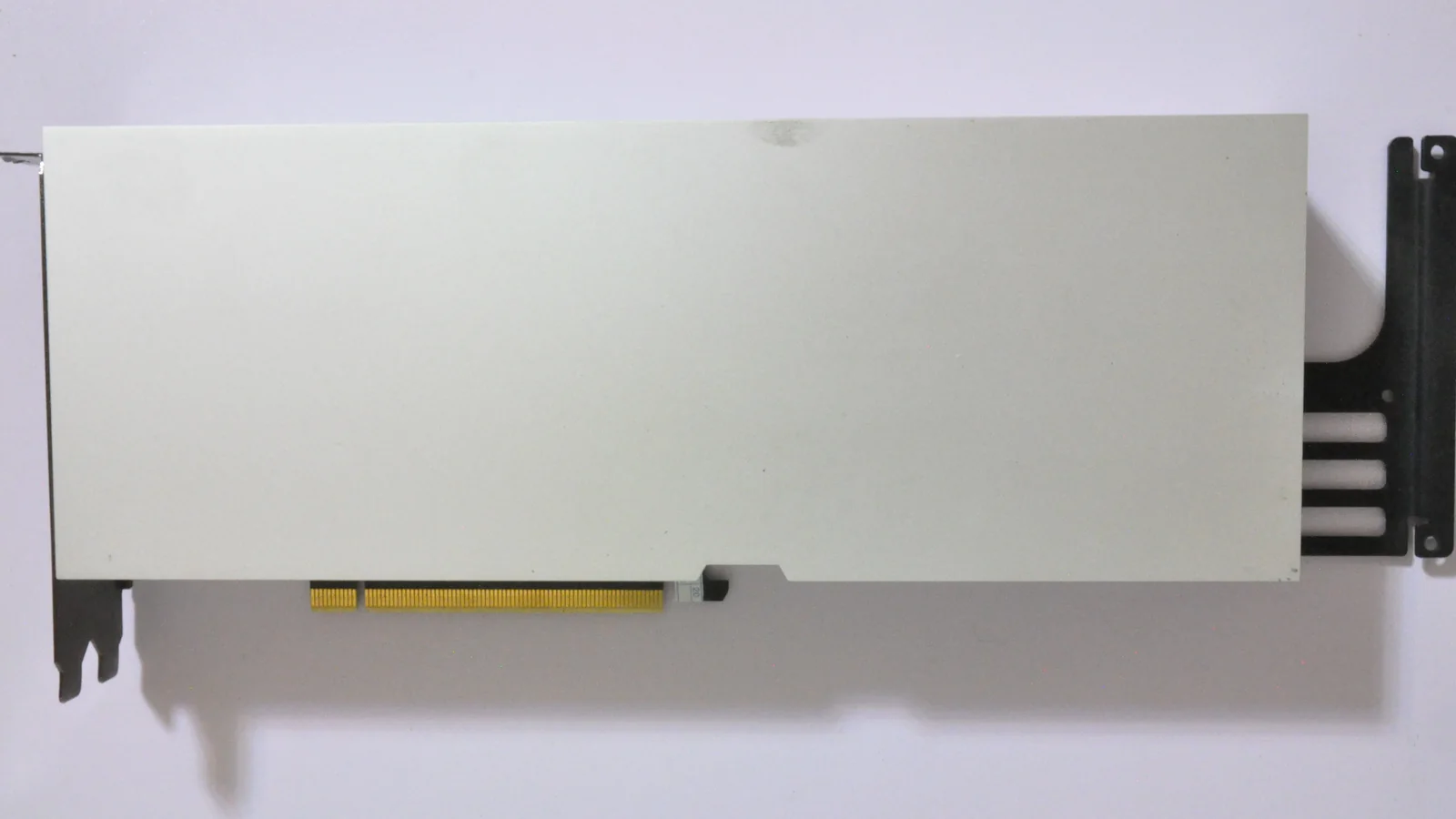
The CMP 170HX uses NVIDIA’s GA100 architecture, the same underlying GPU design found in the company’s A100 data-center accelerators. Although the 8GB mining model exposes only a small amount of memory to applications, Kate’s research indicates that many of these cards physically contain substantially more HBM than their advertised specifications suggest.
According to the published findings, nine of ten examined CMP 170HX 8GB cards contained a functional 80GB framebuffer. The remaining specimen had only 64GB of usable memory, demonstrating that the available capacity depends on the individual GPU.
Earlier software-based modifications had already allowed the 8GB CMP 170HX to access up to 64GB of memory. Kate’s new approach goes further by changing the underlying hardware configuration responsible for disabling additional memory partitions and computing units.
NVIDIA uses electrically programmable fuses, commonly called eFuses, to configure different products manufactured from the same GPU architecture. These settings can disable defective hardware blocks or restrict features to differentiate products.
Kate identified a vulnerability in the GA100 fuse controller that reportedly allows additional fuses to be programmed after certain security restrictions are bypassed. Importantly, some of the controller’s configuration records can be superseded by writing new records, effectively removing restrictions without physically reversing previously programmed fuses.
The researcher achieved this through voltage fault injection, a technique that briefly disrupts the electrical supply to produce unexpected behavior inside a processor.
The experimental setup uses a custom STM32G4-based controller connected to the CMP 170HX circuit board. By manipulating the GPU’s voltage regulation signals during startup, Kate was able to reach a state in which the fuse controller’s normal programming restrictions could be bypassed.
Once this state was achieved, the researcher could program additional fuse records to enable functional hardware blocks previously disabled by the card’s configuration.
The process is considerably more complicated than installing a modified driver or changing a firmware setting. It involves removing a small surface-mounted resistor, attaching wires to the GPU board and carefully configuring voltage pulses. The correct modification also varies between individual cards, particularly because physically defective GPU components must remain disabled.
One of the most significant improvements involves the number of accessible streaming multiprocessors.
The CMP 170HX normally operates with 70 SMs enabled, despite the underlying GA100 design containing as many as 128. NVIDIA’s production A100 accelerators typically expose 108 SMs.
Kate reports that modified cards can operate with approximately 120 to 126 functional SMs, depending on the condition of the individual silicon. One published OpenCL benchmark identifies 124 compute units operating at 1,410MHz.
The researcher’s ProjectPhysX OpenCL benchmark produced the following FP16 FMA throughput measurements:
Software-unlocked CMP 170HX: 50.129 TFLOP/s
Retail NVIDIA A100: 72.488 TFLOP/s
Hardware-unlocked CMP 170HX: 85.861 TFLOP/s
These results suggest that the hardware modification improves FP16 throughput by approximately 71% compared with the software-unlocked mining card and 18% compared with the retail A100 in the same benchmark.
The figures measure a specific floating-point computation workload rather than overall GPU performance. They do not establish equivalent improvements in AI inference, rendering, gaming or other applications, where memory bandwidth, software compatibility and additional hardware characteristics can affect results.
Kate also reports successfully validating the unlocked framebuffer through synthetic memory testing and workloads using vLLM and SGLang. The memory tests involved writing data across the available framebuffer and verifying the results after invalidating the GPU’s L2 cache, helping distinguish genuinely accessible memory from apparent capacity caused by caching or memory aliasing.
Beyond memory and computing performance, the modification reportedly restores several capabilities disabled on the mining-oriented hardware.
The standard CMP 170HX operates with restricted PCIe connectivity. Earlier software modifications could enable PCIe Gen2, but Kate’s hardware approach reportedly removes the relevant restrictions for PCIe Gen3 and Gen4 operation. With an additional circuit-board modification involving PCIe decoupling capacitors, the researcher states that PCIe Gen4 x16 connectivity is achievable.
NVLink functionality can also be restored, allowing compatible GPUs to communicate through NVIDIA’s dedicated interconnect. This requires additional board-level work because the CMP 170HX lacks a component needed to activate the reference clock generator on attached NVLink bridges.
Kate’s published system information shows two modified GPUs, each reporting 81,920 MiB of memory, connected through NVLink.
Other GA100 capabilities, including video decoding and Multi-Instance GPU functionality, may also be accessible through related fuse modifications. However, Kate explicitly states that NVDEC, NVJPG and MIG were not specifically tested, so their practical functionality remains unconfirmed.
The research is particularly notable because it demonstrates how much of a GPU’s physically manufactured hardware can remain inaccessible through product-specific restrictions. It also highlights the difference between software-based GPU unlocking and modifying the permanent configuration stored within a processor.
The approach has some similarities to efforts to unlock additional GPU computing capabilities through firmware and low-level configuration changes. A separate UEFI-based NVIDIA RTX Tensor performance unlock targets consumer GeForce hardware through a different method, without the physical fuse programming involved in Kate’s GA100 research.
Nevertheless, the CMP 170HX should not be confused with a conventional GeForce graphics card. It was developed for cryptocurrency mining, while the A100 architecture primarily targets data-center computing and AI workloads. Neither the published benchmark results nor the researcher’s demonstrations establish improved gaming performance or compatibility with modern games.
The research also does not establish that a modified CMP 170HX is a complete replacement for a commercially manufactured A100. Hardware defects, memory capacity differences, power characteristics and untested accelerator features remain important limitations.
Although the discovery has prompted comparisons between relatively inexpensive mining cards and much more expensive data-center accelerators, successfully unlocking the hardware is not guaranteed. Kate’s sample included a card without the full 80GB of functional memory, and incorrectly modifying the fuses or circuitry could permanently damage the GPU.
Kate has published technical documentation and supporting research code, and states that the vulnerability was disclosed to NVIDIA’s product security team before publication.
For GPU hardware enthusiasts, the findings provide a detailed demonstration of how voltage manipulation can overcome processor-level restrictions that software modifications alone cannot bypass. The reported 80GB framebuffer and additional compute units offer potential value for specialized computing workloads, but the technique remains an experimental hardware modification rather than a practical upgrade for ordinary PC gamers.
