


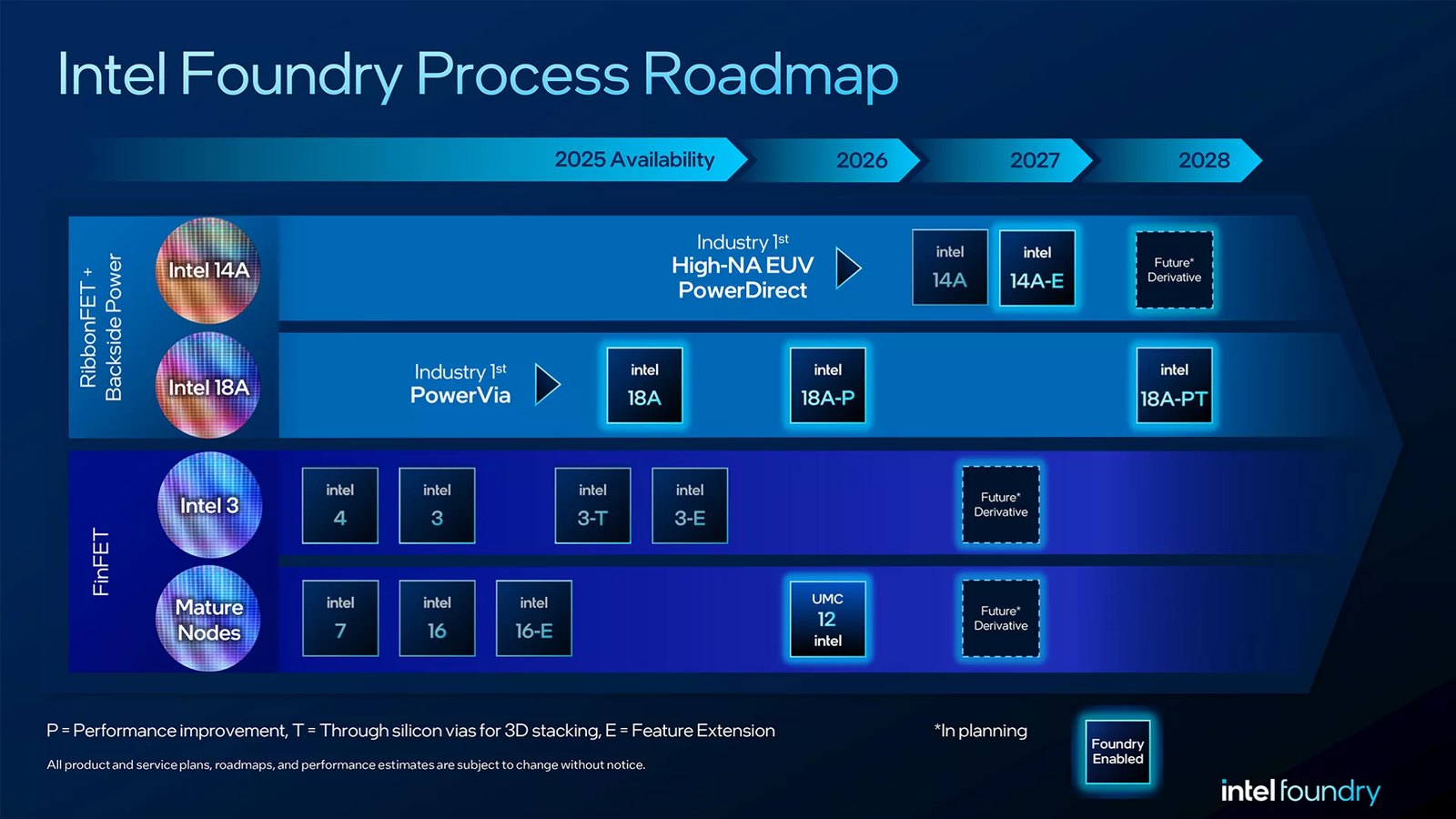
Intel has released version 0.9 of its 14A process design kit (PDK), giving semiconductor customers a more mature environment for developing chips using the company’s next-generation manufacturing technology. The release took place in October 2026, with Intel Foundry confirming that the design kit incorporates models validated against actual silicon. Intel expects to deliver PDK version 1.0 in the first quarter of 2027, ahead of its planned transition toward commercial production.
The milestone was confirmed in an official Intel Foundry technical discussion featuring Ben Sell, corporate vice president and general manager of front-end technology development, and Ali Farhang, corporate vice president and general manager of the Foundry Design Technology Platform organization. Both executives outlined how the updated design kit improves confidence in Intel 14A as the company prepares the manufacturing process for future semiconductor products.
A process design kit provides the transistor models, physical design rules and supporting information required to develop chips for a particular manufacturing technology. Semiconductor designers use these resources alongside electronic design automation software to translate processor architectures into manufacturable designs.
The significance of PDK 0.9 lies in its silicon-backed validation. Rather than relying exclusively on preliminary simulations, the updated models incorporate information obtained from manufactured silicon, allowing customers to make design decisions using a more representative description of the process.
Intel says the release provides sufficient process maturity for customers to begin designs intended for manufacturing around the time the node becomes qualified for production. However, the availability of PDK 0.9 does not mean Intel 14A is ready for commercial mass manufacturing.
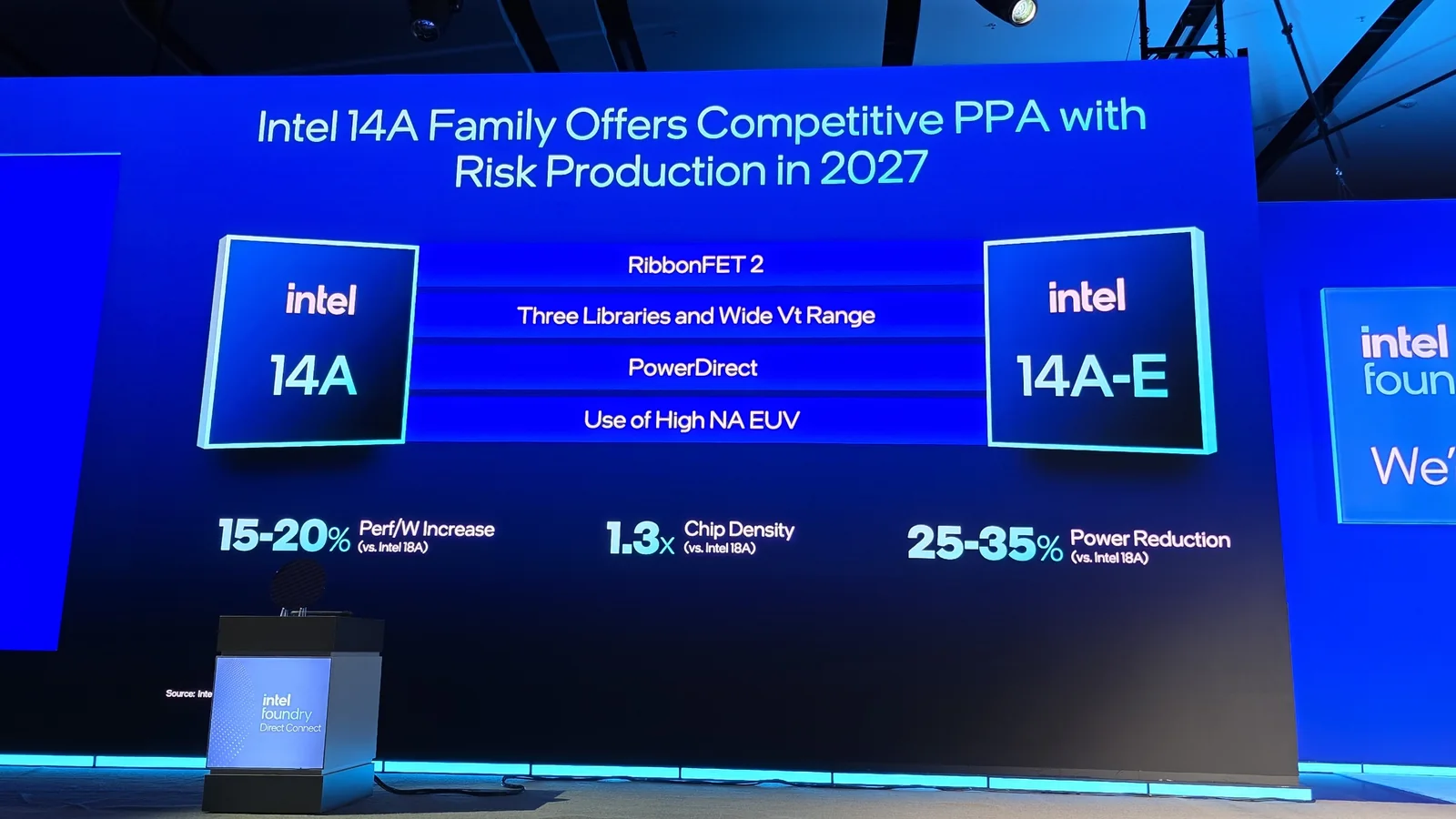
Intel 14A introduces several technologies intended to improve semiconductor performance and power efficiency compared with earlier manufacturing processes.
One of the main changes is RibbonFET 2, Intel’s second-generation gate-all-around transistor architecture. It builds on the RibbonFET technology introduced with Intel 18A, continuing the company’s transition away from conventional FinFET transistor designs.
Another improvement is PowerDirect, Intel’s updated backside power delivery technology. Backside power delivery separates electrical power routing from portions of the signal-routing network, helping address the increasing complexity of manufacturing densely packed processors. PowerDirect advances the approach introduced with PowerVia on Intel 18A by delivering power more directly to transistor regions.
Intel 14A also introduces Turbo Cells, specialized standard cells intended to give chip designers additional flexibility when optimizing performance-critical portions of a processor. These cells can help designers prioritize speed in selected circuits while balancing power consumption and area elsewhere in the design.
These technologies are relevant to the development of future consumer CPUs and potentially GPUs, where transistor performance, power efficiency and physical density influence processor capabilities. However, Intel has not announced a specific gaming processor or graphics product using 14A, and no real-world gaming performance improvements have been demonstrated from this PDK release.
The technical improvements also place Intel 14A within a competitive semiconductor manufacturing landscape. TSMC is developing its own A14 process, with reported SRAM density improvements highlighting another area where advanced manufacturing technologies could influence future processor and cache designs.
Intel’s current development work is focused not only on transistor capabilities but also on improving manufacturing yields, process variation and production cycle times. The company says lessons learned from Intel 18A are being incorporated into 14A development, alongside increased investment in defect detection, modeling and manufacturing simulation.
The design ecosystem is also progressing. Intel confirmed that Cadence, Keysight, Siemens and Synopsys have announced design-tool certifications supporting Intel 14A. These partnerships help ensure semiconductor developers have access to compatible design software and intellectual property as the manufacturing technology matures.
Intel has separately confirmed that its own product teams are developing designs for the 14A process. This establishes internal demand for the technology, although it does not identify which future consumer or enterprise processors will ultimately use the node.
During earlier discussions of its manufacturing roadmap, Intel outlined plans to begin risk production on 14A during the second half of 2027, followed by high-volume manufacturing in 2028. Risk production represents an intermediate stage in which a manufacturing process is tested and refined before large-scale commercial output.
The company has previously outlined targets of approximately 15% to 20% higher performance at equivalent power, or 25% to 35% lower power consumption at equivalent performance, compared with Intel 18A. These are process-level targets rather than independently verified performance figures for finished processors. Intel’s latest PDK announcement does not introduce new benchmark results or updated numerical performance claims.
For PC enthusiasts, the practical significance of PDK 0.9 is that Intel’s next-generation manufacturing process has advanced beyond early development models and is becoming more suitable for actual chip design. The milestone does not affect processors currently available to consumers.
Intel’s longer-term manufacturing plans also come amid changes to its existing processor production priorities, including the allocation of manufacturing capacity between consumer and server processors. Those decisions concern current production resources rather than confirmed changes to the Intel 14A roadmap.
The next major milestone is PDK 1.0, which Intel Foundry expects to release in the first quarter of 2027. That version is intended to provide a more complete and stable design environment as Intel continues improving the process toward production readiness.
For now, the confirmed development is the availability of a silicon-validated PDK 0.9 and Intel’s reaffirmed schedule for the next release. The timing of any consumer CPU or GPU built using Intel 14A remains unannounced.
