


Researchers in China have experimentally demonstrated a quantum protocol capable of securely verifying a device’s position using two verification stations separated by 2 kilometers. The system constrained the test device’s possible location to within 74.3 meters, combining quantum communication with relativistic timing limits to make false location claims substantially harder. The work was published in Nature Physics on September 3 by researchers led by teams at the University of Science and Technology of China and Guangdong University of Technology.
The technique is known as quantum position verification, or QPV. Unlike conventional positioning systems that primarily determine where a device appears to be, QPV is designed to verify whether an untrusted device is actually located where it claims. That distinction matters in scenarios where attackers could otherwise manipulate reported coordinates, spoof satellite-navigation signals or relay authentication messages from another location.
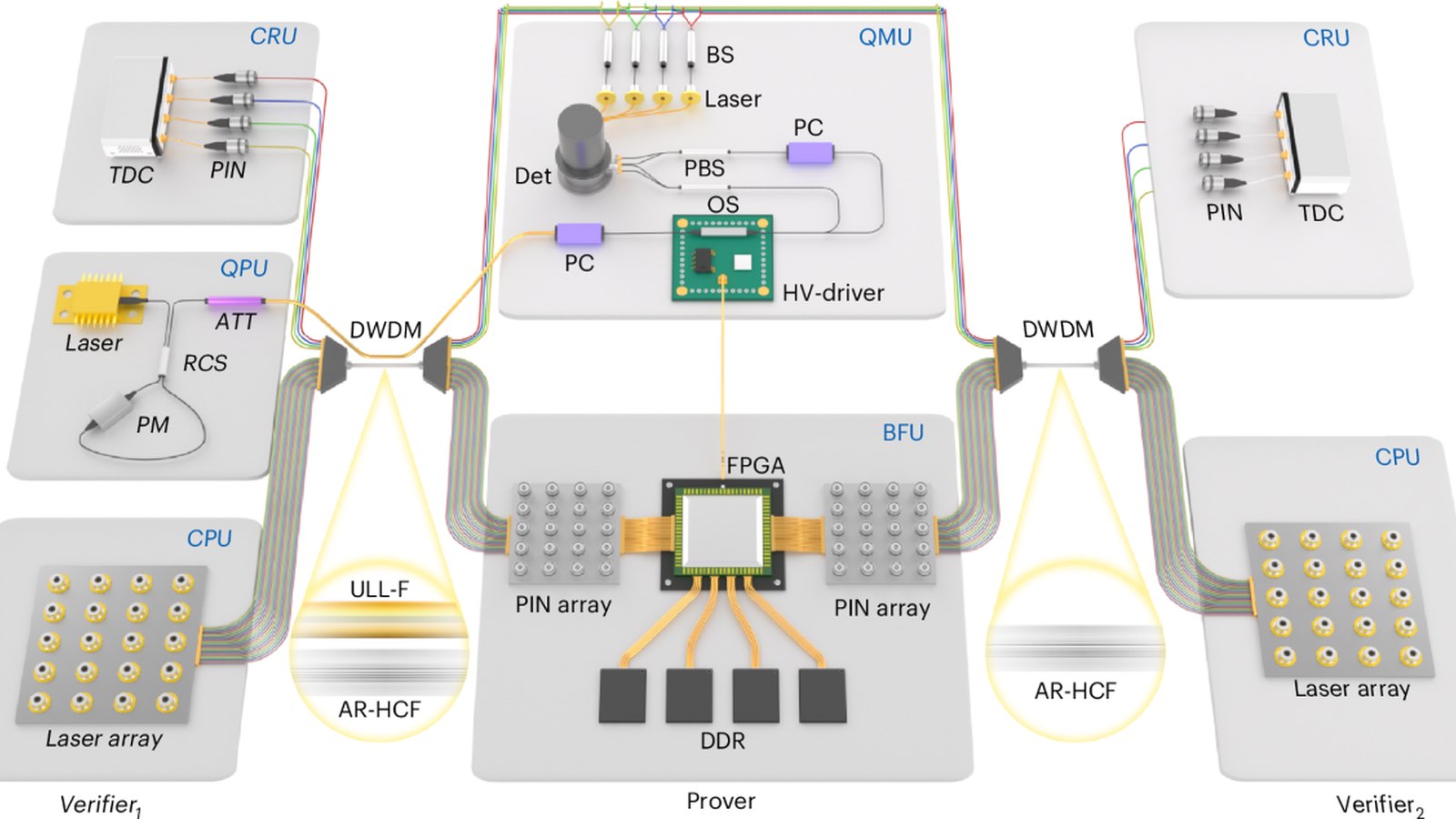
The experiment uses two spatially separated verifier stations and a device referred to as the prover. Both stations send classical information toward the prover, while one also transmits a quantum optical state. The prover must use the incoming information to determine how to measure that quantum state and then immediately return the result to the verifiers.
Timing is critical because the protocol is constrained by the speed of light. An honest prover at the expected location can receive the challenges, perform the required measurement and return the result within a predictable time window. A device attempting to impersonate that location from somewhere else has less freedom to intercept, coordinate and resend the required information without introducing additional delay.
For the demonstration, the researchers placed the verifier stations 2 km apart and sent verification streams at a frequency of 2 MHz. The quantum portion used phase-randomized weak coherent states rather than idealized single-photon sources, which are more difficult to implement practically. The researchers also used low-loss optical components and superconducting single-photon detectors to reduce transmission losses and measurement errors.
The system completed 10 million verification rounds during the experiment. According to the Nature Physics paper, the prover’s largest measured response delay was 247.8 nanoseconds, corresponding to an allowable position range of 74.3 meters. The researchers describe that precision as relevant to building-scale secure zones, where proving that a device is inside a particular office, facility or restricted area could be more important than obtaining meter-level navigation coordinates.
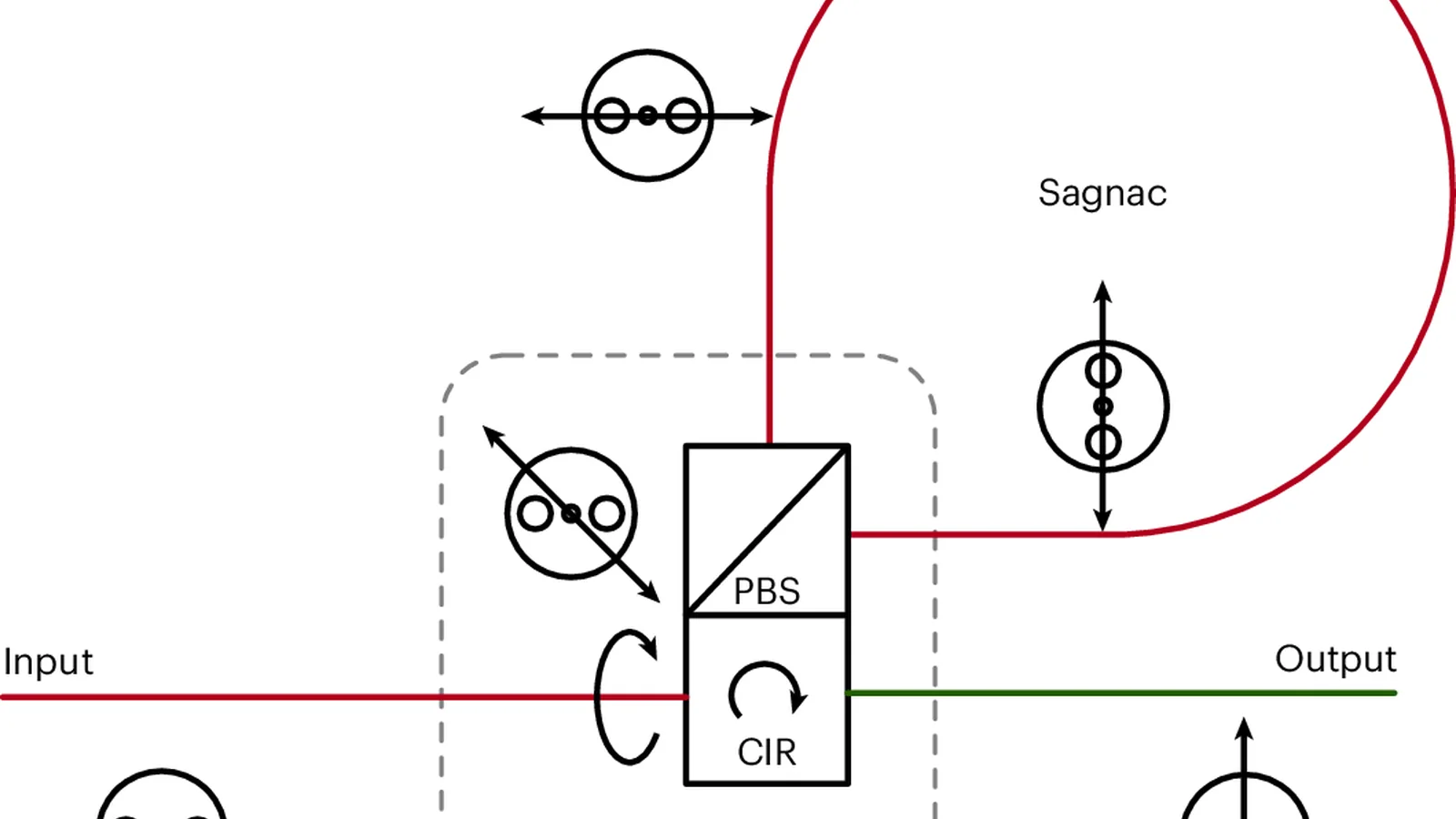
Reducing latency was one of the project’s main engineering challenges. The classical communications path used dense wavelength-division multiplexing and hardware lookup tables, while hollow-core fiber was used to reduce propagation delay. On the quantum side, the team employed low-loss optical switching and detectors with approximately 90% efficiency, helping the overall quantum subsystem reach around 70% transmission efficiency.
The security model relies on both quantum-mechanical constraints and relativity. Because quantum information cannot simply be copied perfectly and communication cannot travel faster than light, attackers attempting to coordinate responses from locations outside the permitted region face physical restrictions that do not apply to conventional software-based location checks. The researchers argue that this provides a path toward position authentication that does not require trusting the device being verified.
The team has suggested applications including financial transactions restricted to particular locations, access to databases from authorized facilities, event ticket authentication and vehicle-access systems that only activate when users are physically nearby. Other potential uses include disaster response and tracking high-value assets, although the current experiment remains a research demonstration rather than a deployable consumer positioning system.
There are also practical limitations. The demonstrated setup relies on fiber connections, specialized optical hardware and superconducting detectors, and its 74.3-meter uncertainty is far less precise than modern navigation systems used for ordinary positioning. The significance is instead in securely verifying a claimed location under an adversarial model, rather than replacing GPS for navigation.
The Nature Physics experiment shows that quantum position verification can move beyond theoretical protocols into functioning hardware over kilometer-scale distances. Future work will need to extend the usable range, reduce positional uncertainty and simplify the equipment before the technique can become practical outside specialized infrastructure.
