


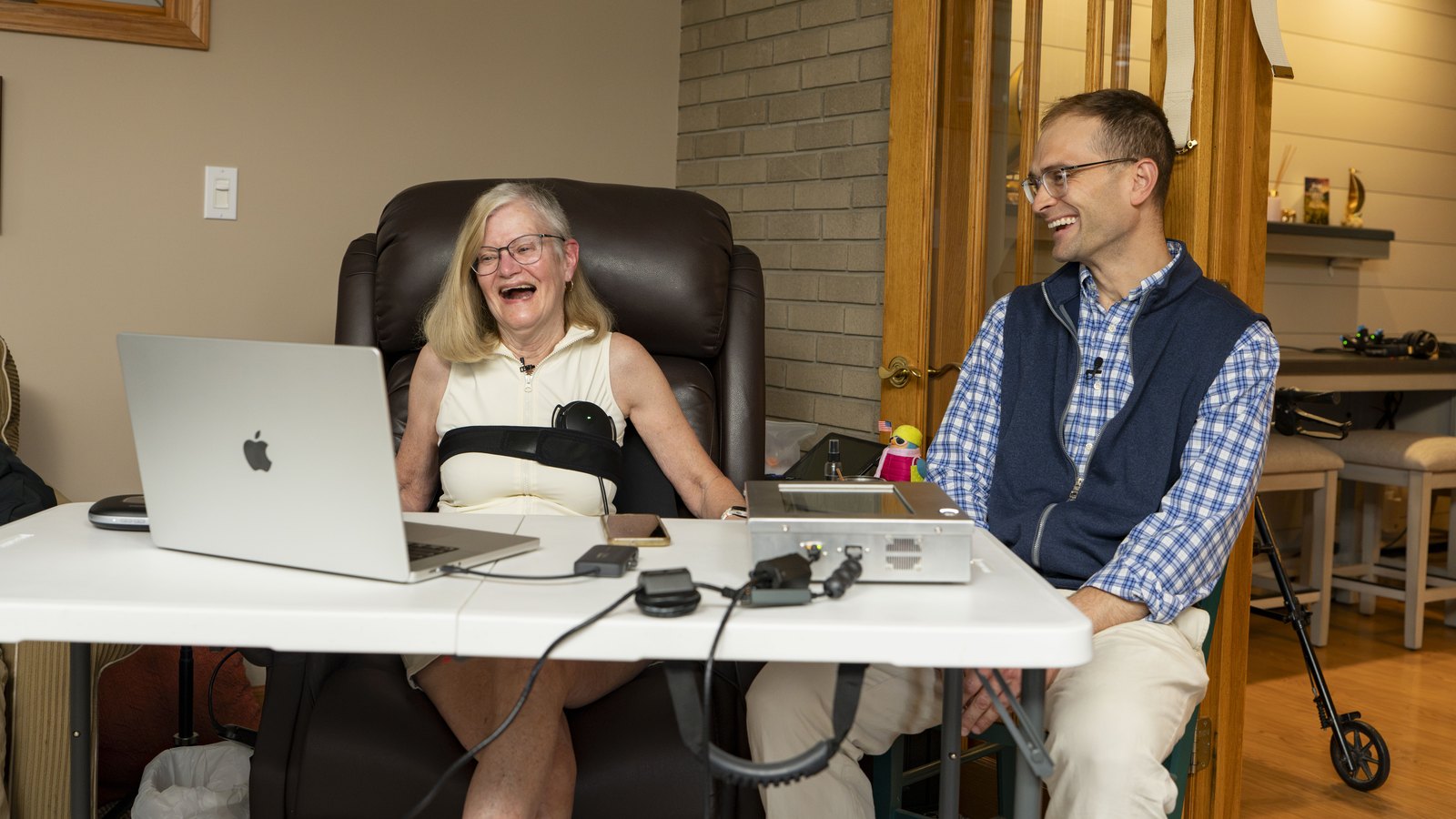
Paradromics says the first participant in its long-term Connexus brain-computer interface trial has used the implanted system to generate spontaneous speech and text in real time. The Michigan woman, who has a progressive motor neuron disease that has severely affected her ability to speak, was able to choose her own words, answer open-ended questions and communicate with her grandchildren during a phone call. The milestone goes beyond earlier copying exercises in which participants repeat phrases selected by researchers.
The demonstration is part of Paradromics’ Connect-One Early Feasibility Study, which is operating under an FDA-approved Investigational Device Exemption. Paradromics implanted the Connexus system in the participant at University of Michigan Health in June 2026, making her the first person to receive the device for long-term use. The New York Times separately reported that the participant is 68 and has lost most of her natural speaking ability.
Connexus records activity from the area of the brain associated with speech movement and converts those neural signals into language using machine-learning software. Paradromics says the resulting output can appear as text and be spoken aloud by a synthesized voice, creating a continuous communication loop rather than requiring the user to construct an entire sentence through another assistive interface. During one demonstration, the participant selected her own first message: “OK, I have a lot to say.”

One of the more notable findings is that Paradromics says it can distinguish neural activity associated with attempted speech from activity associated with imagined speech. Attempted speech occurs when a user actively tries to produce words using the speech muscles, even if those movements are too impaired to be understood. Imagined speech, by contrast, involves internally generating the words without attempting to physically say them.
The company reports that the participant was able to produce decoded language using both approaches. Paradromics chief scientific officer Vikash Gilja told The New York Times that imagined-speech decoding was less clear than attempted speech and could move in and out of focus, indicating that this part of the system remains at an early stage. Being able to separate imagined speech from listening and attempted speech is also important because a practical BCI would need to avoid unintentionally turning a user’s internal thoughts into outward communication.
The hardware itself is designed to avoid the external cable connections used by many earlier intracortical BCI systems. Connexus contains 421 microelectrodes that extend about 1.5 millimeters below the brain’s surface and record activity from individual neurons. Those signals travel to a small implanted transceiver in the chest, which sends the information wirelessly through the skin to an external receiver connected to the processing system.
That wireless design is significant for eventual everyday use because research BCIs have often required participants to connect directly to external computers through ports mounted on the head. Paradromics is attempting to develop a system that can remain fully implanted while still capturing the high-resolution signals required for speech decoding. The company ultimately intends Connexus to support communication and computer control for people with severe motor impairment.
The current result should still be viewed as an early clinical milestone rather than evidence that the technology is ready for general medical use. Connexus remains an investigational device, and the new speech results come from the first participant in an early feasibility study rather than a large clinical trial. The Connect-One study is designed to examine safety as well as whether the system can reliably restore communication over long periods.
The participant will be followed for six years, while Paradromics is also enrolling through study sites connected with University of Michigan, UC Davis and Massachusetts General Brigham. Researchers will monitor how stable the recorded neural information remains and how both the participant and decoding system adapt over time. Long-term reliability is particularly important because implanted electrodes must continue producing useful signals without requiring repeated surgery.
Paradromics is one of several groups pursuing brain-computer interfaces for people who have lost the ability to speak because of conditions such as ALS, other motor neuron diseases or brainstem injuries. Other research teams have already demonstrated increasingly fast speech decoding, but Connexus adds a fully implanted wireless architecture and the ability to distinguish attempted from imagined speech in its first long-term participant. Further participants and longer-term data will be needed to establish how reliably those capabilities can be reproduced.
