


Apple has officially announced its first touchscreen MacBook Pro, introducing a redesigned laptop with a PROLED XDR tandem OLED display, M5 Pro and M5 Max processors, and a 120Hz variable refresh rate. Unveiled on October 28, 2026, the new MacBook Pro comes in 14-inch and 16-inch configurations, with US prices starting at $2,899. Preorders are open, and availability begins November 6.
The announcement marks Apple’s first implementation of touchscreen technology in a Mac laptop, bringing direct screen interaction to macOS alongside the traditional keyboard and trackpad. According to Apple’s official announcement, the new models also introduce Dynamic Island, up to 128GB of unified memory, up to 16TB of storage, and a thinner, lighter chassis.
The most significant addition is the touchscreen itself. Apple has integrated touch sensors directly into the OLED display panel rather than adding a separate touch-sensitive layer. The company says this approach reduces input latency and allows users to interact directly with onscreen content.
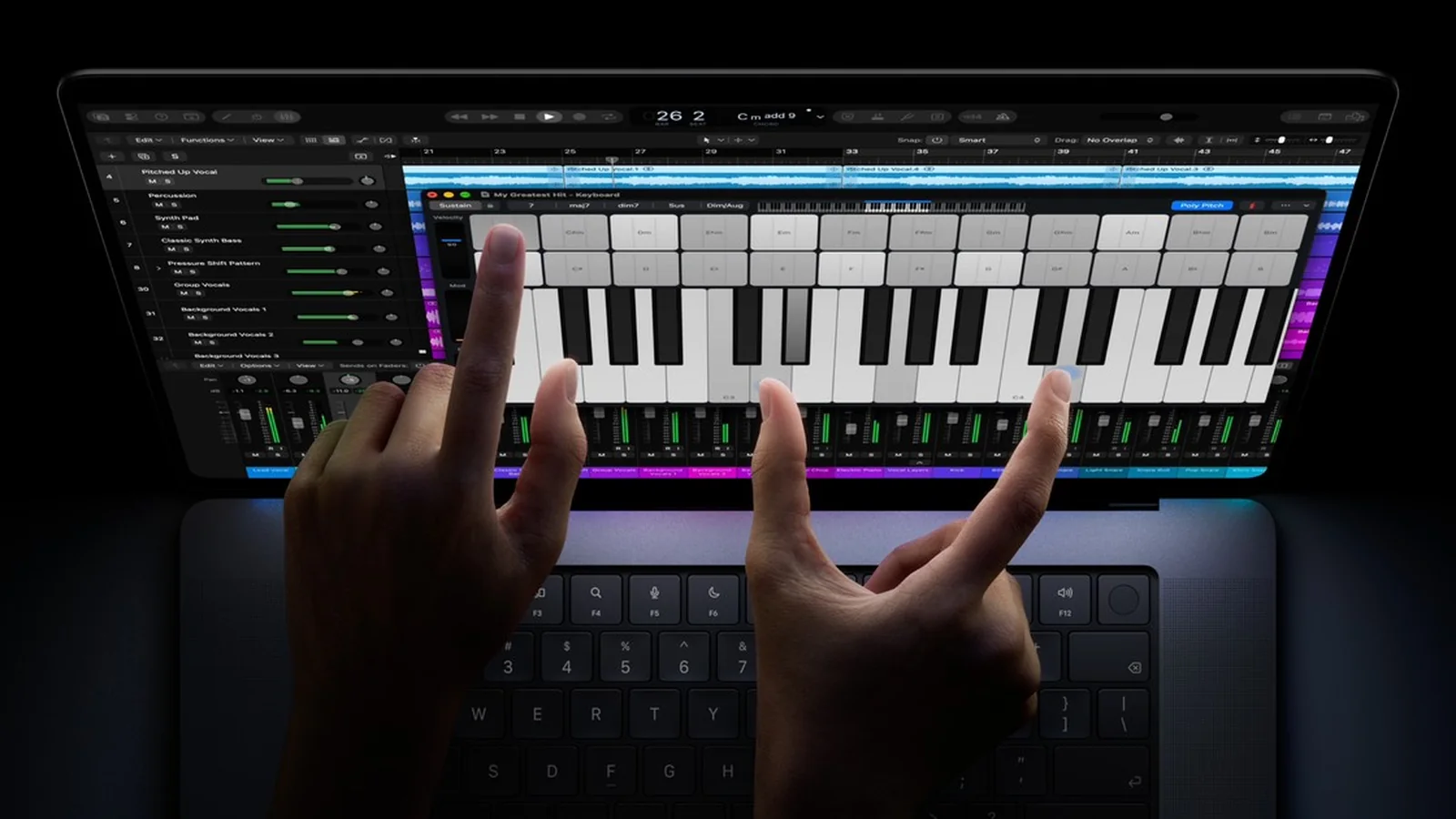
Users can swipe to scroll through webpages, pinch to zoom into images, drag and drop content, and manipulate windows through touch gestures. The feature also extends to professional applications, allowing designers to draw directly on the screen, musicians to interact with virtual instruments, and developers to test touch functionality in applications.
Apple has redesigned the display hinge to improve stability during touchscreen use. However, the conventional keyboard and trackpad remain central to the laptop’s operation, giving users a choice between traditional and touch-based controls.
The touchscreen functionality is integrated into macOS 27 Golden Gate. Existing applications can respond to touch because the operating system automatically translates touch interactions into mouse clicks, while updated gesture APIs allow developers to implement more specialized controls.
Apple’s PROLED XDR display represents another major hardware upgrade. The panel uses tandem OLED technology with two self-illuminating pixel layers, designed to improve brightness, contrast, and uniformity compared with conventional OLED implementations.
Apple lists peak brightness of up to 2,000 nits for both HDR and SDR content, alongside a claimed 10,000,000:1 contrast ratio. The display supports P3 and Adobe RGB color spaces, with more than 80% coverage of Rec. 2020 for HDR production workflows.
ProMotion provides a variable refresh rate between 10Hz and 120Hz, allowing the screen to adjust its refresh rate depending on the content being displayed. The 120Hz ceiling is particularly relevant for smooth animations and supported games, although actual gaming frame rates will depend on individual titles and hardware configurations.
Tandem OLED technology is also becoming increasingly prominent across premium PC displays, including ASUS's latest high-refresh-rate OLED gaming monitors. Apple’s implementation prioritizes brightness, color accuracy, and professional workflows rather than the exceptionally high refresh rates offered by dedicated gaming monitors.
The new MacBook Pro is powered by Apple’s M5 Pro and M5 Max processors. Both chips feature enhanced GPU shader cores, third-generation hardware-accelerated ray tracing, and Dynamic Caching technology intended to improve GPU utilization.
Apple specifically highlights improvements for graphics-intensive applications, including Blender, Unreal Engine, and modern AAA games. The architecture also targets professional workloads such as 3D rendering, visual effects, video production, and on-device AI processing.
These capabilities place the new MacBook Pro among high-end laptops designed for demanding creative and graphics workloads, although Apple has not provided independently verified gaming benchmarks in its announcement. Its gaming capabilities will also depend on macOS game availability and compatibility, not simply GPU performance.
Memory configurations extend to 128GB of unified memory, while maximum SSD storage reaches 16TB. These options are aimed primarily at professionals handling large projects, high-resolution media, complex 3D scenes, and local AI workloads.
The announcement also follows Apple’s broader M6 MacBook Pro and iMac hardware updates, with the new touchscreen models emphasizing display technology and input capabilities alongside their M5 Pro and M5 Max processors.
Connectivity includes three Thunderbolt 5 ports, HDMI, an SDXC card slot, MagSafe charging, and a headphone jack. The M5 Pro configuration supports up to three external displays, while M5 Max models support up to four.
Apple has also included Wi-Fi 7, Bluetooth 6, a 12MP Center Stage camera, studio-quality microphones, and an upgraded six-speaker system. Battery life is rated at up to 24 hours, with fast charging capable of reaching 50% in approximately 30 minutes under Apple’s specified conditions.
Despite adding touch functionality and upgraded displays, Apple has reduced the weight of both models. The 14-inch MacBook Pro weighs approximately 3 pounds, while the 16-inch version weighs around 4 pounds. The larger model features a 16.3-inch display, while the smaller version uses a 14.2-inch panel.
Dynamic Island also makes its debut on MacBook Pro, providing access to Spotlight, Live Activities, and Apple’s Siri AI features. Users can interact with notifications, ongoing activities, and system functions directly through the interface.
In the United States, the 14-inch MacBook Pro with M5 Pro starts at $2,899, while the 16-inch configuration starts at $3,399. The M5 Max versions begin at $4,499 for the 14-inch model and $4,799 for the 16-inch model.
Apple opened preorders on October 28 across 30 countries and regions, including the United States. The new touchscreen MacBook Pro models will begin reaching customers and retail stores on Friday, November 6, 2026.
The introduction of touchscreen support brings MacBook Pro closer to the input flexibility already available on many premium Windows laptops. Apple’s approach combines direct touch interaction with macOS, tandem OLED display technology, and its existing professional computing architecture, creating a new option for users who want touchscreen functionality without moving away from the Mac platform.
