


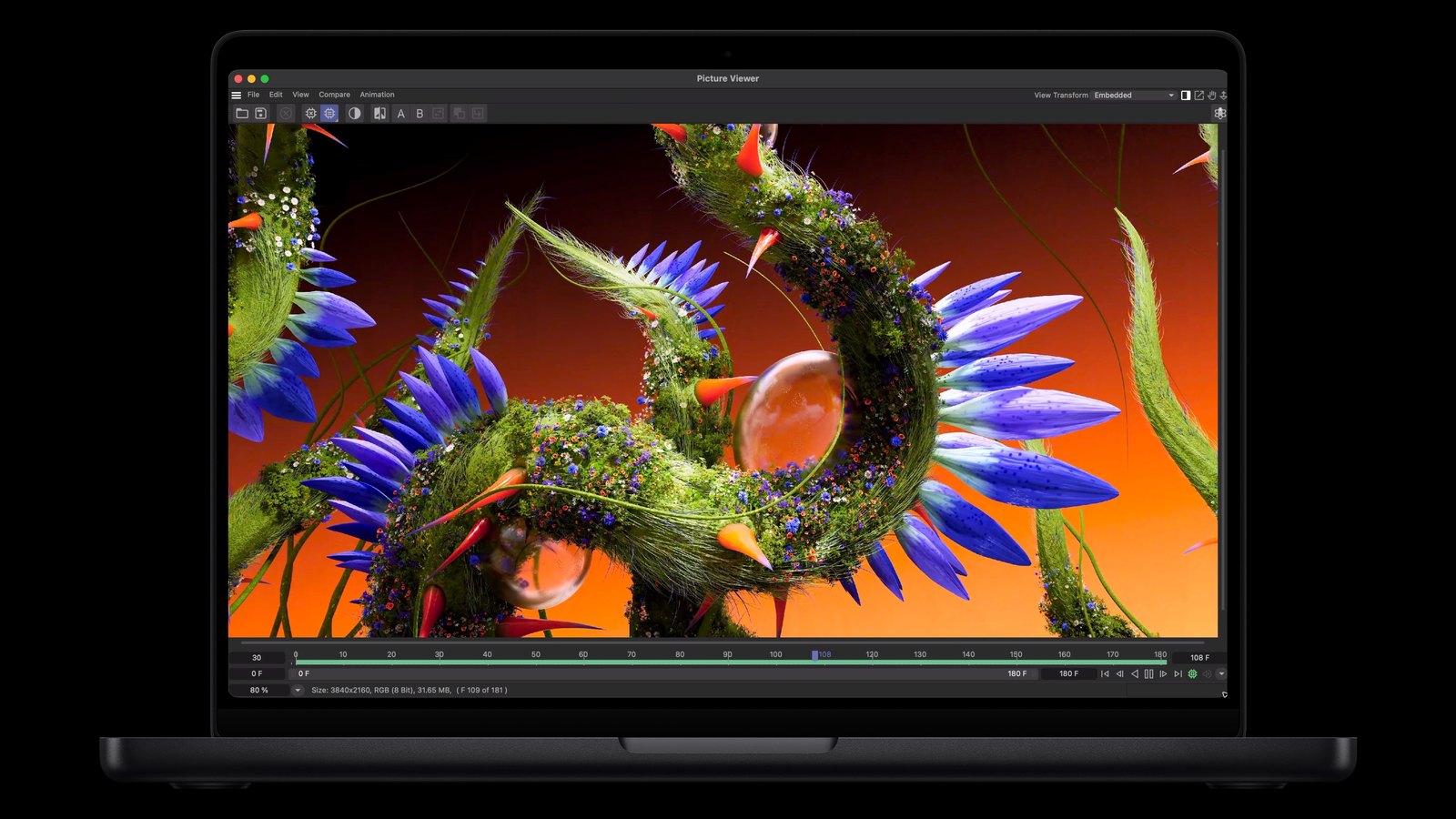
Apple has announced new M6-powered versions of its 14-inch MacBook Pro and 24-inch iMac, bringing its latest processor architecture to two more Mac models. Unveiled on October 27, 2026, the updated computers introduce faster integrated graphics, improved connectivity and expanded AI processing capabilities while retaining their existing designs.
The 14-inch MacBook Pro starts at $1,999, while the iMac begins at $1,499. Both models will be available for pre-order on October 28, with deliveries and retail availability beginning November 6.
The announcement expands Apple’s M6 lineup following the processor’s introduction in August, when it debuted in the Mac mini. The latest releases bring the chip’s updated CPU and GPU architecture to Apple’s professional laptop and all-in-one desktop.
The new 14-inch MacBook Pro features a 12-core CPU and 12-core GPU, compared with the M5 generation’s 10-core configurations. Apple claims the M6 delivers up to 30% faster graphics performance and up to 25% faster AI workloads than its predecessor.
Built using a 2nm manufacturing process, the M6 includes an updated graphics architecture with improved Dynamic Caching, higher geometry processing rates and hardware-accelerated ray tracing. These improvements are particularly relevant to Mac gaming, where integrated GPU performance can influence frame rates, rendering quality and the ability to run graphically demanding titles.
Apple has also increased unified memory bandwidth to 170GB/s, compared with 153GB/s on the M5. The additional bandwidth supports workloads that require rapid movement of data between the CPU, GPU and unified memory.
The new MacBook Pro starts with 16GB of unified memory and 1TB of SSD storage. Buyers can configure it with up to 32GB of memory and 4TB of storage.
Other specifications include a Liquid Retina XDR display, three Thunderbolt 4 ports, HDMI, an SDXC card slot and MagSafe 3 charging. The laptop also gains Wi-Fi 7 and Bluetooth 6 through Apple’s N1 wireless networking chip.
Apple advertises up to 24 hours of battery life, although that figure represents the company’s specified battery testing rather than a measurement of continuous gaming performance.
The M6-powered iMac offers two processor configurations. The $1,499 entry-level model features a 10-core CPU and 10-core GPU, while the $1,699 configuration increases both to 12 cores.
The desktop retains its 24-inch 4.5K Retina display and familiar all-in-one design. It remains available in seven colors: blue, green, pink, yellow, purple, orange and silver.
Compared with the previous M4-powered iMac, Apple claims the new model can deliver up to twice the graphics performance in certain workloads. The company also advertises up to twice the gaming performance with ray tracing, although that improvement should not be interpreted as a universal doubling of frame rates across all games.
The updated iMac includes Wi-Fi 7, Bluetooth 6, faster SSD storage and optional 2.5 Gigabit Ethernet connectivity. Depending on the configuration, buyers receive up to four Thunderbolt 4 ports.
Both iMac configurations start with 16GB of unified memory and 256GB of storage.
Beyond conventional computing and graphics improvements, the M6 incorporates Neural Accelerators within its GPU cores alongside a Dual 16-core Neural Engine. Apple claims the new iMac can deliver up to five times faster on-device AI performance than its M4 predecessor in selected workloads.
For gamers, the most significant development is the availability of the M6’s upgraded graphics hardware in Apple’s laptop and all-in-one desktop products. The architecture’s hardware ray tracing support and updated rendering capabilities provide a technical basis for improved performance in compatible Mac games.
However, Apple’s published performance figures are manufacturer claims, not independent gaming benchmarks. Actual results will depend on individual games, graphics settings, resolution, optimization and the GPU configuration selected.
The distinction is particularly important when comparing integrated Apple graphics against dedicated laptop GPUs. Systems such as RTX 5070-class gaming laptops use discrete graphics processors, making direct performance comparisons dependent on controlled testing rather than theoretical specifications alone.
The new MacBook Pro and iMac also arrive as hardware-accelerated ray tracing continues to influence modern PC graphics, with technologies demonstrated in projects such as Left 4 Dead RTX highlighting the visual techniques supported by contemporary graphics architectures.
Apple has not provided comprehensive game-by-game benchmarks comparing the new M6 MacBook Pro and iMac against Windows gaming systems. Independent testing after their November 6 release will be needed to establish their practical gaming performance, including sustained frame rates, ray tracing capabilities and performance at higher display resolutions.
