


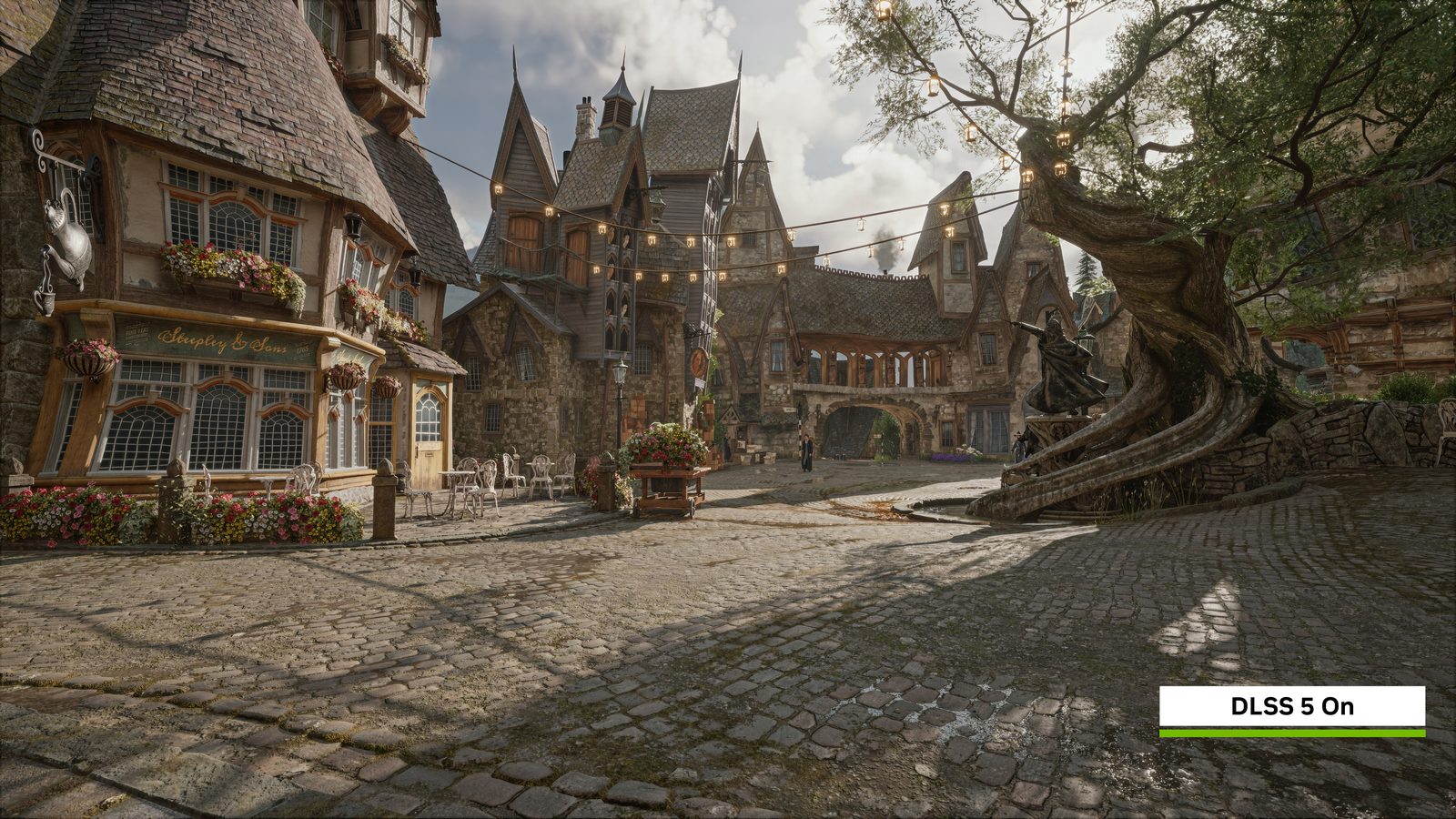
NVIDIA has confirmed that DLSS 5 with 3D-Guided Neural Rendering is coming to Hogwarts Legacy, War Thunder and Where Winds Meet throughout November 2026. Hogwarts Legacy will receive the technology on November 5, followed by War Thunder in mid-November and Where Winds Meet on November 23. The updates will introduce AI-enhanced lighting and material rendering, supported by NVIDIA’s latest neural model designed to reduce memory requirements and improve processing performance.
The rollout details were announced in NVIDIA’s November 3 GeForce update, which also showcased new visual comparisons and technical improvements. While Hogwarts Legacy’s November 5 launch and the faster neural model were previously announced in October, NVIDIA has now confirmed War Thunder’s integration and established a specific release date for Where Winds Meet.
DLSS 5 introduces a feature NVIDIA calls 3D-Guided Neural Rendering, extending its graphics technology beyond traditional resolution upscaling and frame generation. Rather than simply reconstructing pixels or generating additional frames, the system uses AI to enhance lighting, shadows, reflections and material properties within an existing game scene.
The technology operates near the end of the rendering pipeline, using the game’s original frame, geometry, textures, lighting information and motion data as its foundation. NVIDIA says this approach allows developers to introduce more detailed lighting and material effects without explicitly rendering every additional visual detail through conventional graphics techniques.
Developers retain control over how these enhancements appear. NVIDIA’s tools include multiple neural models, adjustable structure and tone intensity, and masking options that can apply different effects to environments, objects and characters. These controls are intended to improve visual quality while preserving the game’s established artistic direction.
Hogwarts Legacy will be the first of the three games to receive the November update. Developed by Avalanche Software, the open-world RPG will gain a dedicated Neural Rendering option that players can activate through its graphics settings.
According to NVIDIA, enabling the feature improves environmental shadows, surface textures, character materials, lighting and reflections. The company’s comparisons highlight more detailed stonework, foliage, rooftops and other elements throughout Hogsmeade.
Avalanche Software director of software engineering Jose Villeta confirmed that the studio worked closely with NVIDIA to integrate the technology while retaining the game’s visual identity. The development team adjusted environmental lighting, tone and character-related settings to balance the new rendering effects with the original artistic design.
NVIDIA recommends combining Neural Rendering with DLSS Super Resolution, Multi Frame Generation and Reflex. Players using ray-traced effects can also enable DLSS Ray Reconstruction.
In NVIDIA’s own performance demonstrations, Hogwarts Legacy reaches up to 300 FPS at 4K on a GeForce RTX 5090 with maximum graphics settings, ray tracing, DLSS 5 and 6X Multi Frame Generation enabled. This figure represents NVIDIA’s demonstrated configuration rather than independently verified performance, and the reported frame rate includes generated frames.
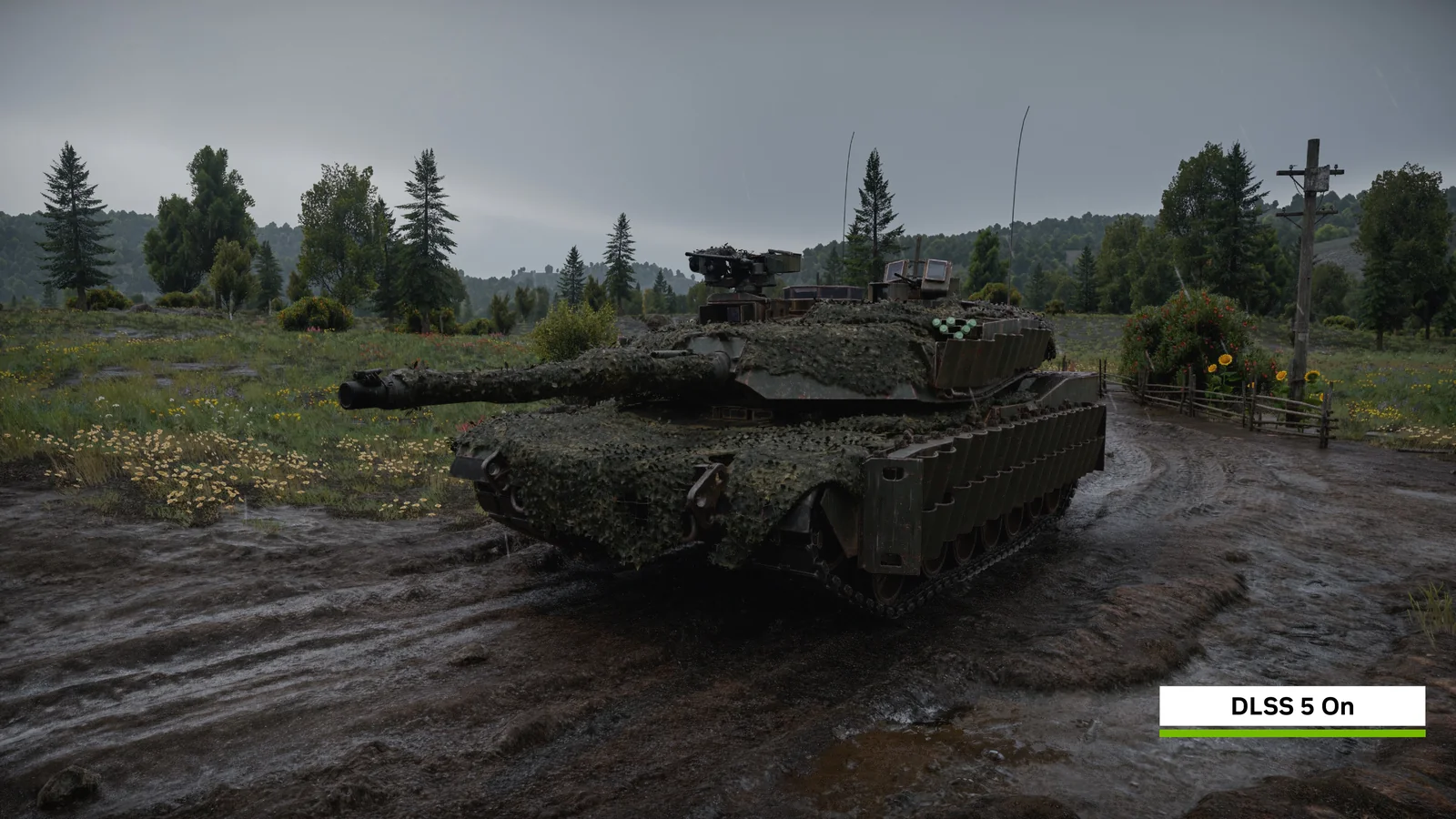
War Thunder will receive DLSS 5 through Gaijin Entertainment’s upcoming Eagle’s Shadow major update in mid-November. The update will also introduce additional aircraft, ships and tanks, alongside other gameplay and visual improvements.
For War Thunder, the neural rendering system focuses on improving the appearance of military vehicles and their surroundings. NVIDIA demonstrated stronger ambient occlusion beneath tank tracks, more detailed camouflage materials, enhanced reflections on wet surfaces and refined lighting across naval vessels.
These enhancements build on War Thunder’s existing support for DLSS technologies, ray tracing and path-traced global illumination. NVIDIA says the game will also support up to 6X Multi Frame Generation alongside Neural Rendering, allowing players to combine its visual improvements with frame-generation technology.
Where Winds Meet completes the announced November rollout on November 23. The open-world Wuxia action RPG, developed by Everstone Studio and published by NetEase Games, already supports DLSS Super Resolution and Multi Frame Generation.
Its upcoming update will add 3D-Guided Neural Rendering to enhance environmental lighting, character materials and other visual details throughout the game’s world. The rollout follows the game’s Hutuo expansion scheduled for November 13, giving PC players another graphical update later in the month.
NVIDIA also detailed improvements to the neural model powering all three integrations. The October 2026 revision reduces the model’s footprint by 24%, bringing it to approximately 118 million parameters. According to the company, the revised model requires 20% less VRAM at 4K and delivers twice the neural-processing performance of the previous version.
These figures describe improvements to NVIDIA’s neural rendering technology rather than guaranteed increases in overall game frame rates. Actual gaming performance will depend on hardware, resolution, graphics settings and the combination of DLSS features enabled.
NVIDIA says DLSS 5 has achieved a tenfold performance improvement since its initial demonstration in March 2026, when the technology required two GeForce RTX 5090 GPUs. Subsequent optimizations have made it possible to run the technology on a single supported graphics card.
DLSS 5 Neural Rendering is officially supported across GeForce RTX 50 Series desktop and laptop GPUs, RTX Spark systems and GeForce NOW Ultimate. NVIDIA has not announced equivalent native support for older GeForce RTX generations.
The technology is also expanding into game modification tools, with RTX Remix 1.6 adding DLSS 5 neural rendering for supported projects. Separately, an unofficial DLSS 5 modification for AMD Radeon GPUs has explored compatibility beyond NVIDIA’s officially supported hardware, although that does not establish native support for these three games.
To prepare for the November releases, NVIDIA has scheduled a new Game Ready Driver for November 4 through the NVIDIA app. Eligible players will also be able to access supported DLSS 5 experiences through GeForce NOW Ultimate.
The three updates represent NVIDIA’s latest expansion of neural rendering into released PC games. While the company has published visual comparisons and performance demonstrations, the practical differences in image quality, frame rates and memory consumption across supported GPUs will become clearer as the individual game updates arrive.
