


The ASUS XG Core external graphics dock uses significantly lower GPU clock speeds than conventional Radeon RX 9060 XT LP graphics cards, according to updated specifications reported on November 2, 2026. The compact device features a 1,010 MHz game clock and a maximum boost clock of 1,600 MHz in its default configuration, reflecting the limitations of its 75 W power budget.
The specifications are also reflected in retailer listings for the ASUS XG Core Radeon RX 9060 XT LP 16GB, which identify the same 1,010 MHz core frequency. ASUS’s updated specifications reportedly list a slightly faster OC mode, increasing the game clock to 1,030 MHz and the boost clock to 1,620 MHz.
These frequencies are substantially lower than those of AMD’s standard Radeon RX 9060 XT LP desktop GPU, which is designed to operate at up to 140 W. The desktop variant has been listed with a 1,380 MHz base clock and boost frequencies reaching approximately 3,040 MHz.
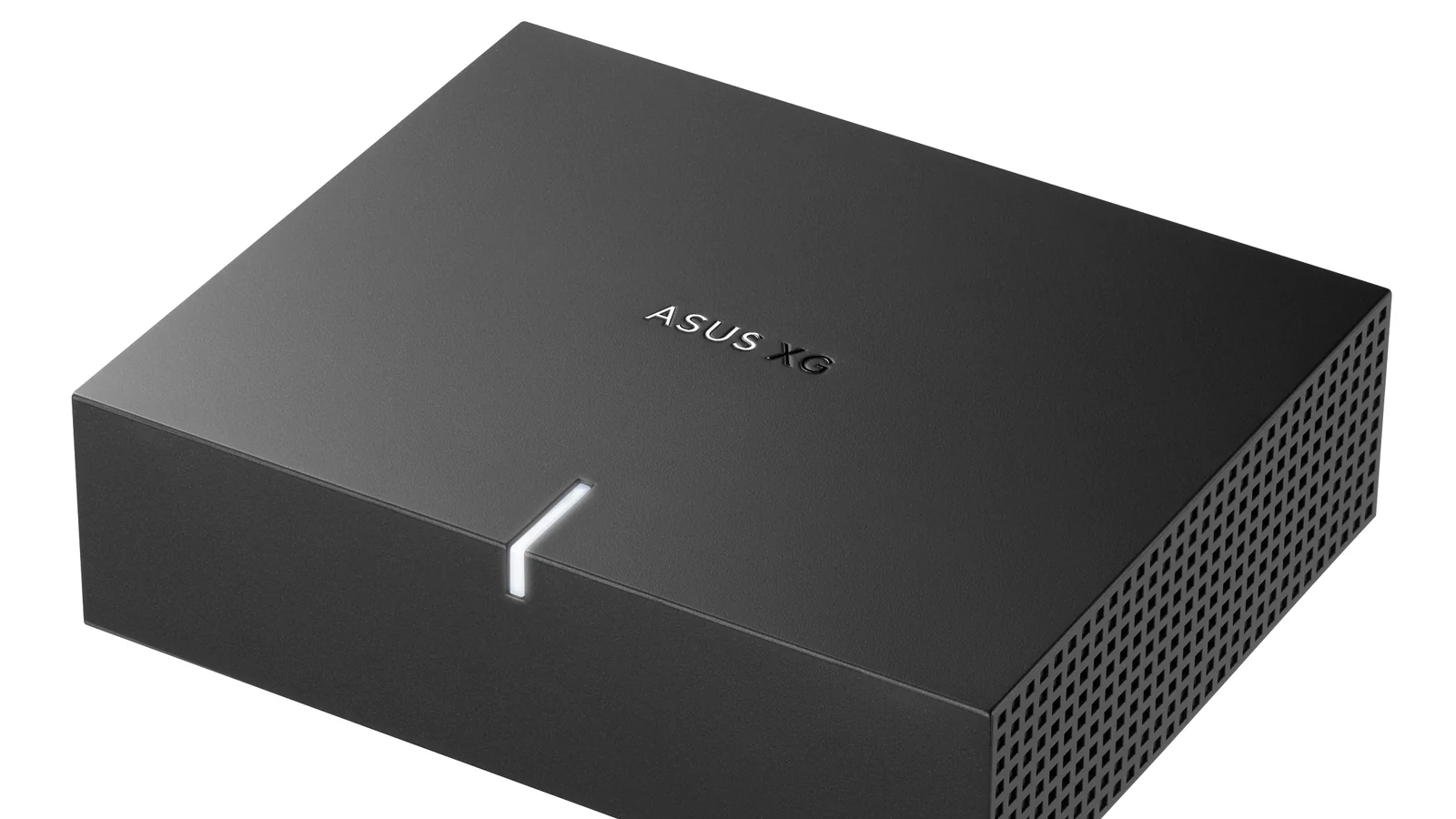
The difference is particularly notable at the maximum boost frequency, where the XG Core’s default 1,600 MHz specification is approximately 47% lower than the 3,040 MHz desktop figure. However, these clock specifications do not represent identical operating conditions, and the frequency difference cannot be used to calculate an exact gaming performance deficit.
Power consumption explains much of the distinction. ASUS designed the XG Core as a portable external graphics solution with a 75 W power envelope covering the complete unit, including its USB4 controller. The GPU therefore operates within a more restrictive power budget than the conventional desktop variant, which requires an additional eight-pin PCIe power connection.
Despite the reduced frequencies, the XG Core retains the Radeon RX 9060 XT LP’s RDNA 4 architecture, 2,048 stream processors and 16GB of GDDR6 graphics memory. AMD’s desktop RX 9060 XT LP specifications list 32 compute units and a 128-bit memory interface.
ASUS originally introduced the XG Core as a compact external GPU for notebooks, mini-PCs and gaming handhelds. The device uses a 40Gbps USB-C connection and includes HDMI and DisplayPort outputs for external displays. Its portable design allows compatible systems to access dedicated Radeon graphics without installing a conventional desktop graphics card.
The company has previously promoted the XG Core as capable of running AAA games at 1440p and more than 60 FPS, although that marketing claim does not establish performance across different games or graphics settings. The newly detailed clocks make independent gaming benchmarks particularly important for determining what the 75 W configuration can actually deliver.
The XG Core’s operating limits also highlight how significantly graphics performance can depend on available power. While experimental NVIDIA VBIOS tools for adjusting GPU power and voltage limits explore modifying the restrictions on existing graphics cards, ASUS’s external GPU is specifically designed around a much lower power envelope.
For buyers comparing portable graphics docks against desktop cards, the shared RX 9060 XT LP designation should not be interpreted as a guarantee of equivalent gaming performance. Actual results will depend on the dock’s sustained operating frequencies, thermal behavior, USB4 connection and the demands of individual games. Independent testing is needed to establish the size of the performance difference.
